

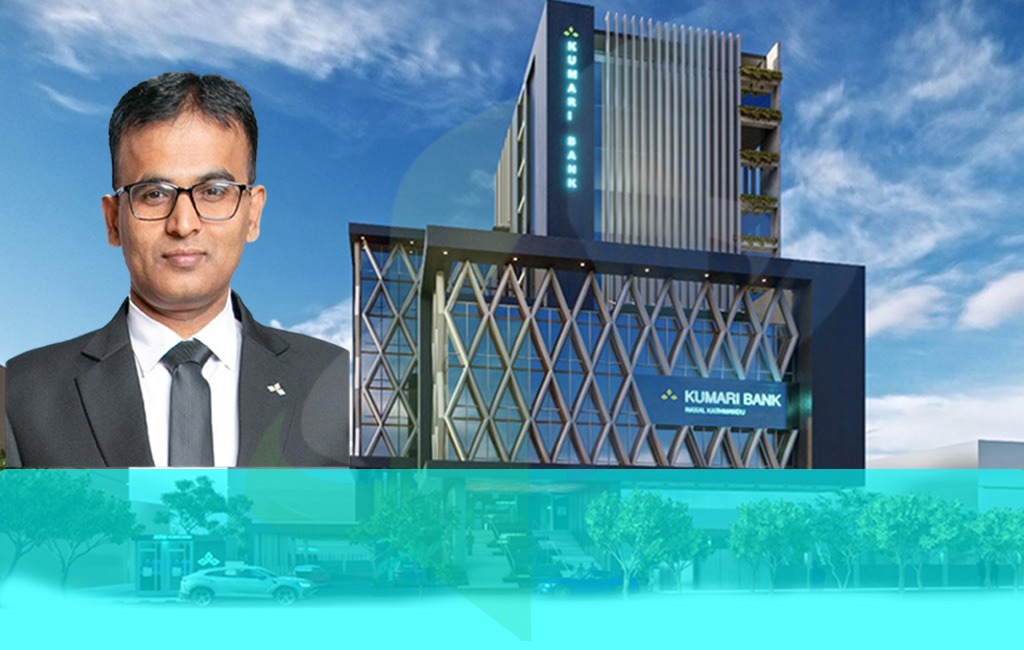
Kathmandu. Kumari Bank, which was struggling with the pressure of capital fund in loan expansion, management of non-performing loans and challenges after the merger until a few years ago, is now gradually returning to normal.
Improvement in loan recovery, easing of mortgage sale, decreasing interest rate and increasing capital fund have made the bank’s journey more comfortable. This is confirmed by the financial situation up to the end of June of the last fiscal year.
In the last fiscal year 2082/83, the bank earned a profit of Rs 7.38 billion. The profit of the bank increased by 305.96 percent compared to the previous fiscal year 2081/82.
The bank had posted a net profit of Rs 1,710,000 crore in the same period last year. The bank has been able to reverse the impairment charge of Rs 1.43 billion till the end of the last fiscal year. In the review period of the last FY, the bank earned a distributable profit of Rs 79.16 crore and a distributable income of Rs 3.02 crore.
Although deposits increased last year, it was not easy for the bank to extend loans due to capital adequacy. Although the CD ratio of the bank was around 75 percent, there was a problem in loan flow due to the pressure of the capital fund.
However, the bank’s capital adequacy ratio has improved significantly. According to the bank, the capital fund has increased from 8.5 percent to 13.55 percent.
According to Chief Executive Officer (CEO) Ram Chandra Khanal, the bank has the capacity to disburse additional loan of up to Rs 24 billion.
The bank has not only used the mortgage auction as a means to recover loans from borrowers. The bank has been adopting the policy of facilitating the borrowers to repay the loan, finding customers for the sale of the collateral, auctioning the collateral and encouraging the borrowers to repay the loan by selling the collateral themselves.
The bank has been facilitating blacklisted borrowers to repay loans by selling collateral.
According to the banks, the interest rate of loans has come down after a long time and the base rate of the banks is also low.
People who think it is better to invest in real estate than to keep money in the bank at a time when interest rates are low have started increasing their investment in real estate.
With the increase in investment in real estate, the bank’s remaining real estate cases in Kathmandu are not out of the question.
A large part of the bank’s mortgaged land is now left in the Terai region. Chief Executive Officer (CEO) Ram Chandra Khanal says that the bank has become easier to manage bad loans after the sale of land in the Terai in recent times.
“Although there is a problem in new plotting, there is no such problem in the land pledged by the bank,” he said, “This is the reason why the process of selling the collateral has become relatively easy.” ”
In the past, there was a tendency to delay loan repayment due to political influence or power, but now this situation is gradually declining, according to bank officials. The tradition of making powerful leaders and ministers call has diminished. Bank officials say that after the formation of the new government, the number of people coming to repay the remaining loans has increased. Bank officials say that those who used to do power shows earlier are now focusing on repaying loans on time.
According to bank officials, the number of calls from leaders and ministers to the bank officials has also decreased in recent times. According to the bank’s experience, the banks have started developing the awareness that they have to repay the loan on time as they will eventually face problems if they do not repay the loan.
Some borrowers have started coming in contact with the bank because they understand that they will eventually have to pay the loan they have not paid because the organization is running uninterruptedly. This has given the bank more success in loan recovery.
The bank now has a policy of increasing credit growth to a modest rate of around 7-8 percent instead of increasing it unnaturally. The bank has also made significant progress in loan loss management.
In the previous and last fiscal year, there was a provision of Rs 26-26 billion for loan loss management. According to the bank, some of the money has been returned after the loan recovery and management improved in recent years.
According to the bank, out of Rs 1.43 billion, about Rs 370 million related to the previous fiscal year has been written back. The withdrawal of the provision made for loan loss will also have a positive impact on the profit of the bank.

}
The bank is currently in the second position in the banking sector on the basis of profit. CEO Khanal said that the priority of the bank officials is to make the bank healthier by resolving the past problems and directly benefit the shareholders.
“To move from a negative profit of Rs 41 lakh and distributable profit to a position of ‘being able to pay dividend even if it is a little’ is an important achievement in itself,” CEO Khanal said, “This is not just a profit figure but an indication that the bank has moved ahead overcoming the past challenges.” ”
On the basis of indicators including paid-up capital, loan and deposit size, Kumari Bank is in the fifth or sixth position but is in the second position in terms of profit.
According to the bank, various managerial and operational challenges that have arisen after the merger have also been gradually reduced. The entire team of the bank is now in a position to work with confidence, gradually overcoming the challenges of consolidation process, capital fund pressure, bad loan management and business expansion. According to CEO Khanal, the bank has come to this position due to the hard work of the employees and continuous support of the Board of Directors.
Now the bank’s focus is on preventing the recurrence of past problems, expanding loans in a balanced manner, making loan recovery more effective and providing sustainable returns to shareholders.
For Kumari Bank, recent reforms are not limited to reducing bad loans or increasing profits. The bank has adopted a strategy to maintain a balance between business expansion and risk management.















प्रतिक्रिया दिनुहोस्