

First of all, in this dignified Parliament, I would like to pay my heartfelt tribute to all those who lost their lives in the unimaginable and devastating flood in the Bhotekoshi-Trishuli River on August 10. I also pray for the speedy recovery of the injured and pray for the strength of the bereaved family members to bear the pain.
The pain in the eyes waiting for the return of the contactless relatives cannot be expressed in words. It has been almost a month since the floods snatched away our happiness. Where will the pain subside with the passage of time? These days are spent in waiting, tears and uncertainty for many families. Many eyes are still waiting in the hope of hearing the news, a glimpse or a voice from the relatives. This calamity has snatched away the parents of many. Many laps have been empty, the seams have been wiped away, the support of life has been lost. Some have lost their homes, some have lost their jobs, some have lost the support of life.
It is a deep and irreparable wound inflicted by nature. In the midst of such pain, we are standing at a difficult crossroads. Should we grieve or should we rise again by turning this grief into courage and strength? We must get up, wiping our tears, shaking the mud and dust. We must rise up to make the future of the citizens safe and beautiful. No mother should have to cry in such a calamity again, our children’s schools should not be destroyed. We have to support and reassure the citizens with the hope that the business should not be swept away and become helpless.
We have not given up. We have mobilized all our strength for search and rescue till the last door of the possibility. Our first responsibility now is to continue the search and rescue till the last possibility, to treat the injured, to rehabilitate the displaced families and to rebuild the damaged infrastructure, including electricity, roads, bridges, and at the earliest. It is the highest responsibility of the state to restore the lives of the affected citizens to normalcy. In this hour of pain, the government is with the citizens. The state’s condolences are also attached to the pain and tears of the people. Of course, we are in grief and pain. But we are not in despair. Tears are in tears, but hope is not dead. The wound is deep. However, we are trying to apply ointment.
The flood has snatched away a lot from us. However, it has not been able to take away our humanity, courage, and support for each other. We have given the message that we Nepalis are united in any crisis. Even small children have sent help by cutting their lunch. All Nepalis and well-wishers who love Nepal are not only supporting their skills, skills but also body, mind and wealth, we thank them all.
I salute from the bottom of my heart to all the rescue workers, including security personnel, health workers, employees, people’s representatives, volunteers, experts from home and abroad, who are engaged in searching, rescue and service day and night amidst geographical complexities and adverse weather in such a disaster that is rare in the world. Their dedication, courage and human sensitivity cannot be expressed in words. Their actions in times of disaster are an unparalleled introduction to humanity.
The concerns and condolences expressed by the honorable gentlemen regarding the loss of life and property due to the disaster, search and rescue, treatment of the injured, relief and rehabilitation of the victims and reconstruction of damaged structures are very relevant.
The dialogue and initiative between the Honorable Prime Minister Balendra Shah and the Honorable President of the Rastriya Swatantra Party, Mr. Rabi Lamichhane, along with the solidarity among the political forces of the country in the difficult situation is commendable. There can be no greater responsibility than the lives of the people. The Parliament is well aware that the Honorable Prime Minister has already informed the august Parliament in detail about the disaster. However, I would like permission to inform the respected Parliament about the major issues under the Ministry of Energy, Water Resources and Irrigation through the Honorable Speaker.
The most painful aspect of the disaster is the human loss. According to the information received, more than 800 people working in various hydropower projects and structures are still uncontacted. Of them, 47 are employees of the Nepal Electricity Authority.
Before the floods, out of 1,433 people working in the Upper Trishuli-1 Hydropower Project, 955 were rescued safely and some came in contact with themselves. However, 439 people were reported to be out of contact with the project. On the 12th day of the floods, one Chinese national was rescued safely from the project. So far, 39 bodies have been recovered from the project.
Similarly, 39 people are out of contact from Upper Trishuli-3 ‘A’. As a result of continuous search and rescue work, it was possible to rescue two employees Sanjay Sah and Kabir Maharjan from Upper Trishuli-3 ‘A’ on the 10th day of the floods. One body has been recovered from the project.
According to the report, 178 people from Upper Trishuli-3 B, 93 from Rasuwagadhi Hydropower Project, 7 from Mailang Khola Hydropower Project and three from Rasuwa-Bhotekoshi Hydropower Project have gone missing.
Similarly, 39 people are missing from the Langtang Khola Hydropower Project. 19 people have been rescued safely from the project and two bodies have been recovered. The bodies of five employees have been recovered during the search and rescue operation at the power house of Chilime Hydropower Center, while one person is still missing there.
I request the honorable parliament that 2 employees of Middle Trishuli Ganga Hydropower Project, 3 employees of Trishuli Hydropower Project, Devighat Hydropower Center, Trishuli 3B Hub, Rasuwa Distribution Center, Chilime-Trishuli Transmission Line are also out of contact. The government has given high priority to the search and rescue of people trapped in the underground structures of the hydropower project due to the disaster.
I request that the Ministry of Energy, Water Resources and Irrigation is continuously coordinating and collaborating with the people’s representatives, the Ministry of Home Affairs, the National Disaster Risk Reduction and Management Authority, the Nepal Army, Nepal Police, the Armed Police Force, local administration, private sector, national and international tunnel experts, geologists, technicians, rescue workers and the victims’ families to make the search and rescue work intensified and effective.
To make the rescue work effective, the Electricity Authority has also arranged for the necessary vehicles as well as dedicated helicopters. It has been coordinating and facilitating with the concerned agencies in the mobilization of explosives, fuel, equipment and skilled manpower. I request that the resources of the Authority should be used not only for the NEA but also for all the affected people.
Arrangements have also been made to regularly inform the public media and the victim’s family about the information received during the rescue operation, the status and progress of the incident site. I also request that high priority has been given to provide accurate information and necessary assistance to them by contacting and coordinating directly with the families of the victims.
Separate teams have been mobilized at Shanti Bazaar of Rasuwa, Battar of Nuwakot and Headquarters of the Authority in Kathmandu for the management of materials and equipment required for search and rescue. It has been coordinating with the local administration, security agencies, promoters and those involved in the rescue operation. In addition, the Damage Assessment Committee of the Ministry of Energy, Water Resources and Irrigation has been coordinating with the affected promoter companies.
The Nepal Electricity Authority, its subsidiaries and 11 power generating stations operated by the private sector in the Bhotekoshi-Trishuli river system have been shut down due to the floods. About 275 MW of electricity has been damaged to seven hydropower projects and one solar project that were in operation before the floods, while three hydropower projects with a capacity of 135 MW have not been damaged but have stopped production due to damage to the transmission line. A total of 410 MW of electricity is out of the national electricity system due to the disaster.
Similarly, six under-construction hydropower projects with a capacity of 508 MW have also been damaged. The floods have completely damaged the 220 KV Trishuli-3B Hub Substation at Trishuli. The 220 KV Hub at Matatirtha-Chilime has also been disrupted. Similarly, the Matatirtha transmission line of the 132 KV Trishuli 3B Hub and the 66 KV Chilime-Matatirtha transmission line have also been damaged. The Chilime Switch Yard, the Upper Trishuli 3A Switch Yard, the Devighat Switch Yard, as well as the distribution line and poles have also been badly damaged.
The impact of the disaster is not limited to large hydropower projects and structures. Renewable energy technologies in domestic and community use have also been badly damaged. According to the preliminary assessment, the overall energy sector is estimated to require Rs 390.62 billion for revival.
The floods have also damaged irrigation projects, river control structures and water centers. It is estimated that Rs 4.94 billion will be required for the rehabilitation of these structures. The figures mentioned do not include the structures constructed by the state and local governments.
Due to the flooding of the Bhotekoshi-Trishuli river system, the lower coastal areas were also severely affected. I also request that a technical team including experts was immediately mobilized from the Department of Water Resources and Irrigation to reduce the damage due to the increased risk from Bharatpur, Majhuwabasti to Susta.
Although the floods had caused a serious blow to the national transmission system, the employees of the Nepal Electricity Authority (NEA) demonstrated high professional efficiency and succeeded in supplying electricity to the flood-affected Nuwakot within a few hours, even if it was partial. For this, alternative arrangements were made from Kathmandu, Sindhupalchowk and other places.
Power supply was completely disrupted in Rasuwa district due to the floods, while power supply was partially affected in various areas of Nuwakot, Dhading and Gorkha. I request that the power supply has been restored in all the affected areas after repairing and rehabilitating the damaged structures.
I request the government to distribute 20 Watts solar system and 2 KW institutional solar power system to health institutions, schools, holding centers, security personnel, rescue workers and the common people’s households through the Alternative Energy Promotion Centre under the Ministry in areas where it is difficult to provide immediate electricity service.
To facilitate the operation of essential services, the Ministry has provided 605 sets of small domestic solar power systems, 1,000 sets of portable solar lights and 14 sets of institutional solar systems through the Alternative Energy Promotion Center. A day after the incident, 500 sets of domestic solar systems were provided. Also, 1,000 sets of portable solar lights received from the private sector have also been sent to the affected areas based on the demand of the local level.
Similarly, demand collection is underway for the distribution of 2,000 sets of improved portable iron stoves in the affected areas. I request that the necessary process has also been initiated to set up one electric vehicle charging station each in Gosainkunda, Uttargaya and Aamachhodingmo rural municipalities as per the goal of resuming roads and other physical infrastructures before Dashain.
Money is not worth more than the life of a person. The pain caused by the devastating floods cannot be alleviated by money. However, in this hour of grief, the government should stand with them to meet the immediate needs of the affected families. I would like to inform you that it has been decided to provide immediate relief of Rs 5 lakh and 50 percent of the salary for 6 months to the dependent families of the employees of the Electricity Authority, who are lost and out of contact in Trishuli while serving the nation. This is not compensation for the pain, but just a small effort of the state’s support and responsibility in the hour of grief. In the coming days, more help will be provided as per the bylaws of the NEA and the relief package announced by the government.
Similarly, in order to provide some relief to the affected households and businessmen from the financial burden associated with electricity service, it has been decided to stop the minimum billing of the flood-affected customers from August, to deduct the data of the damaged meters and to provide new meters free of cost to those who want to get electricity service again. Also, I request that a study is being conducted on the possibility of additional concession in electricity tariff to the customers of the affected 15 municipalities.
{{TAG_OPEN_em_70} The role played by the security personnel in search, rescue and rehabilitation despite difficult geographical conditions, adverse weather conditions and limited resources is highly commendable. Highly respecting their dedication and contribution, I request that the necessary process has been initiated to ensure 2 percent participation in the initial share (IPO) of the hydropower project for the incumbent security personnel.
Employees from the Ministry, Electricity Development, Electricity Authority, Department of Irrigation, Alternative Energy Promotion Center, Department of Hydrology and Meteorology were committed to regularizing electricity supply, coordinating with various bodies in search and rescue operations, facilitating and providing technical support, regular contact with the affected families, mobilizing experts.
I would like to thank all of them from the respected parliament. The disaster has not only caused us huge human and material losses, but has also taught us serious lessons for the future. We have to assess the damage and learn from it and create a system to reduce the risk of the future. I also inform that the Ministry of Energy, Water Resources and Irrigation has directed the concerned authorities to formulate a plan keeping safety on top priority so that the infrastructure and other structures to be built in the future can reduce the risk of such disasters.
Meteorologists have predicted that there is a possibility of heavy to very heavy rainfall in Nepal due to the strong low-pressure effect that is developing in the Bay of Bengal this week. There is a possibility that central and western Nepal may be more affected by this. Along with these areas, additional vigilance is needed in Rasuwa, Nuwakot, Dhading, and other areas affected by the recent floods.
I request that the Ministry of Energy, Water Resources and Irrigation has mobilized the subordinate agencies to keep the public and concerned informed by regularizing the information of the Department of Hydrology and Meteorology as the amount of rainfall and forecast about the affected areas may change further. I urge everyone to take necessary precaution as the forecast should be taken as an indication of the potential risk.
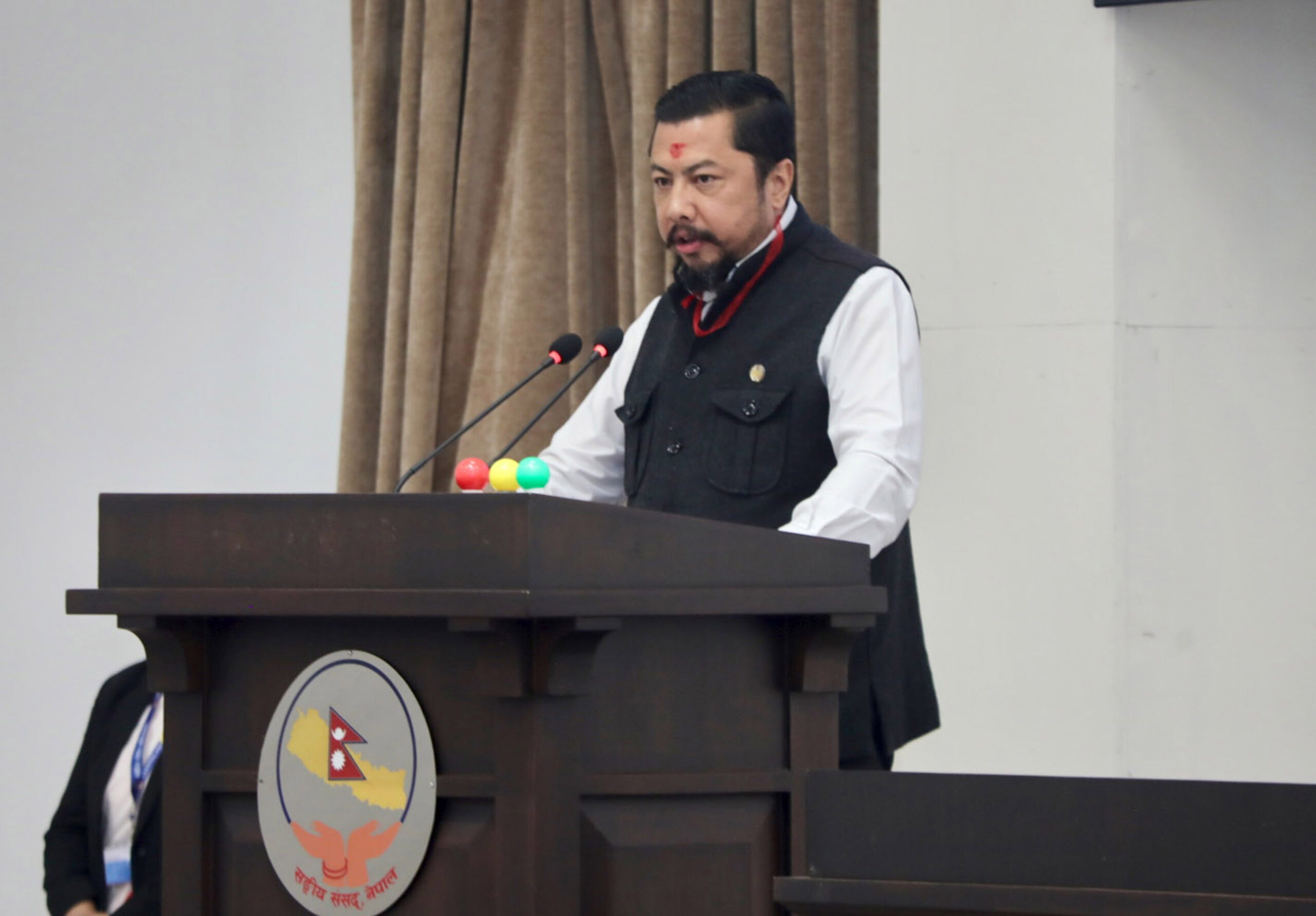
Minister for Energy, Water Resources and Irrigation Biraj Bhakta Shrestha delivered a speech of public importance in the House of Representatives on Wednesday.












प्रतिक्रिया दिनुहोस्