



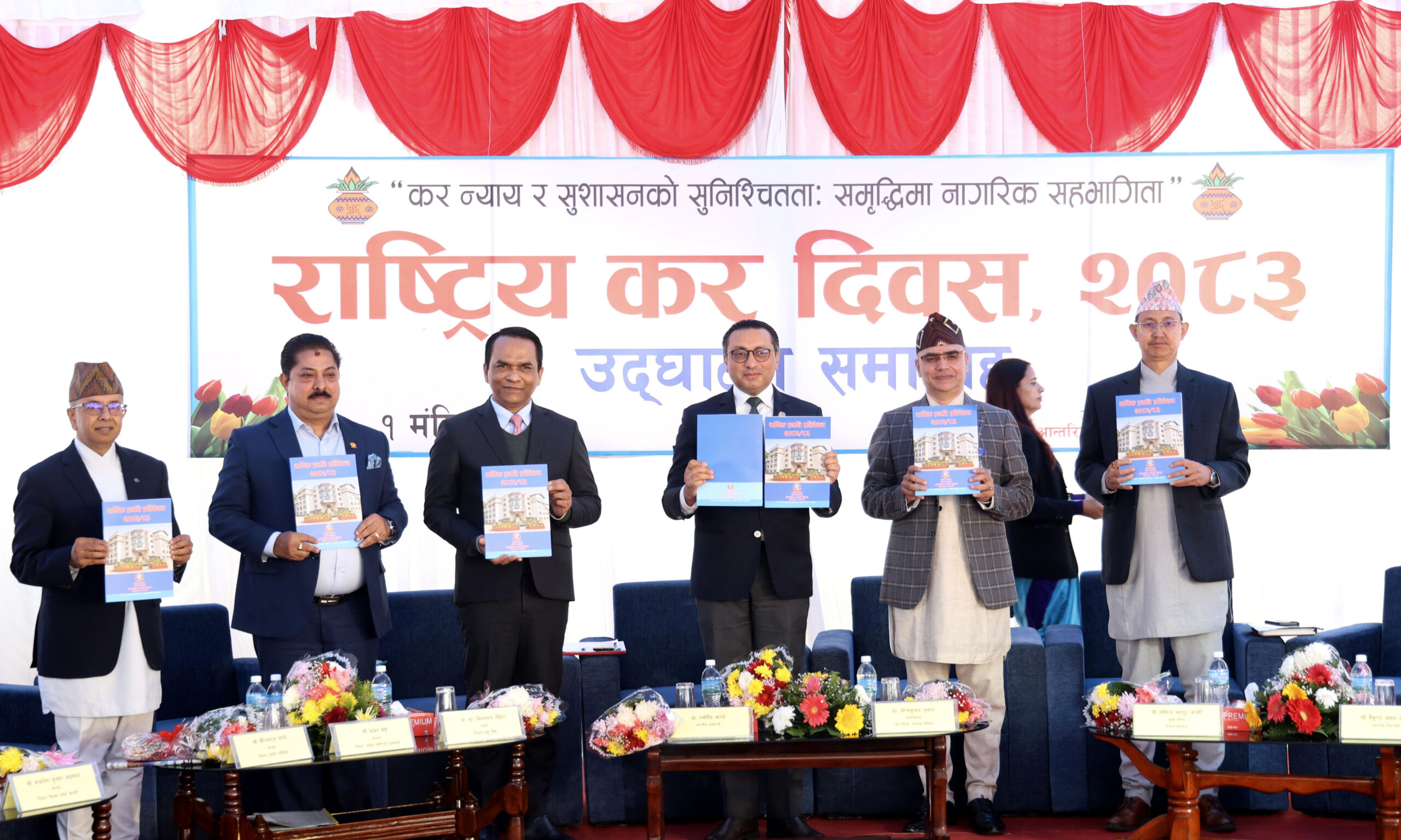
Kathmandu. The Internal Revenue Department has released a 15-point resolution aimed at making tax administration technology-friendly, transparent, and service-oriented. On the occasion of National Tax Day 2083, the department has proposed various reform plans aimed at transforming the tax system, innovating in technology, improving good governance in services, and sustainably increasing revenue collection.
The department has announced the establishment of a call center and chatbot based on artificial intelligence 9AI, which operates 24 hours a day to promptly address taxpayers’ queries and complaints. This is expected to eliminate taxpayers from having to wait for office hours to obtain tax-related information and submit issues.
The department has announced that under the plan to fully digitize tax administration, the process of automating the existing tax system will begin from Magh 2083. For this, work will be advanced according to the detailed project report 9 of the Dyagkashlabbhakak Chv.
Similarly, by developing a ‘One Taxpayer, One Digital Identity’ system, each taxpayer’s information, transactions, and tax compliance details will be managed securely and in an integrated manner. The department expects this to simplify taxpayer data management and make tax administration more effective.
The department has also announced plans to develop a system that automatically generates invoices when making digital payments and QR payments. The system, to be developed in coordination with Nepal Rastra Bank, is believed to help hide transactions, avoid issuing invoices, and help control tendencies of tax evasion.
Similarly, a digital sticker system will be implemented to convert financial reports into machine-readable formats, and a digital sticker system will be implemented to track the production, storage, and distribution status of excise goods.
The department stated that risk-based tax testing, investigation, and monitoring will be prioritized to control revenue leakage and enhance tax compliance. Risk analysis of statements submitted through the self-declaration system will be conducted to place special surveillance on areas where revenue leakage may occur.
The department has also set a target of collecting 775 billion rupees in revenue for the current financial year. Additionally, it has committed to auditing at least 60 percent of the revenue burial.
To raise taxpayer awareness about the tax system, a nationwide taxpayer education program will be conducted in collaboration with local levels and the private sector, launching the ‘Voluntary Tax Participation National Campaign.’
The department has also prioritized prompt resolution of tax disputes, uniformity in the format of tax payment certificates, data exchange among various government agencies, and capacity building of staff working in tax administration.
Similarly, the department is committed to conducting risk-based supervision and research to reduce risks related to money laundering and making Nepal’s tax system modern, transparent, predictable, and investment-friendly in line with international standards.













प्रतिक्रिया दिनुहोस्