



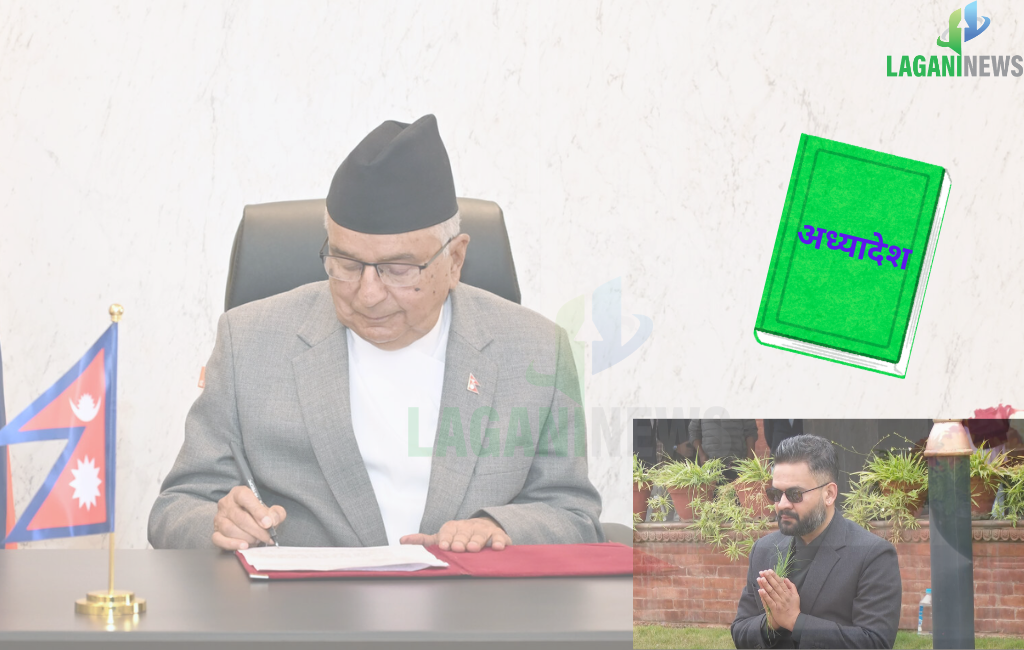
Kathmandu. The government is planning to amend 19 sections of the Insurance Act 2079. The government is planning to amend 19 sections of the Insurance Act 2079 through the Ordinance 2083, which amends certain Nepal Acts related to investment and infrastructure.
According to the draft ordinance, Section 2 of the Act has been amended to replace the words in clause (c) with “if a member of a single-family member separately owns one percent or more shares,” and the words “if the ownership of shares held separately by members of a single-family family is calculated jointly amounting to one percent or more of the insurer’s paid-up capital.”
Similarly, the provisions in Section C of Section 2 have been changed. Where ‘financial interest’ means the actuary of a person, firm, company, or organized entity or other person, firm, company, or organized entity dealing with the actuary, or other persons, firms, companies, or organized entities having direct or indirect economic or financial interests.
The insurer’s director, fundamental shareholder, executive head, or member of their single-family family,
The person, firm, company, or organized entity authorized to appoint or nominate a director of the actuary is a director, executive head, or member of their household in accordance with subsection (2).
If a person, firm, company, or organized entity holds direct or indirect share ownership of ten percent or more of the paid-up capital of another firm, company, or organized entity, the interest of the individuals in such firm, company, or organized entity, even if the percentage of share ownership is less than 10 percent, the person or entity will retain the financial interest of that person or entity.
Other arrangements regarding the identification of actual ownership, direct or indirect share ownership, joint ownership, control, and financial interests shall be in accordance with the criteria determined by the authority. Double counting of the same share or interest shall not be allowed. The authority must disclose the basis of such identification and give the concerned party the opportunity to present evidence to correct the record and seek remedies in accordance with prevailing laws on adverse decisions.
Similarly, Article 6 was amended to add clause (c) after clause (c) and then (c1), providing that the Deputy Secretary of the Ministry of Nepal, responsible for infrastructure development matters, would be a member.
Similarly, Article 7 has been amended to replace the words “expert member related to the insurance sector” in subparagraph (1) with “an independent expert with experience in insurance regulation, financial sector regulation, or institutional governance, and one member with expertise in management.”
Similarly, Article 8 has been amended by replacing the words “economics, engineering, or law” in subparagraph (1) of clause (a) of Article 8.
Amending Article 25, the restrictive phrase of paragraph 3 of Article 25 has been removed.
Subparagraph 5 of Article 25 is followed by paragraph 6. It states that the provisions of subsection (3) do not apply to shares held by the Government of Nepal, provincial government, organized institutions (excluding actuaries) holding more than 50 percent shares of the Government of Nepal (excluding actuaries), or foreign investors approved by the authority.
However, if such an organized institution or foreign investor wishes to maintain share ownership in more than one insurer carrying out the same type of insurance business beyond the limits specified in subparagraph 5, prior approval from the authority must be obtained.
When granting such approval, the authority must assess the investor’s actual ownership, financial capacity, transactions between the parties concerned, the sense of interest, the insurer’s institutional governance, market competition, and the potential impact on the insured’s interests.
The exemption granted under this subparagraph shall not be considered exempt from the foreign investment approval required by applicable law, competition regulation, or other mandatory approvals.
Similarly, Article 27 has been amended by replacing clause (c) of subparagraph 1 of section 27 with clause ‘c’ and its restrictive phrase.
If the direct or indirect share ownership of any one of the founding shareholders of the proposed insurance company, a family of a single household, or related person or institution is calculated jointly, exceeds fifteen percent of the paid-up capital of that company, but that arrangement does not apply to persons or institutions exempted from the share ownership limit as per subsection 6 of Section 25.
Similarly, Article 34 has been amended to replace the words “license revokable” in the title of Article 34 with “license may be revoked in whole or in part.”
Subsections 4, 5, 6, 7, and 8 have been added to section 34 of the draft. Regardless of what is otherwise stated in this section, 4 states that if a license is required to be revoked only for a certain type of insurance business operated by an insurer, the authority may only revoke the license to operate the relevant type of insurance business without revoking the entire license of that insurer.
Before revoking the license under subsection 4 of Section 5, the concerned insurer must be given a reasonable opportunity to submit a clarification.
6. The revocation of any license to operate any insurance business under subsection 4 shall not be deemed to have terminated previously issued insurance accounts, the insured’s rights, claim payments, and other obligations under that insurance business.
7. When a license is revoked under subsection 4, the authority may issue necessary instructions for the management, transfer, settlement of claims, and protection of the insured’s interests of the relevant insured and liabilities.
Section 8 states that the process for partial cancellation of licenses under this section and other provisions related to liability management of the related insurance business will be as prescribed.
Similarly, by amending Article 35, the words “at least two national-level daily newspapers” in subsection (1) of Article 35 have been replaced by “at least one national-level daily newspaper and.”
Subparagraph 3 has been added after paragraph 2 of the same section. The authority must maintain a public record of the old lists published under this section. If incorrect information is confirmed in the list, corrections and the date must be recorded, and arrangements must be made for persons without internet access to obtain information about the list from the authority’s office.
The website must provide free access to the list and identify the date of publication and update.
Amending Section 45, the words “face value of shares” in subsection 5 have been replaced with “face value of shares or issued per share price approved by the Securities Board of Nepal in accordance with prevailing securities laws.”
Subparagraphs 6 and 7 have been added after subsection 5 of the same section. When issuing shares at a premium price under Section 6, the method of valuation and the main basis of the risk assessor and the interest of the parties involved in the issuance must be disclosed in the statement. If capital approval is required under insurance law, the authority must decide on the matter and inform the securities board. The approval of the issue price and prospectus shall be made by the securities board in accordance with applicable law. The authority shall not request re-approval of the same value.
Approval by the authority or securities board shall not be considered a guarantee of the price or return of the shares.
If false or misleading information is given or necessary facts are concealed in the prospectus, the insurer, valuer, or other responsible person shall be liable under applicable law and the investor’s right to remedy shall be maintained.
Similarly, Article 46 was amended to replace the words “Executive Head of the actuary in paragraph 4” with “Director of the actuary, Executive Head.”
By amending Article 49, the words “person of the country” in paragraph 1 have been replaced by the words “person who has fulfilled one of the qualifications” in subsection 1.
Subparagraph 3 is added after paragraph 2 of the same section. The optional qualification under paragraph 1 shall not exempt independent operators from the special qualifications under paragraph 2, disqualification under section 50, or the honesty and fitness conditions applicable to all operators under this Act. The authority must disclose the objective basis of the suitability test and, in making adverse decisions, must give the person concerned an opportunity to express their views and inform them of the decision with reasons.
Similarly, amending Article 50
A new provision has been made instead of clause (e) of Article 50.
A new restrictive phrase has replaced the restrictive clause in Section 50, Section T, of a bank, financial institution, or other organized institution permitted to collect deposits under applicable law. Provided that this section does not preclude the appointment or nomination of a director representing such share ownership in a different type of insurer whose share ownership is maintained by the Government of Nepal, provincial government, or any insurer with more than 50 percent share ownership under applicable law. In making such representation, the director must meet the qualifications, sense of interest, and institutional governance standards as determined by the authority.
Similarly, by amending Article 57, the words “in the chairperson or director” in the restrictive clause of clause six of subsection 57 of Article 57 have been replaced by the words “in the head of the executive”
Amending Article 69 by replacing the restrictive phrase in Section 1, Section C of Article 69 with a new restrictive phrase
. In which the actuary may lend or lend to its employees in accordance with regulations concerning the services, conditions, and facilities approved under applicable law, and the actuary may participate in co-financing loans led by banks and financial institutions, subject to investment criteria, limit capital adequacy, liquidity, and risk management conditions set by the authority
However, the relevant party may not be allowed to lend money, invest in a way that adversely affects the insured’s ability to pay claims, or lend in areas prohibited by the authority. The insurer’s participation in co-financing loans will be voluntary. The authority’s public standards must include the eligibility of the leading institution, matching the duration of assets and liabilities, and the concentration of the sole debtor and the affiliated group. It is stated that the insurer must independently assess credit risk independently, relying solely on the valuation of the institution being led.
Similarly, the words “in shares or securities” in clause six of subsection 1 of section 69 have been replaced with “in securities.”
Amending Section 95, a restrictive clause has been added to subparagraph 1 of Section 95. “However, if a license automatically revoked due to non-renewal is applied for reinstatement and renewal within 5 years from the date of revocation, the authority may reinstate and renew such license by charging a restoration fee equal to the license fee and the applicable renewal fee, ensuring that the relevant intermediary meets the qualifications, necessary training, examinations, and other conditions in accordance with applicable laws.”
However, this restrictive phrase cannot be reinstated in cases where the license is revoked due to serious regulatory violations, fraud, acts contrary to the interests of the insured, or other legal incompetence.
Similarly, Section 101 has been amended by removing clause ñ of subsection 1. Article 128 has been amended by adding 3A after subsection 3.
To implement the order issued by the authority under the applicable law under subsection (3), the Government of Nepal and the relevant government or public bodies must provide necessary assistance and coordination within their jurisdiction. For assistance, the authority must submit a written request to the relevant authority. The order to be executed upon request must be disclosed the assistance requested, the relevant authority, and the necessary details. In such cooperation, information exchange must be carried out only to the extent necessary, and confidentiality, hearing, appeal, and interim court orders must be followed in accordance with prevailing laws. No body shall be deemed to have the authority to withhold or recover seizures not in accordance with applicable law under this subsection.
Similarly, Article 160 has been amended to replace the words “other committees or subcommittees” in paragraph 1 with “other committees, subcommittees, or authorized staff of the authority.”
A restrictive clause has been added to the same subsection. It states, “However, the authority to make substantive policy decisions, decisions to revoke an insurer’s license, or decisions clearly designated by the authority itself under prevailing law may not be delegated to an officer-level employee.”
Subparagraphs 3 and 4 are added after paragraph 2 of the same section.
Section 3 states that when delegating powers under this section, the scope of the delegated powers and the review authority must be disclosed in a written decision, and the schedule must be made public. The authority must ensure the qualifications and efficiency of the concerned officer. 4. The powers referred to in the restrictive clause of subparagraph 1 and the authority to make rules, regulations, or directives shall not be delegated.
An authorized employee exercising delegated powers shall not be permitted to redelegate those powers to another person. Similarly, the officer must make a reasoned decision, and the right to review or appeal under prevailing law shall be maintained.
Similarly, Article 168 has been amended and paragraph 2 has been added. The draft includes provisions on “alternative risk transfer instruments other than reinsurance, their use, risk management, capital and security needs, and regulation.”














प्रतिक्रिया दिनुहोस्