



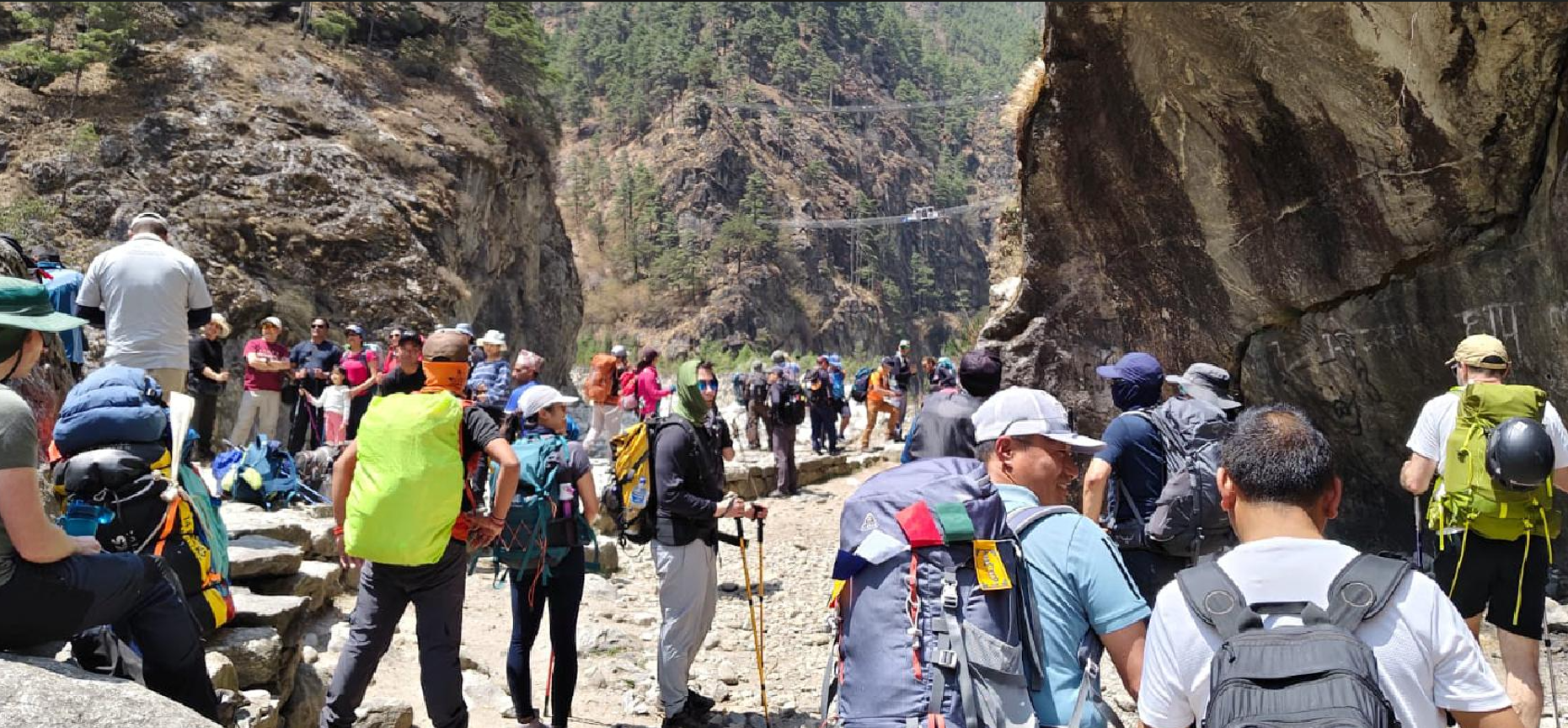
Solukhumbu. As the cold of winter intensifies this year, the number of tourists leaving the Sagarmatha region by air has risen. According to weekly data provided by the District Police Office, the number of tourists entering and leaving the Khumbu area has more than doubled in recent times.
According to police data, in the past seven days, 1,180 tourists have left the Sagarmatha region (Khumbu) by air, while 529 tourists have entered. The number of tourists entering is 651 more than those who have left. The number of outgoing tourists is more than twice that of entering, indicating that the autumn tourism ‘season’ is gradually coming to an end.
According to Police Inspector Mausam Tamang, the information officer of the District Police Office, the available weekly data shows that the number of foreign tourists leaving is 877 and the number of domestic tourists is 303. During the same period, 374 foreign and 155 domestic tourists entered the Khumbu area.
According to details, among the foreign tourists leaving the Khumbu area, 327 are women and 550 are men. Among the domestic tourists, 46 are women and 257 are men. Similarly, among the foreign tourists entering the Khumbu area, 102 are women and 272 are men, while among the domestic tourists, 54 are women and 101 are men. Local Dali Sherpa said that as the cold in Khumbu has increased, the number of tourists returning has increased. He said, “In the Namche area itself, nighttime temperatures have started dropping below zero, and after temperatures drop below zero during the night and morning, water has started to accumulate, which is why the cold has increased. ”
Among the main tourist seasons in the Sagarmatha region, tourist crowds are higher in the months of Ashot and Kartik during autumn. After the monsoon ends, the weather clears up, the mountains are clearly visible, and the environment becomes favorable for trekking, leading to an increase in tourist arrivals in this area. However, with the latter half of Kartik, temperatures drop, nights become extremely cold, and the likelihood of snowfall increases in the higher Himalayan regions, leading to a rapid return of tourists.
Lamakaji Sherpa, chairman of the Sagarmatha Pollution Control Committee (SPCC) and a tourism entrepreneur, said that as the cold increases in the high Himalayan region, the duration of tourists’ stays and activities will be affected. He said that towards the end of the season, tourists will manage their trips by considering weather conditions, temperature, snowfall, and trekking conditions, so the number of returnees will increase.
Mentioning that tourism activity in the Khumbu region is directly linked to the season, Sherpa said that seasonal changes affect tourist movement. Although tourist crowds are higher in the autumn season, travel to the high Himalayan region will become more difficult once winter begins, and the number of tourists will decrease, said tourism entrepreneur Speedkaji Sherpa.
TAG_OPEN_div_38 According to Amrit Magar, station in-charge of Tara Air in Lukla, seasonal conditions and the impact of the tourist season are evident in tourist arrivals. He said that as tourist pressure increases, air traffic also increases, and as the season weakens, the number of tourists leaving increases. “Since weather conditions are important for air flights, flight activities at Lukla Airport are also affected by the weather,” said In-charge Magar.














प्रतिक्रिया दिनुहोस्