



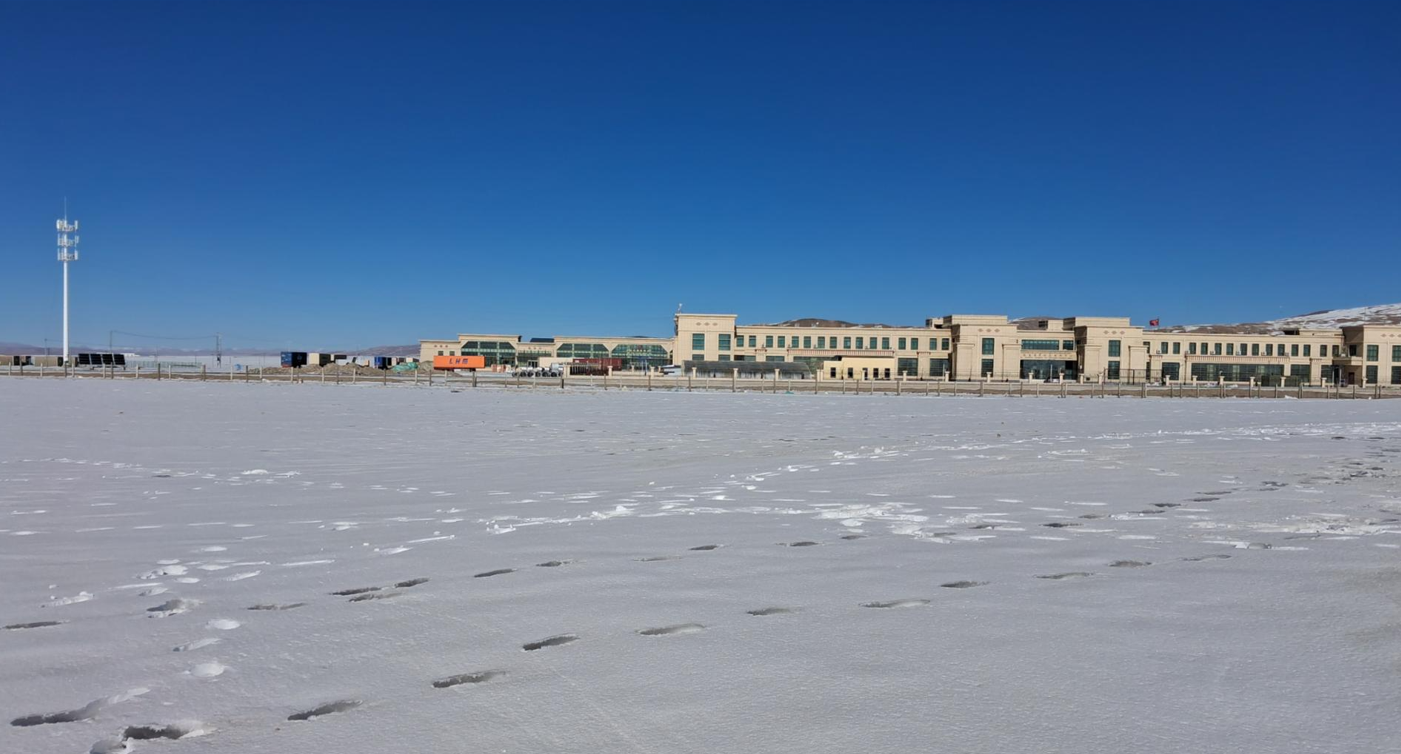
Mustang. Even after four years since the detailed project report (DPR) was prepared for the construction of physical infrastructure in the Nepal-China Northern Korala border, construction work has not yet begun.
In Falgun 2079 BS, the government conducted a DPR survey in the Korlana area with the aim of constructing customs, immigration, quarantine, dry ports, and integrated security posts. Before that, about one thousand ropani of land on the Nepal side of the border had been acquired in the name of the Nepal government for customs and other facilities.
The survey, conducted with the aim of expanding trade routes with China, was conducted for two months. During this, the geological condition of the proposed infrastructure construction site and soil testing were also conducted. According to the plans of the then Ministry of Industry, Commerce and Supplies and Nepal Intermodal Transport Development Committee, a DPR was prepared for the construction of necessary structures, including customs.
Sitara Intusip–Fullright JV completed the DPR survey by contracting a contract at a cost of one crore rupees. It is unfortunate that infrastructure construction work has not started even after a long time since the report was submitted to the government, said Lopsang Chomphel Bista, chairman of Loghekar Damodrakund Rural Municipality.
Among the border crossings with China, Korlana has already been established as an important alternative trade crossing, but due to the lack of necessary infrastructure, there are difficulties in managing export and inflow trade and developing it as a transit transit point, according to Chairman Bista.
It has been three years since Nepal-China was opened to the citizens of Upper Mustang in northern Karalana, and it has also been two years since it began operating as an alternative trade crossing. Last year, more than six billion in revenue was collected from this crossing. In just the first four months of the current fiscal year, more than 12 billion in revenue has been collected.
Recently, 60 to 70 containers and about 100 electric vehicles have been entering Nepal daily through Korlanaka. However, due to the lack of necessary physical infrastructure, problems have arisen in the operation of the border and vehicle management.
With the Tatopani and Rasuwagadhi crossings completely closed, business activity has increased at the Korlanak connecting Nepal and China. Hundreds of containers and electric vehicles are moving daily via the Beni–Jomsom–Korla road. After the crossing is fully operational, the customs yard in Lomanthang–4 Nhechung has seen increased pressure on containers and electric vehicles. Parking containers covering up to three lanes of the road has affected traffic movement on the main road leading to Korlanaka.
Without a dry port, containers have to be haphazardly parked on the road, and even electric vehicles have to be unsafely parked along riverbanks and cliffs, said Dharmveer Mandal, a representative of BYD vehicle importer Cymex Inc. He added that the lack of necessary infrastructure and charging stations at the checkpoints is causing further problems.
Local representatives say that although ministers and dignitaries from the federation and provinces have visited the Korlanaka, concrete work has not progressed beyond assurances for infrastructure construction. They demand that there should be no delay in the infrastructure construction of this crossing, which is considered important for the economic activities and trade of Gandaki Province.
This week, the delegation from the House of Representatives’ Infrastructure Development Committee, which visited the Korlanaka inspection, was also urged by local representatives to focus not only on revenue collection from the checkpoint but also on the construction of necessary infrastructure. They demanded that the construction of Korlanaka’s infrastructure and access road be made easier as soon as possible before the committee chairman, Ashish Gajurel.
Not only in the Korlanak area but also in Lomanthang-4 Nhechung, where the Mustang customs office is located, land was made available for government agencies in 2075 BS. In the Lomanthang area of Korlanaka, land was made available for various government agencies in 1,436 ropanis. Similarly, the Nepali Army was provided 1,271 ropani of land in the Thurlung area of Lomanthang.
In Nhechung, 109 ropani were allocated for the customs office, 12 ropani for the immigration office, 13 ropani for the Nepal Police, and 33 ropani for the armed police. Among the available lands, the armed police have already constructed the building, and the Nepal Police has recently initiated the contract process for building construction. However, the customs and immigration office buildings have not yet been constructed. The upgrading work of the customs office is being carried out partially.











प्रतिक्रिया दिनुहोस्