

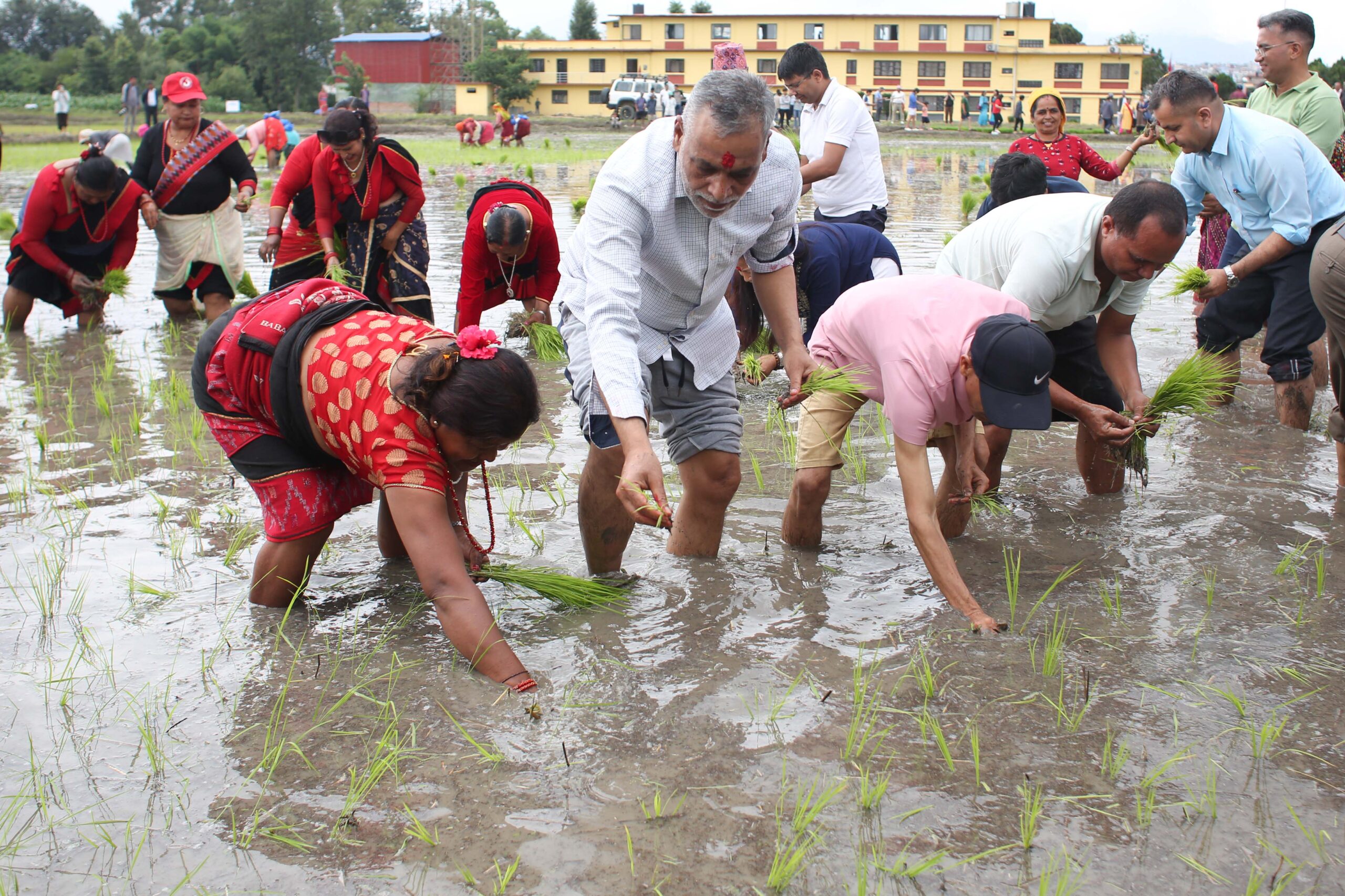
Kathmandu. The government has organized the 22nd National Paddy Day and Planting Festival at Khumaltar, the premises of the National Agricultural Research Centre, today. Minister for Agriculture and Animal Husbandry Development Ramnath Adhikari has planted saplings in the festival.
The day is being celebrated today with the theme ‘Food Security and Self-Reliance in Paddy Crop’.
June 15 is the main day for farmers throughout the year. So far, 15.6 percent paddy sowing has been completed. According to the Department of Agriculture, this data is up to Friday, June 15. Rice is the main food crop of Nepal. Rice accounts for about 80 percent of the total food crops consumed in Nepal.

The government has been taking various initiatives to increase the production and productivity of paddy. Despite this, the data on rice imports is also alarming. Rice worth Rs 39 billion was imported in the 11 months of the current fiscal year, according to data from the Customs Department. During this period, 261.919 million kg of paddy was imported.

There is an annual demand of about 7 million metric tons of paddy in Nepal. Out of this, one million metric tons of paddy is insufficient. According to statistics, 1.2 to 1.5 million metric tons of rice are imported into Nepal annually.
Paddy has been cultivated on 1,420,636 hectares of land across the country in the current fiscal year 2081/82 BS. More than 140 different varieties of paddy crop have been registered with the Nepal Agricultural Research Council.

Although the soil of Kathmandu Valley is very fertile for cultivation, due to unsystematic urbanization and fragmentation of land, houses and residential areas are now being constructed on the agricultural land here. Although farming is done in some old settlements and villages in the Valley, there is a shortage of land for cultivation in other areas.
The import of rice has increased further due to the construction of houses on agricultural land. Not only in The Kathmandu Valley, but also in the villages, agricultural land has been destroyed due to the impact of migration.
Photo: Nepal Photo Library


















प्रतिक्रिया दिनुहोस्