

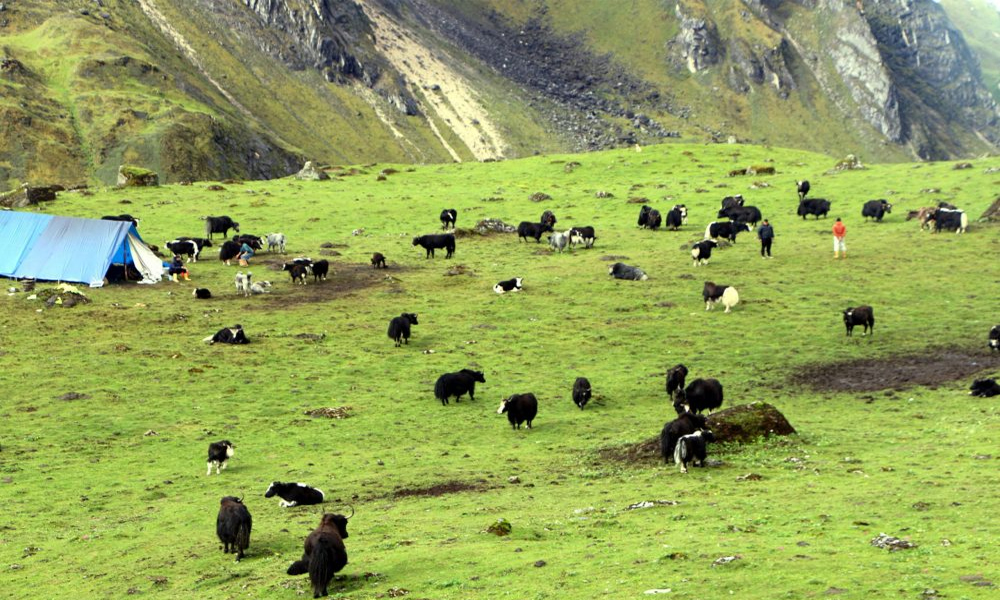
Manang. Manang: Livestock farmers in the mountainous district of Manang have been provided relief of Rs 3.14 9 million for the loss of animals and human lives by wild animals. The relief was given as compensation to the livestock farmers of the district in the fiscal year 2081/82 BS.
The Annapurna Conservation Area Project Area Conservation Office (ACAP), Manang, has provided relief for the damage caused by wildlife. Chief of Annapurna Conservation Area Project Area Conservation Office (ACAP) Dhak Bahadur Bhujel said that relief of Rs 3,149,292 has been provided to 43 livestock farmers of the district.
Chief Bhujel said that relief ranging from Rs 14,000 to Rs 335,000 has been provided to the livestock farmers who have lost their livestock due to wildlife attacks. “Relief has been provided to the farmers who have suffered loss of livestock due to snow leopard attack,” he said. Compensation has been provided to the farmers for the damage caused by wildlife attacks. Relief has been provided this year as it did last year. ’
Man Kumari BK, a cattle farmer of Bhraka, has been provided rs 335,000 as relief for the maximum damage caused to her livestock due to the snow leopard attack, said Bhujel. A relief of Rs 230,000 has been provided for the loss of livestock due to the attack of snow leopard and leopard by livestock farmer Suresh Thakali.
Similarly, Shambhu Ghale of Tachai has been given Rs 97,000 as relief for the loss of human lives due to wildlife attack. Ghale, who was injured in the attack of the himalayan black bear, has been given the relief amount.
Livestock losses are increasing in Manang due to wildlife attacks. According to the Annapurna Conservation Area Project Unit Conservation Office (ACAP), 87 livestock were damaged in the fiscal year 2081÷82 BS.
This year, 58 yaks, 22 goats and prawns, one horse and six cattle have been killed by wild animals. Farmers here have suffered losses to livestock due to attacks by wild animals including snow leopards, leopards and bears. Compared to last year, more yaks have died due to wildlife attacks this year. In the fiscal year 2080÷81 BS, 17 yaks, 37 goats and prawns and one horse were killed. According to ACAP, the number of wild animals attacking pets is increasing due to lack of food.
“It is customary to keep yaks under the open sky. A single farmer rears a large number of yaks. As a result, it is difficult to protect,” said Bhujel, adding, “For the safety of the calves of Yakchauri, fencing is now made safe.” However, large yaks are kept under the open sky. Studies show that this leads to wildlife attacks. ’
“The direct impact of climate change has been on the khark of the mountainous region. Due to its effect, the temperature is increasing and the khark has to be moved upwards. The possibility of wildlife attack has increased as the grazing area of the animals is close to the forest. Since there are grasslands in areas with water sources, the risk of wildlife attacks has been reduced, which has now changed.
Suresh Thakali, president of The Federation of Livestock Farmers and Yakschowri Farmers of Gandaki Province, said, “In the past also, there used to be attacks by wildlife. It’s growing now. Earlier, there was no provision for compensation if an animal died.
He said that the farmers are suffering due to this. In case of loss of livestock, the government has made arrangements for compensation to encourage and support the farmers. Chairman Thakali said that this has brought relief to the livestock farmers.















प्रतिक्रिया दिनुहोस्