

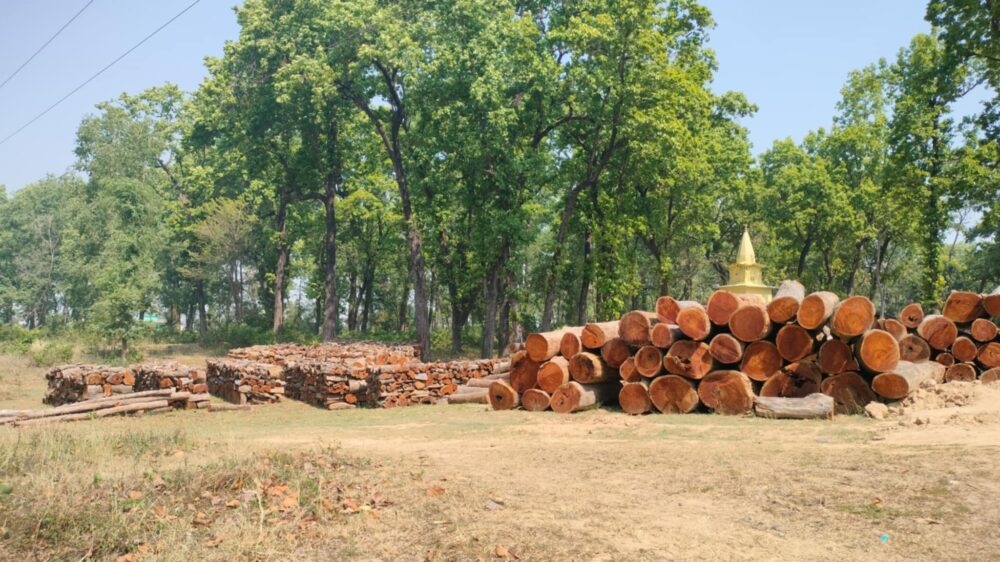
Kanchanpur. Dozens of community and partnership forest users’ groups in Kailali and Kanchanpur are facing problems due to lack of new sustainable working procedures even after five years of the scrapping of the Scientific Forest Management Procedure.
Wood worth millions of rupees in the forest has started to rot due to lack of timber collection. Forest groups are facing financial crisis as they have not been able to collect timber and firewood produced in the community forest as per the technical action plan.
The government had scrapped the scientific forest management procedure on January 1, 2017. Bir Bahadur Rajbanshi, secretary of the Community Forest Coordination Committee, said that after the decision, the implementation of the pre-approved action plan of the community forests of Kailali and Kanchanpur has been stopped. “This has neither made it possible to collect timber nor conserve and promote forests,” he said, adding that the path of sustainable forest management has also been closed due to lack of working procedures. ’
He said that millions of timber are rotting in the forest due to legal hurdles in collection and sale. According to him, although it is clear that forest management can be done by adopting a silviculture system (forest promotion system) as per Section 30 of the Forest Act 2077 and Rule 2 of the Forest Regulation 2078, the delay in bringing the new procedure has affected the consumer groups economically, socially and institutionally.
Bahadur Singh Mahara, chairman of Baijnath Community Forest Users’ Group, said that there have been problems in forest management, livelihood, social services and operation of institutions due to lack of working procedure for the last five years.
A team led by Pushkal Bahadur Bam, far-western coordinator of the National Federation of Scientific Forest Users Nepal, has submitted a 23-point memorandum to Secretary at the Ministry of Industry, Tourism, Forest and Environment of sudurpaschim province, Dirgha Narayan Koirala, accusing the government of neglecting sustainable forest management.
The memorandum has demanded reform of the tax system, access to bank credit, provision of subsidy for the operation of timber and non-timber industries and ensuring the rights of community forests in the management of lakes. Proper management of the forest area has not been possible as the state government has not yet come up with a sustainable forest management procedure. Although the far-western state has about 60 percent of the total forest area, its management is becoming challenging, according to consumers.
According to the existing Financial Act, 10 percent of the income earned from community and partnership forest management should go to the State Consolidated Fund and 10 percent to the Local Level Consolidated Fund.
Similarly, 25 percent of the income earned from external sales distribution has to go to the State Consolidated Fund. Consumers of community forests have demanded the implementation of ‘one-door tax system’, saying the management of wood and wood has become more complicated due to the dual, triple and four-way tax system.
According to sub-section 4 of Section 22 of the Federal Forest Regulations 2079 BS, there is a provision to send 25 percent of the remaining timber to the supply committee after internal consumption of the timber of the consumer group, but it has not been implemented.














प्रतिक्रिया दिनुहोस्