

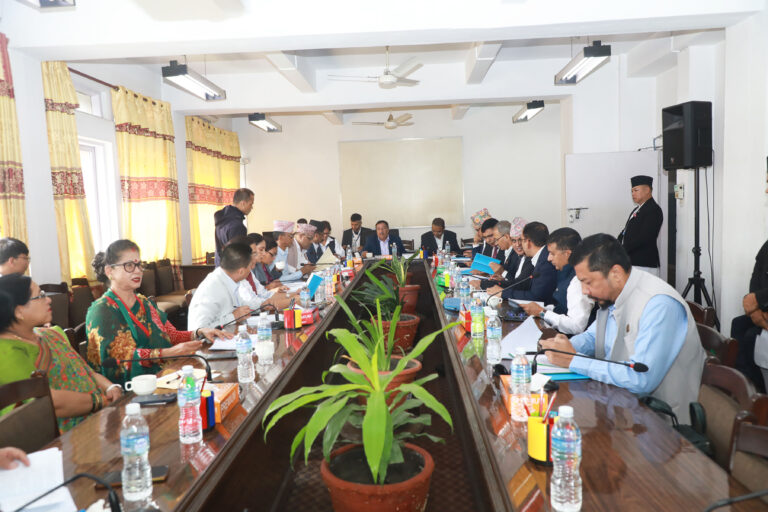
Kathmandu. A meeting of the Finance Committee of the House of Representatives today discussed clause-wise on the ‘Bill to provide for mobilization of alternative development finance, 2082 BS’.
Today’s meeting concluded with a view to further refine the provisions made in Clause 19 of the Bill regarding the Chief Executive Officer (CEO) of the Alternative Development Finance Fund.
According to the bill, a foreign national can also be appointed as ceo for the first time after the commencement of the act. Non-resident Nepalis cannot become CEO, according to the bill.
According to the bill, a person who has obtained a Diversity Immigrant Visa (DV), Permanent Resident Visa (PR), Green Card or permanent residence permit of any name to settle permanently in any foreign country will be ineligible for appointment to the post of CEO.
Committee President Santosh Chalise said that the committee has come to the conclusion that foreign nationals can be made CEOs and non-resident Nepalis cannot be made CEOs.
Similarly, Deputy Prime Minister and Finance Minister Bishnu Prasad Poudel agreed with the committee’s findings and said such an arrangement could be made for the first time. “Once the fund is established, a qualified person can be brought from abroad for its operation. It’s only for one time,” he said.
A three-member board of directors will be formed in the fund with finance minister as coordinator and vice-chairman of national planning commission and governor of Nepal Rastra Bank as member. Although the bill has been proposed to have a seven-member board of directors headed by the finance secretary, the committee has amended it so that there will be a board of directors above the board of directors. The functions, duties and powers of the board of directors have not been decided yet.
Provision has also been made to invest in agriculture, forest produce and mining and mineral related sectors from the Alternative Development Finance Fund. According to the bill, alternative sources of finance can be used for the construction of power generation, transmission and distribution projects, roads, railways, airports, tunnels, industrial development infrastructure (special economic zones, industrial parks, dry ports or information technology parks).
Similarly, such funds will be mobilized for the construction and operation of urban development infrastructure, cable car, ropeway and other structures. The Fund can also invest in national priority projects under public-private partnership to be implemented by the private sector.
However, no investment can be made from the fund in projects costing less than Rs 1 billion. The Fund will not invest in projects that do not give immediate returns, projects that cannot be pledged as loans or security, projects that seek loans by pledging or securing debentures issued by the Fund, projects implemented by any natural person.
The government has brought this bill as alternative finance mobilization is necessary in addition to traditional investment to implement infrastructure projects necessary for the country’s prosperity, sustainable development and productivity enhancement. According to the bill, the authorized capital of the fund will be Rs 100 billion and the paid-up capital will be Rs 25 billion.















प्रतिक्रिया दिनुहोस्