

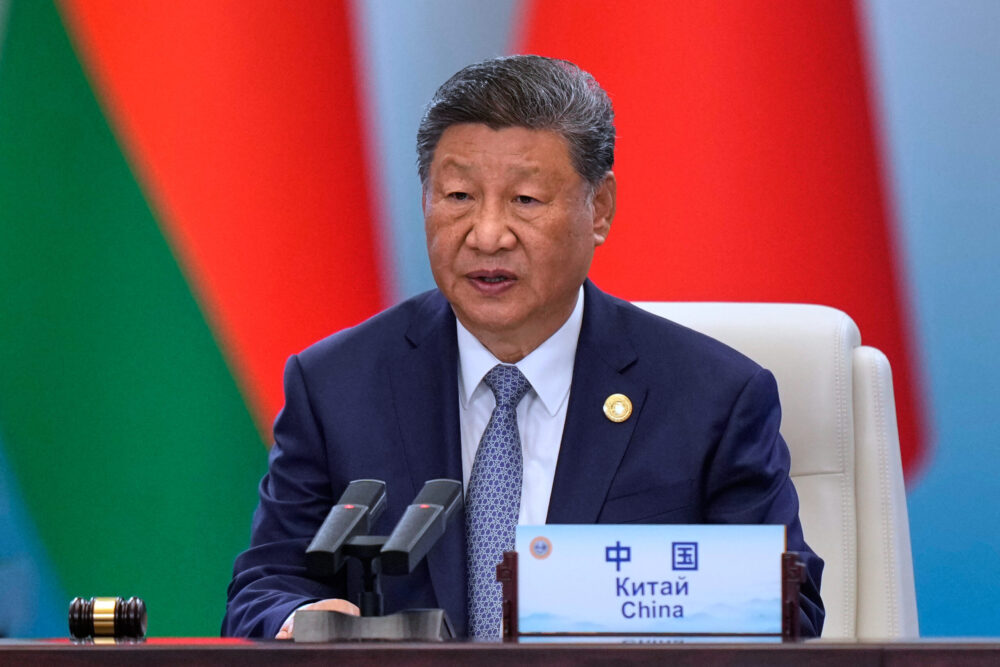
Tianjin. Chinese President Xi Jinping said at the annual summit of the Shanghai Cooperation Organization (SCO) in Xi’anjian on Monday that China will try to speed up the process of establishing the SCO Development Bank.
“Right now, the world situation is becoming more complex and turbulent. Member states are facing even more difficult security and development responsibilities,” Xi said in his opening address to the forum.
He pledged $1.4 billion in loans to SCO member states over the next three years. However, he clarified that this amount is not only for the new bank.
The summit was attended by Xi, Russian President Vladimir Putin, Indian Prime Minister Narendra Modi and leaders of dozens of other countries. Although the group’s size and influence, originally founded to balance U.S. influence in Central Asia, has expanded in recent years, it is still largely known as the Security Forum.
Through the proposal to provide banks and loans, Xi has indicated to expand the scope of the organization towards development.
China message
Alfred Woolley, a professor at the Lee Kuan Yew School of Public Policy at Singapore’s National University, said Xi wants to present an alternative world order as the US-led system weakens. That’s his main message.
Xi said nations should “resist the Cold War mentality, block-based confrontation and bullying, defend the UN’s international system” and “contribute to an equitable and orderly multipolar world, inclusive economic globalization, and a just and appropriate global system of governance.”.
This message was no different from china’s previous statements. Opposition to the Cold War mentality is often aimed at the US. According to Wuley, although China has sometimes cut funds to some UN agencies, its stability is the message at this time.
Founded in 2001, the SCO now includes Russia, Belarus, China, India, Iran, Kazakhstan, Kyrgyzstan, Pakistan, Tajikistan and Uzbekistan. Afghanistan and Mongolia are observer states, while 14 countries in Southeast Asia and the Middle East are engaged as “dialogue partners”.
This year’s summit comes days ahead of china’s planned military parade, which Beijing sees as an opportunity to invite its allies and neighbours.
Focus on conflict
On Sunday, Xi met Indian Prime Minister Modi and promised to resolve differences over the border dispute. These disputes strained relations in 2020, with border disagreements in ladakh, Arunachal Pradesh and various areas near Bhutan.
Putin met with Xi on Sunday and held talks ahead of tuesday’s bilateral talks. “I hope that the recently concluded high-level Russian-American summit in Alaska has paved the way for peace in Ukraine,” he said. ’
Recently, the message of China-Russia development has become particularly strong. In an interview with China’s official Xinhua news agency, Putin said the two countries were “opposed to discriminatory sanctions”. According to him, such restrictions have dealt a major blow to the socio-economic development of the world.
Putin said Russia and China together support reforms of the International Monetary Fund (IMF) and the World Bank. “The practice of using finance as a tool of neo-colonialism needs to be put to an end as it works against the interests of the majority of the world’s nations,” he said. ’
Security still priority
While China wants to make the SCO an effective platform globally, its true effectiveness is still under question. In the past, security has always been a priority for the organisation, which claims to fight the “three forces” – terrorism, separatism and extremism.
But critics see it differently. Derek Grossman, a professor of international relations at the University of Southern California, said, “The SCO’s counter-terrorism practices often protect authoritarian regimes from threats rather than fighting real terrorism.” Since major economies are linked to the BRICS grouping, it is more likely to compete with the West. ’
“Although the impact and reach of the SCO summit may remain limited, one thing is clear : China is in a diplomatic upheaval and the UNITED States is on the path to self-destruction,” Grossman concluded.












प्रतिक्रिया दिनुहोस्