

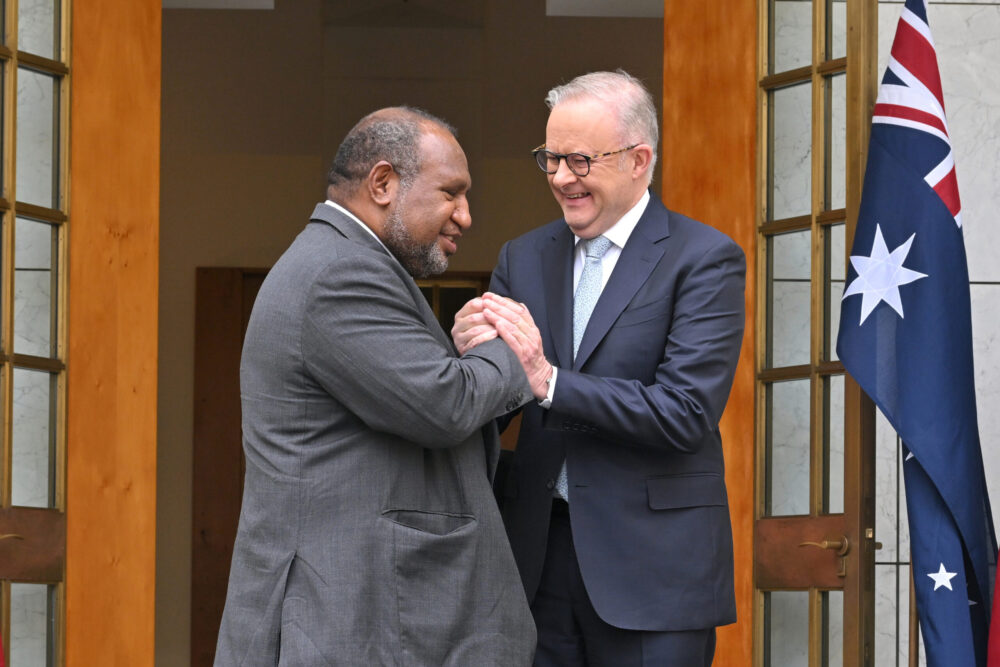
Melbourne. The leaders of Australia and Papua New Guinea signed a landmark defence pact on Monday. China has expressed dissatisfaction with the treaty, calling it an agreement aimed at itself.
Australian Prime Minister Anthony Albanese and Papua New Guinean Prime Minister James Marape described the agreement as a mutual defence treaty that will ensure unprecedented cooperation and integration between the two countries’ defence forces and military personnel.
It is Australia’s second alliance-level security pact, following the 1951 Treaty of Anjos with the United States and New Zealand. This is the first such treaty for Papua New Guinea. The treaty will come into effect after it is ratified by the parliaments of both countries.
Albanese said it was a matter of pride that Australia’s closest neighbour is now its main security partner. “This treaty includes a mutual defense obligation similar to that of the Anjus Treaty. “In the event of an armed attack in any of our countries, both sides will work together to counter a common threat,” he said at a joint press conference at the Australian Parliament House. “Our two countries have agreed not to engage in any such activity and will not enter into any agreements that compromise the implementation of this treaty. ’
After signing the key principles of the treaty last month, the Chinese Embassy in Papua New Guinea issued a statement saying the agreement should not be exclusive in nature and should not impede cooperation with third parties. “It should not target any third party or undermine its legitimate rights and concerns,” the embassy said on social media.
“The treaty does not violate Papua New Guinea’s principle of ‘friendship with all’ and ‘hostility to none’,” Marape said. It is not a compromise to create enemies, but a symbol of friendship and transparency. We’ve made it clear to China that Australia is our security partner of choice and they understand that. ’
“The treaty strengthens our security partnership with Australia, but there is no intention to create enemies elsewhere,” Marape said. In recent years, Australia and the United States have expanded military cooperation with Papua New Guinea in what is seen as a strategic effort to contain China’s growing influence in the Pacific.
For Papua New Guinea, it is a balancing act as the country seeks an economic partnership with China. Australia has been actively trying to strengthen ties with island nations in the region since China signed a security pact with the Solomon Islands in 2022.
Apart from Australia and New Zealand, Papua New Guinea, Fiji and Tonga are the only countries in the South Pacific region that have their own militaries. Australia is also negotiating a bilateral defence deal with Fiji.
Since 2019, as China’s influence has grown, three Pacific island nations have shifted their diplomatic status from Taiwan to Beijing. Allies, including the United States, are concerned about China’s growing security influence through police training in Fiji, Kiribati, Samoa, the Solomon Islands and Vanuatu.












प्रतिक्रिया दिनुहोस्