

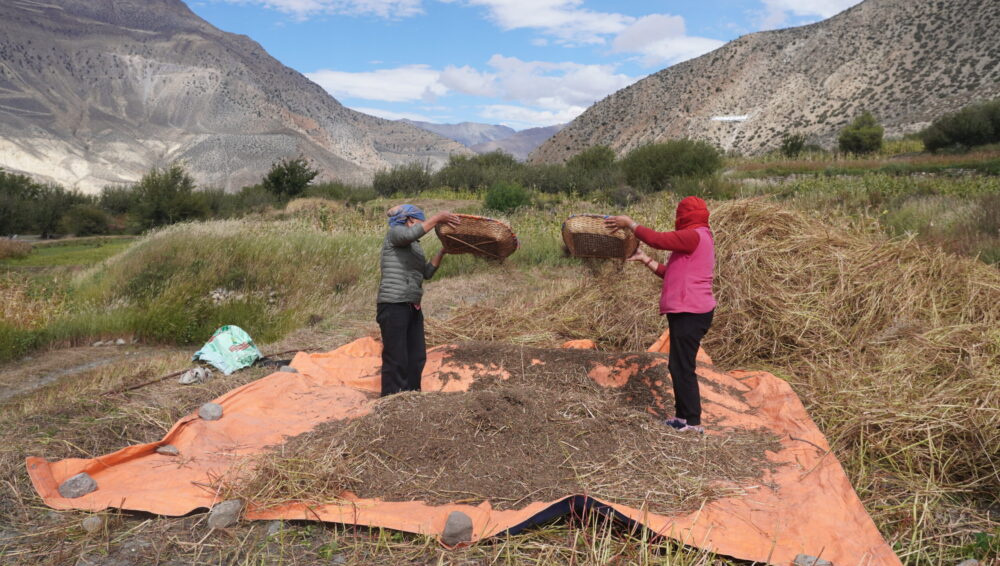
Mustang. The farmers here are busy harvesting their traditional crops with the end of the Dashain festival. Farmers in the lower belt of Gharpajhong, Waragung Mukti Chhetra and Thasang rural municipalities are busy taking care of the food crop. Buckwheat is considered a popular food crop here.
The farmers here have been cultivating buckwheat for domestic purpose, religious ceremonies, business purposes and to send their relatives living abroad as Koseli.
Pramila Gurung Thakali, a farmer of Thini, Gharpajhong-5, said that buckwheat can be cultivated in an average of 100 days after sowing of buckwheat in the fields. He said that it is customary to cut the buckwheat and dry it in the fields for three consecutive days along with the stalk. Buckwheat stems are kept as straw to feed the livestock and to feed the animals when there is no grass, said Thakali, a farmer.
Though sweet buckwheat and bitter buckwheat are cultivated in the district, the main cultivation of sweet buckwheat is in abundance. According to him, some farmers have started collecting buckwheat saffron using new technology in recent period.
Locals have been adopting indigenous buckwheat farming from the lower to upper areas of the district. Barley, barley, maize, potato, beans, beans and other buckwheat farms have become the main brands here.
Buckwheat is cultivated at an altitude of 1,984 meters to 3,900 meters above sea level. Although buckwheat is cultivated in mountainous and high hilly areas, buckwheat is a local crop produced in the cold climate of Mustang and the food is tasty and nutritious.
Sweet buckwheat is cultivated in the first week of June and July and brought to the house in the first and second week of September. Bitter buckwheat is sown in the months of July and August and brought into the house from the first week of Kartik. Normally, it takes nine months for the local crops to ripen, but buckwheat can ripen in three months, said Pramila.
In Upper Mustang, sweet buckwheat is sown in the first and second week of Baisakh and brought from the first week of Kartik. It is customary to sow bitter buckwheat in the fields in the first and second week of Baisakh and bring the crop towards the end of Kartik.
Palsang Gurung, a farmer of Thini in Gharpajhong-5, said that various disasters have been seen in buckwheat crops due to climate change in recent period. According to him, the pest attack has been seen in the buckwheat crop here this year. He said that last year, the crop was affected due to frost.
Gurung, a farmer, said that the local crop is grown as an intercropping in the apple orchard. According to him, buckwheat farming is highly preferred by the consumers of the city market as various dishes like dhido, roti and other dishes can be made in the buckwheat crop.
He said that the management of traditional indigenous crops has become much easier as they are less cumbersome than other crops due to the climate crisis. He said that the demand for buckwheat is high as it is the main variety in the kitchens of the city market.
The average height of the buckwheat plant ranges from 100 cm to 110 cm. Under the buckwheat crop, the flowers of the sweet buckwheat flower bloom in a cluster of light pink color, while the saffron of the buckwheat is light and black in color. White colored flowers of bitter buckwheat. Buckwheat flour is prepared by grinding it in a local water mill and mill. According to farmers, the price of one buckwheat mill is being sold for Rs 1,2000. In particular, the sweetness of buckwheat is used in large quantities to eat bread and bread.
The farmers here have not adopted buckwheat farming commercially. The farmers here have adopted the local buckwheat crop only for their own household purpose. According to Roshan Thakali, agriculture section officer of Gharpajhong rural municipality, the local levels have been implementing various programmes for the promotion of indigenous food crops.
According to him, buckwheat crop is the identity of Mustang and it is the responsibility of the local government to protect it.
According to nutritionists, more than 24 types of nutrients are obtained from buckwheat. Buckwheat is said to reduce blood cold stores and prevent gallstones. It reduces obesity and is useful for blood pressure patients. Buckwheat, in particular, is rich in mineral water and vitamins. It is said to contain carbohydrates, fiber, protein, fat and water.
















प्रतिक्रिया दिनुहोस्