

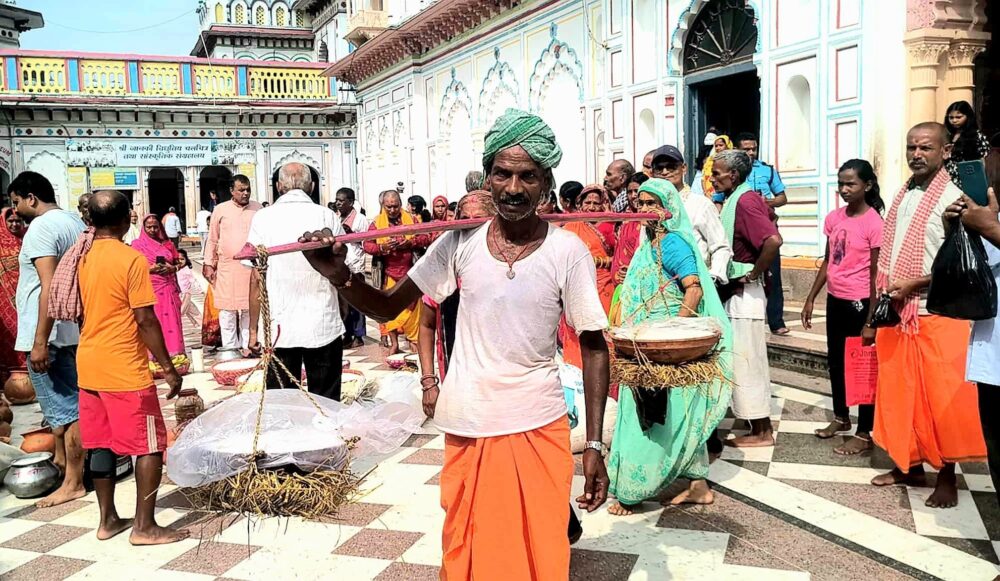
Bow. On the occasion of Kojagrat Purnima, 101 koseli (weights) were brought to the Janaki Temple in Janakpurdham today.
A total of 101 koseli brought from Ratauli village of Mahottari to the Janaki temple has been offered this year as well. According to Mahantha Ramaroshan Das Vaishnav, heir of the Janaki Temple, the people of Ratauli have brought various worship materials to the temple even today as per the tradition that has been going on continuously for hundreds of years.
Kojagrat Purnima is a night of special significance in Hinduism. According to religious belief, Goddess Lakshmi showers wealth and prosperity on the waking devotees tonight. Therefore, this night is considered as the night of ‘Amrit Varsha’.
The load brought from Ratauli is dedicated to the special worship of the Janaki temple. It is considered as a symbol of devotion to Janaki and Ram. This tradition has been strengthening the cultural and religious unity of the Mithila region, said Pandit Kusheshwar Upadhyay.
Rataulika late. There is a tradition of kissing Lord Sita and Ram from the load brought to the temple from the house of Mahendra Prasad Thakur. Paan, makhana, laddoo, snacks, rice, lentils, vegetables, clothes of Lord Rama and Mata Janaki are brought in the load. This tradition has been going on for hundreds of years.
Betel leaves, butter, fruits, yogurt, sweets, fennel seeds and peanuts are mandatory in the load. When the load comes from the bride’s house to the groom’s house, the groom is kissed. That is, kissing is done. After the priest chants mantras and kisses the groom, the elders bless him. On this day, the groom is dressed in the clothes brought by the in-laws wearing the turban of Mithila.
The bridegroom is kissed with the offerings like baskets, rice, akshata, curd, banana, etc. from the bride’s house. It is customary to kiss the five main places from the head to the feet of the groom. Kissing is a kind of blessing. After the ritual is over, a group of food and drink is organized like a feast. Those who have the ability organize a big feast. On this occasion, sweets, butter, betel leaves must be distributed.
After eating and drinking, it is customary to play Pachisi with Kauda. Sixty-four dice are played between the bride and groom’s brother and the bride’s brother with eight cowries and sixteen pieces. On this day, it is customary to give weight and other items from the bride’s side. Jewelry, rings, umbrellas, watches should also be given to the bride’s side by the bride’s side. On this day, it is customary to give the remaining dowry as per the promise made for the marriage of the daughter. On this day, at least 5 to 11 or 15 people from the bride’s side come with a load. Those with the capacity have to send up to 100 loads and those who do not have the capacity have to send at least 11 loads.
Koseli is given during the Kojagara festival, just like the Koseli given at the time of marriage and farewell of the daughter. According to the Mithila culture, on the day of Madhushravani, the load has to be carried from the groom’s house to the bride’s house.
Festival at Janaki Temple
Janakpurdham: A special festival has been organized at the Janaki Temple, the famous religious site of Janakpurdham, on the occasion of Kojagrat Purnima.
To make Kojagrat Purnima grand, bhajans and kirtans are organized in the Janaki temple. Mahantha Ramtapeshwar Das Vaishnav of Janaki Temple said that there is a sense of humor during the festival every year.
Bhajan kirtan is organized in the temple to make the festival attractive. According to Mahanta Vaishnav, Mithilanis also send burdens for their sons-in-law. This tradition is said to have been going on for the last 115 years.















प्रतिक्रिया दिनुहोस्