



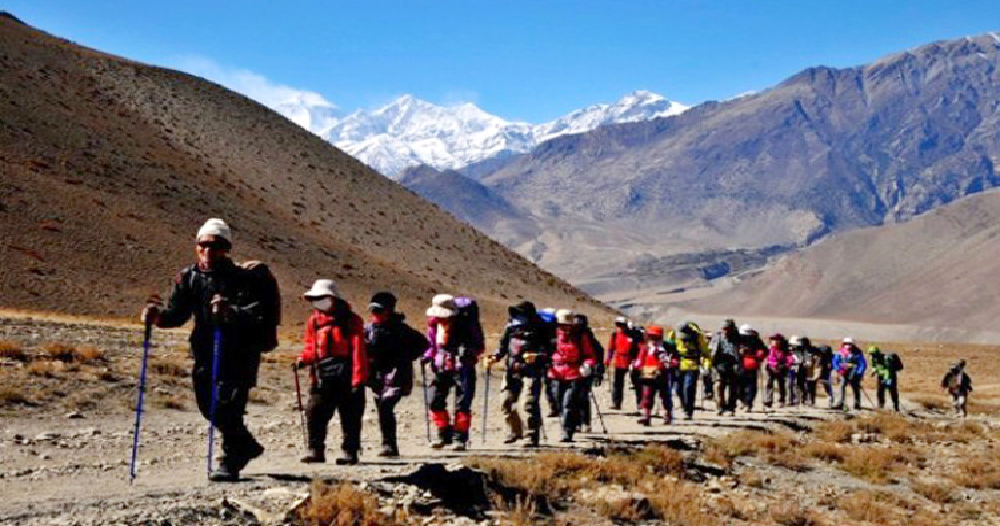
Kathmandu. After the Genji movement, the tourism sector has returned to normalcy. The number of domestic and foreign tourists has increased across the country with favourable weather following Dashain and Tihar. According to hoteliers, hotels, resorts and homestays across the country are currently 80 percent occupied.
Major destinations like Pokhara, Chitwan, Lumbini, Mustang, Bandipur, Ilam and Kathmandu Valley are seeing an increasing number of domestic tourists. Hoteliers say that domestic tourism has improved significantly. According to Laxman Subedi, president of Hotel Association Pokhara Nepal, hotel bookings in Pokhara have reached 80-90 percent. As a result, he says that the tourism business continues to flourish even after the Genji movement.
According to him, due to the Genji movement, the tourists coming from abroad are not as expected. However, he said that there has been a significant improvement in domestic tourists. “Until a few days ago, it was difficult to find accommodation in hotels in different parts of Nepal. Binayak Sah, president of Hotel Association of Nepal, said, “We have been getting calls from hotels in Mustang and Pokhara and other areas saying that there is no place to stay in them.” ’
According to Shah, although the number of foreign tourists has not been as per the expectation, the number of domestic tourists has improved. “A few days ago, Myagdi Municipality had asked people not to come without booking a hotel. Chairman Sah said, “Entrepreneurs have urged the tourists to come only by securing their accommodation in different parts of the country due to problems in management.” ’
The number of tourists participating in jungle safaris, boat rides and elephant riding has increased in Chitwan as compared to the same period last year, according to local entrepreneurs. Deepak Raj Joshi, chief executive officer of Nepal Tourism Board, said the number of foreign tourists coming to Nepal at present is more than that of the last year. However, Joshi believes that tourism is still not coming in as it was before the Corona epidemic.
“Tourism has entered a phase of revival. The impact of the corona epidemic in recent years is gradually decreasing. Joshi says, “But due to the Genji movement, it has had some effect. Although the number of tourists coming from outside has improved compared to last year, the number of tourists coming from outside has not been able to meet our target. ’
According to the statistics made public by the Nepal Tourism Board, the number of foreign tourists coming from Europe, India and China has increased in comparison to the previous year. This has sent a positive message to Nepal’s overall economy. However, there is still psychological panic among the tourists who want to visit Nepal.
Liladhar Awasthi, information officer at the Department of Tourism, says, “There was a fear that the number of tourists would decrease due to the Jenji movement. But that didn’t happen. Tourist arrivals have increased compared to last year. Visitors from abroad especially come to Nepal to climb the mountains. There is no shortage of it. This has also increased his royalty. Awasthi says that although the Genji movement is expected to reduce tourist arrivals, it has not made a major impact.
According to Awasthi, the government has not been able to meet the target set by the arrival of international tourists as the hotel business has suffered the most in the Jenji movement. According to Hotel Association of Nepal’s President Saha, the hotel capacity of Nepal can accommodate 35 lakh worth of tourists.
However, he says that tourists have not been able to come to Nepal as per the capacity. According to the Nepal Tourism Board, 128,443 tourists visited the country in October. Earlier in March, 1.21 lakh tourists had visited the country. Since then, 1.16 lakh tourists had visited the country in April. Statistics show that there is no dearth of foreign tourist arrivals despite the Jenji movement.
After some big hotels such as international chain Hilton, Hyatt Hotel and Varnabas were torched and vandalized in the Sept. 24 incident, many feared that it would have a direct impact on the tourism sector. There was a possibility that such a catastrophic incident would cause negative publicity in the international community and the tourists who wanted to come to Nepal might change their minds. After the incident, bookings of some hotels were canceled.
According to Sah, Nepal’s hotel business has the capacity to handle more than 30 lakh tourists in the current situation. According to him, Nepal’s hospitality sector has developed adequate infrastructure in recent years with the growth of new big and small hotels, resorts, lodges and homestays built across the country. However, he says that the number of visitors has not yet reached even half of that capacity. At present, occupancy is 65 percent of the capacity during Nepal’s tourism season. “There is a lot of potential in Nepal’s hotel business and what is needed now is to promote tourism, transport and improve the policy to the level where we can utilize this potential,” said Sah.












प्रतिक्रिया दिनुहोस्