Concerns have been raised that the energy sector will end due to the government: IPPAN Chairman Karki
लगानी न्यूज
For the successful implementation of TAG_OPEN_div_135 the Electricity Act 2049, I would like to thank hon’ble Former Prime Minister and Nepali Congress President Sher Bahadur Deuba for attending the program as the chief guest, accepting our invitation to give more encouragement to us promoters who have been able to produce about 2923 MW in 26 years of the decision to purchase electricity from the private sector in 2055 BS. ।
I would also like to express my gratitude to TAG_OPEN_div_133 the Ministry of Energy, Water Resources and Irrigation, Electricity Regulatory Commission, Department of Power Development, Nepal Electricity Authority, loan-investing banks and financial institutions as well as to all those who love the energy sector, including the media for their support, coordination, collaboration and facilitation for the success of the private sector in power generation. According to a study conducted by the Water and Energy Commission, Nepal has a generation capacity of 120,000 MW, including 48,000 MW reservoir-based projects. If we look at the current 3600 MW, it is less than 4 percent in terms of generation capacity and we still have the capacity to produce 196,000 MW. This is a great opportunity for us.
Due to the government’s policy of bringing private sector investment in energy after the Electricity Act 2049, the total power generation capacity of the country before the arrival of the private sector was only 252 MW, which has reached 3625 MW in 25 years of private sector’s entry into energy. The private sector’s share in this is about 81 percent i.e. about 2900 MW. At present, there are about 4,288 MW projects under construction in the private sector and 4,210 MW projects going into construction through PPAs. So far, 11,421 MW PPA has been completed between Nepal Electricity Authority (NEA) and the private sector. Apart from this, 4,966 MW hydropower and about 960 MW solar projects are undergoing PPA. In this way, by 2082-83, the installed capacity of the projects signed between the private sector and THE NBP will reach 17,347 MW.
The total capacity TAG_OPEN_div_129 of 13,590 MW projects approved by the Department of Power Development, 187 projects of 9,724 MW and 87 projects of 11,170 MW that have been surveyed with survey applications have a total capacity of 34,484 MW. So far, the private sector has invested more than Rs 1.3 trillion in these projects, while the private sector’s investment in these projects will be more than Rs 3 trillion in the next 10 years. Not only this, Nepal has become a net exporter by selling electricity worth Rs 17 billion in the last fiscal year and has moved ahead with the target of exporting 23 billion in the current year. Due to electricity, Nepal’s exports are increasing and imports are decreasing.
TAG_OPEN_div_127 I would like to thank all the energy entrepreneurs involved in the energy sector for bringing the umbrella and common organization of the sector with the highest investment in the manufacturing sector of Nepal to the place where independent energy producers’ organization Nepal (IPPAN) is presented to the distinguished personalities including the former Prime Minister. Because this success of the private sector is associated with many struggles, pains and challenges. Had it not been for the private sector, it would still be in the grip of load shedding and many rural areas of the country would have been in darkness.
The role of the government and its policies is important behind the success of any sector. Various policies, plans and programmes since the policy of opening ppa of the Electricity Act, 2049 and 2055, and the Power Trade Agreement (PTA) between Nepal and India during the tenure of the then Prime Minister Late Sushil Koirala about 11 years ago, have been important in energy development. In addition, today’s chief guest was 39 MW for the first time in Kartik 2078 BS during the tenure of the then Prime Minister. Export of electricity to India started. With the agreement reached between Nepal and India to export additional 325 MW of electricity during the then visit to India, the provisions mentioned in the joint vision paper for the cooperation in the energy sector between the then Prime Minister Sher Bahadur Deuba and Indian Prime Minister Narendra Modi are considered important for Nepal’s energy development.
According to the agreement, the TAG_OPEN_div_123 two countries will jointly develop hydropower, provide electricity to Nepal in the Indian electricity market, secure the grid between the two countries and extend the bilateral partnership to BBIN. On the basis of this agreement, the long-term, medium-term and current markets (day-a-head and real-time market) have been opened to Nepali electricity in the Indian market. Nepal and India have signed a long-term agreement to export 10,000 MW of electricity within 10 years during the visit of then Prime Minister Pushpa Kamal Dahal to India. As a result, India has now allowed import of up to 941 MW from Nepal. I would like to specially thank former Prime Ministers Sher Bahadur Deuba and Pushpa Kamal Dahal for such an important understanding.
Similarly, I would like to extend special thanks to Minister for Energy Deepak Khadka, who played an important role in the launch of 40 MW export to Bangladesh recently with a target of exporting 5000 MW of electricity in the future. TAG_OPEN_div_121 All these actions have far-reaching significance in taking the country on the path of economic prosperity through energy.
The Government TAG_OPEN_div_119 of Nepal has taken an important decision to approve the Energy Development Roadmap and Action Plan-2081 from the Council of Ministers meeting no. 49/081. It has also approved an 81-point action plan to reach the target of increasing nepal’s installed capacity to 28,500 MW by 2035. Out of the target of 28,500 MW, 3,625 MW projects are in operation. So to achieve this target, 25,000 MW will be spent in the next 10 years. It is necessary to generate electricity. For this, Nepal will have to invest about Rs 6.5 trillion in the energy sector in the next 10 years. In this way, to spend Rs 650 billion every year on energy development, the government has to invest more than three times the actual capital expenditure of Rs 200 billion every year.
The multi-TAG_OPEN_div_117 layer of this investment in the infrastructure sector through energy will also solve the problems of increasing trade deficit, declining balance of payments, lack of employment generation, rising inflation, the main challenge seen in our country’s economy for a long time. Now that Nepal has started exporting electricity and fuel imports have decreased, nepal’s progress in energy development in a short period of time is also being highly appreciated by neighboring countries. The Energy Development Corridor 2081 brought by the present government is an important plan and document to enrich the country, but its implementation aspect is still uncertain. If the government does not pay serious attention to its implementation, then this roadmap will not be implemented like the announcements made by the government at different times in the past.
The Forest Act, TAG_OPEN_div_115 Environment Act, National Parks and Wildlife Protection Act, Himalayan National Parks, Intermediate Areas Act and the regulations and procedures related to them are not development friendly. As many as 217 projects with a capacity of around 19,000 MW have also been stalled after an interim order was issued by the Constitutional Bench of the Hon’ble Supreme Court before the amendment to the National Parks and Wildlife Protection Act was implemented in the first half of the investment conference. Therefore, IPPAN believes that the successful implementation of the roadmap should be implemented by creating a sunset law for the energy sector immediately. For this, the government should declare the next 10 years as the Energy Development Decade to achieve economic prosperity in the country through energy development, to create employment, to earn foreign exchange as well as for the development of energy infrastructure.
It is necessary to increase electricity consumption in the country to make the country rich. However, domestic consumption has not increased compared to electricity generation. The reason for this is that large manufacturing industries have not been established in the country. If big industries are established, electricity consumption will not only increase but employment will also be created in the country. Therefore, the government and all political parties need to pay attention to this. The private sector is also in favor of electricity trade along with increasing electricity consumption in the country.
TAG_OPEN_div_112 While talking about the unprecedented progress being made in the energy sector, the sufferings and problems faced in the journey so far are no less struggling. At least 14 ministries, 40 departments under it, Nepal Electricity Authority, Nepal Rastra Bank, Electricity Regulatory Commission, Securities Board of Nepal and many other bodies have to be sent to build a project. The private sector, which is engaged in energy, has been suffering the most in recent times. Until a few years ago, we had been urging the government to facilitate the disruption and vandalism of energy projects by various individuals and groups in the name of different locals. But now, along with sadness, it should be said that we are in a position to agitate with a demand to remove the suffering and sufferingfrom the government and government agencies.
In the naturally occurring PPA, there is a situation of struggle to remove the obstacles in the issue of regular IPO issuance in the name of Take and Pay. I would like to thank today’s Chief Guest for taking the initiative taken with an important role in removing the IPPAN movement against the recent provision of Take and Pay PPA in the budget and program of the government.
Hon’ble Prime Minister, Hon TAG_OPEN_div_108’ble Deputy Prime Minister and Finance Minister, Hon’ble Energy Minister as well as Hon’ble Chairman of infrastructure committee of the House of Representatives, Hon’ble Former Energy Minister, Expert Advisors to the Prime Minister, Major Political Parties and their Chief Whips, Hon’ble Parliamentarians, Journalist Friends and others who have expressed their views on this issue in parliament will directly and indirectly cooperate for removing the take and pay. I would like to thank everyone.
With you, the participation of the private sector in the energy that is dying today has been revived and discouraged has created an environment for us to get excited again. But due to the apathy shown by the Electricity Authority to do PPA, there is still concern in the private sector that there will be no PPA immediately. Take and Pay has been removed from the budget, but for the last two years, the Securities Board has not issued an IPO, banned the construction of hydropower infrastructure, including hydropower, within the national park, the obstacles to hydropower development remain and we are struggling to remove them.
Not only this TAG_OPEN_div_105, projects worth about 13,000 MW have been waiting for PPA for a long time due to the partial opening of PPA by the Electricity Authority for about seven years. In the past, the pain of having to fight with the government agencies that facilitated energy development has become painful. However, we have no choice but to continue raising this voice to continue the participation of the private sector in energy. The country, which was hit by load shedding a few years ago, has now become a power exporter and now it has become a power exporter of 17 billion rupees. Electricity exports are projected to reach Rs 23 billion in the current fiscal year. In such a situation, the government should have encouraged, encouraged and supported energy production, but due to the government, the private sector is on the verge of displacement.
We are going to move forward with the slogan of ‘Private Driving Government Backing’ i.e. ‘With the government, private sector drivers’ to overcome this situation. This means that we want to see the government as a parent, facilitator, coordinator, policymaker, regulator, promoter as well as motivation for us. Therefore, as the chief guest today is the party chairman of the major parties involved in the government, I would like to briefly mention things on the occasion of this general assembly.
1. PPA TAG_OPEN_em_76 for projects up to 10 MW was opened until the tech and pay PPA came into the budget. Now that the Prime Minister and the Finance Minister have expressed their commitment in the House of Representatives to remove take-and-pay from the budget, we hope that the PPA up to 10 MW will move forward regularly. However, there is no target to open PPAs immediately and we feel that the Electricity Authority of Nepal (NEA) is putting conditions on conditions and not moving the PPA forward.
About seven dozen projects were damaged by the flood TAG_OPEN_em_75 s that occurred on June 1, 2080 and September 11, 2081. The Government of Nepal has publicly announced to provide relief to the projects affected by natural disasters, but till date we have not received any relief.
3. Due to earthquake, economic slowdown, non-cooperation of the Ministry of Forests, National Park Department, lack of explosives, etc. in the use of government land and felling of trees, it is difficult to complete the project within the stipulated time.
4. Ipo and right share issue of power projects have been stalled for two years. As a result, the private sector is on the verge of losing about Rs 100 billion, including additional interest, potential income and revenue paid. The construction work of about 1,000 MW projects has become uncertain. The public accounts committee of the House of Representatives has directed not to issue shares to those with a real net worth of less than 90. We reached out to the prime minister to the leaders of major political parties after the parliamentary committee directed us to implement the provisions not in the law. Later, the Finance Committee of the Parliament directed the Securities Board not to withhold the shares for any reason. But after that, the public accounts committee wrote a letter to the Securities Board, now the process of issuing shares has been stopped. The securities board has not given even to those with more than 90 net worth. We are now in a position to launch an agitation as the Securities Board has stopped the general process of issuing shares by the Securities Board by showing the direction of the Accounts Committee of the Parliament.
The government TAG_OPEN_em_72 has introduced the Electricity Bill 2080 in the Parliament. The private sector is shocked to see the proposed provisions in the bill. If the proposed provisions are passed in this way, then not only will there be a complete halt to the energy journey of the private sector so far, but the future of the 34,000 MW projects currently being pursued by the private sector in some way or the other will also be uncertain. For which the bill is being made, the biggest opposition is, so the Government of Nepal needs to make an investment-friendly bill for the private sector with amendments to it. The private sector has objected to what point has been sent in writing from the Infrastructure Development Committee of the Parliament to the Ministry of Energy. If this bill is passed as it is, then the environment to invest in energy will also end with the end of the policy of the Electricity Act, 2049, which allows the private sector to participate in energy. We have received assurances from the Minister for Energy and the Chairman of the Infrastructure Development Committee of the Parliament that it will be improved. However, we are apprehensive that the anti-private sector electricity act will not completely eliminate the investment in the energy sector.
Nepal Electricity Authorit TAG_OPEN_em_71 y (NEA) is not purchasing all the electricity produced by the private sector during the rainy season due to lack of transmission lines and low consumption in the country. This year, it is estimated that more electricity will be wasted during the off-peak hours. Private sector promoters are the worst hit when electricity is wasted. It needs to be resolved quickly.
TAG_OPEN_em_70 7. Power projects have been paying revenue, taxes and royalty taxes as per the legal provisions made by the Government of Nepal. According to the law, we have been paying to the federal government, but lately many local bodies have started sending letters to hydropower promoter companies by illegally fixing the tax rates themselves. This has further put energy projects in jeopardy. We have sent letters to the Ministry of Federal Affairs and Local Development, The Ministry of Finance, among others, to end the situation of paying taxes and revenue to the federal government. We have demanded necessary instructions to the local level, but the problem has not been resolved yet.
TAG_OPEN_em_69 8. We are facing a cumbersome process of the Ministry of Forest and Environment to pass the Environmental Impact Assessment Report and cut down trees. At present, we are facing an even bigger problem for the construction of hydropower projects in the national park. The full text is yet to come, but after the Supreme Court’s order that infrastructure projects, including hydropower, including hydropower projects of 19,736 MW capacity, which are going to be constructed immediately and an additional 20,000 MW to be constructed in these areas in the coming days, many transmission lines, including a total of 40,000 MW hydropower projects, will be constructed in these areas. The doors of construction of infrastructure projects including roads have been closed. In a country where about 50 per cent of the land is covered by forests, many economic activities will be halted if infrastructure is not built within that forest.
The private sector has high expectations from today’s chief guest to solve the above problems as the president of the ruling partner party and former Prime Minister. In the coming days, there is a need to facilitate the private sector in the policies, programs and plans to be forwarded by the government.
Topics to be facilitated
1. The provision of 100 percent income tax exemption for the first 10 years and 50 percent income tax exemption for the next 5 years to the projects generating electricity up to the financial year 2082/83 will be increased to 28,500.
2. Removing the existing system of tax capitalizing on project construction costs through VAT deduction or refund method imposed on project construction and operation and imposing zero value added tax on local sale and export of electricity immediately, it is necessary to make provision for the sale of electricity as a value added tax item as the consumer price will not increase and the tax cost in the construction of the project will also be reduced.
3. It is necessary to allow the private sector to transmit, trade, distribute and produce hydrogen. At a time when nea is not doing PPA and the private sector is publicly declaring that they are ready to manage the market in the neighboring country if the private sector gives permission for power trade, there is no doubt that the private sector can trade, transmit and distribute electricity in the internal and external countries if the government gives permission to half a dozen companies waiting for electricity trade license keeping electricity trade in high priority. The government needs to take this seriously.
4. In the last financial year, it was mentioned that a private hydropower promotion policy would be formulated and the work of restructuring the energy sector would be completed as per the Hydropower Policy 2058, but that has not been done. There is a need to restructure the energy sector as the monopoly of one agency is causing serious problems in the development of the energy sector.
TAG_OPEN_em_64 To achieve the goal of net zero emissions by 2045, subsidy programs are needed to attract private sector investment in energy.
6. In recent times, there has been an increasing trend of vandalism in energy projects in the name of various demands. There is a need to formulate an energy project safety policy and make arrangements for hydropower project security on the basis of river basin.
At TAG_OPEN_em_62 a time when private sector promoters are doing business responsibly for the prosperity of the country, we are suffering from the government and related agencies. In the past, we did not have to fight for policy, we were fighting for its solution due to pain during the empty implementation. But now there are problems from the past, and there is a situation to fight against the provisions brought by the previous governments against the open and liberal policies introduced by the government in the past.
TAG_OPEN_em_61 We investors are in a state of panic and discourage investment as decisions and activities that have a serious impact on the construction of power projects are being taken by the legislature, executive and judiciary. It is necessary to formulate policies, plans and programmes for the coming days keeping in view the situation in view of the discouraging the private sector, which is contributing a lot to the country’s GROSS domestic product (GDP) and has created more than 700,000 jobs in the country, drinking water and irrigation along with 3,300 kilometers of roads.
In the past TAG_OPEN_em_60, so much progress has been made in energy development due to the facilitation of the government, but again we feel that the situation has been created that the energy sector will be completed due to the government. We hope that the Chief Guest will take important initiatives to encourage the private sector in the coming days.
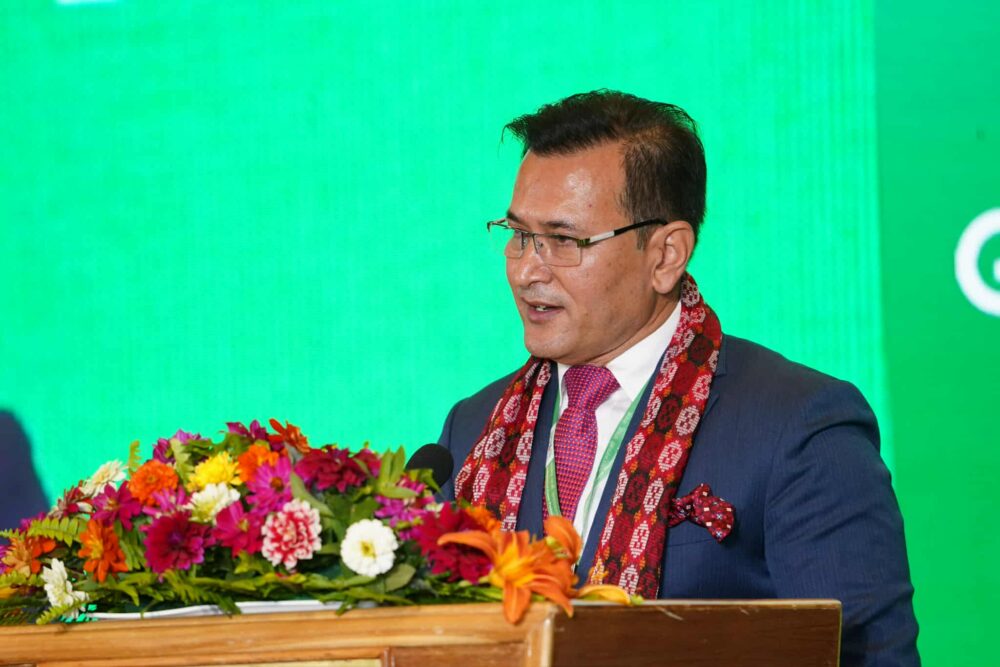
(Speech at the inauguration of the 23rd Annual General Meeting of independent power producers’ association Nepal (IPPAN)



















प्रतिक्रिया दिनुहोस्