India has become the superpower of French fries, how has potato changed the lives of farmers?
लगानी न्यूज
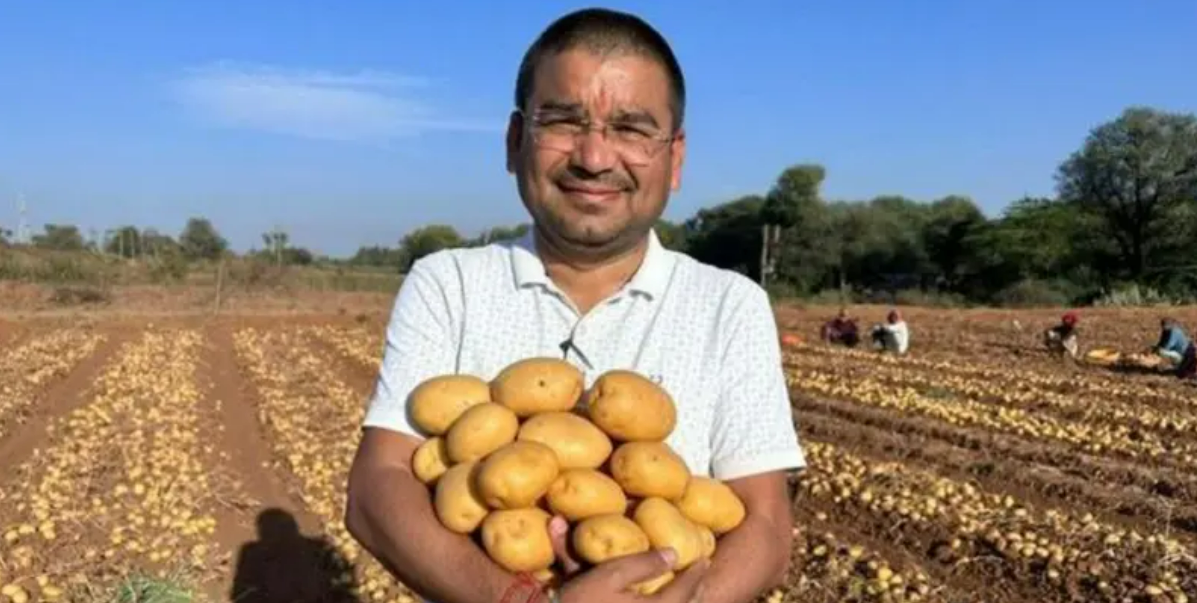
Agency. Jitesh Patel hails from Gujarat, India, from a traditional cotton farming family. The Patel family, which has been cultivating cotton for a long time, had a very low income. Moreover, severe droughts in Gujarat in 2001 and 2002 made the situation even more critical. The Patel family then came to the conclusion that they should look for a new alternative.
TAG_OPEN_div_93 Jitesh Patel says, “We know that we have to plant crops that don’t need a lot of water. ”
Then he started potato farming. Initially, he produced potatoes used for daily consumption, but did not earn the expected income from it. The income from cotton was less than that.
But patel’s life took TAG_OPEN_div_89 a new turn in 2007 when French fries companies stepped into Gujarat. From that time on, he started producing special types of potatoes used in the processed food industry and that decision proved to be very successful. “Since then, I have never looked back,” patel says with a smile.
Second largest country in potato production
India is now the second largest potato producer in the world. TAG_OPEN_div_85 India has made rapid progress, especially with regard to French fries. Gujarat has become like the capital of French fries production. There are huge chip manufacturing factories, including Canadian multinational McCain Foods and India’s largest French fries company Hyphen Foods. Fries made from Gujarat are now being exported all over the world.
Large market potential
According to Devendra K TAG_OPEN_div_81, an expert monitoring the potato market, Asian countries — The Philippines, Thailand and Indonesia — are major export destinations. In February this year, India’s frozen fries exports crossed the 20,000-tonne mark for the first time. A total of 181,773 tonnes of fries have been exported so far, an increase of 45 per cent over the previous year.
The cheap price of frozen fries in India is also a major reason behind this success. Devendra says, “Frozen fries in India are popular in the global market due to cheap prices. ”
The average price TAG_OPEN_div_77 of Indian fries in 2024 is also cheaper than china, he said.
Hyphen’s leadership
According to Haresh Karamchandani, CEO, Hyphen Foods, India has now emerged as a major exporter due to its rich agricultural produce, low-cost production and increasing attention to quality. TAG_OPEN_div_73
Hyphen TAG_OPEN_div_71 has already commissioned seven potato processing plants in Gujarat and plans to add two new plants by 2026. “Due to urbanization, rising incomes and changing lifestyles, the demand for frozen food, both indoors and outdoors, is growing rapidly. ”
Scientific use in farming
Farmers have been trying for decades to meet the growing demand for
. Jitesh Patel, who has studied at the university level in agricultural science, has been doing scientific experiments in farming himself. Together with his friends and family, he has been adopting new methods of potato production. “We are educated farmers, so we are constantly experimenting with new ones,” he says.
In 2003, Patel implemented a drip irrigation system on his farm. He has started the practice of giving rest to the fields in the summer and using cow dung from the cowshed as organic manure. He is currently looking for a suitable potato variety for the soil and weather of his farm. “We’re experimenting with seeds, and soon we’ll have a new type of species,” he says.
Advanced irrigation and seed technology
Jain Irrigation Systems TAG_OPEN_div_63, India’s leading agricultural technology company, is engaged in the development of improved seeds of other crops, including potatoes, selling irrigation equipment. The company clones advanced varieties of potatoes using a technology called tissue culture, which helps to produce seeds with immunity properties. In this technique, potato tissue is grown in a sterile environment in the laboratory, from which seeds are produced. Vijay Singh, vice-president of marketing of the company, said that a lot of care is taken in seed production.
Currently TAG_OPEN_div_61, Singh is battling a major problem. Due to the high amount of sugar in the potato variety used in the manufacture of chips, there is a problem of looking black when cooked. “Tissue culture companies like ours are trying to develop new species to address such problems in the industry,” he said.
Challenge in infrastructure
Indian farmer TAG_OPEN_div_58 s are working to improve production, but the frozen food industry still feels the need for investment. In particular, there is a lack of infrastructure to store potatoes in temperatures below zero degrees celsius and deliver them to customers on time.
According to Vijay Kumar Nayak TAG_OPEN_div_56, co-founder of Indo Agri Foods, currently only 10-15 per cent of cold storage in India is suitable for such foods. Rural and remote areas are still deprived of such facilities. After cold storage, another challenge is instant transportation.
“There TAG_OPEN_div_54 is a huge shortage of refrigerated trucks and containers in India. Temperature-controlled transportation is impossible. As a result, frozen food deteriorates. Reliable power supply is also essential for the frozen food industry. “The risk of food destruction has increased due to frequent load shedding in some places, in such a situation, it is challenging to strengthen the supply network of frozen food,” says Nayak.
Farmer towards a brighter future
But Jitesh Patel is happy at his farm in Gujarat. Because the companies that make chips have reached out directly to the farmers. “Gujarat has now become a hub of food processing. Not only me, but many farmers are farming on contract. It has also given us a good income along with security,” he says enthusiastically.












प्रतिक्रिया दिनुहोस्