


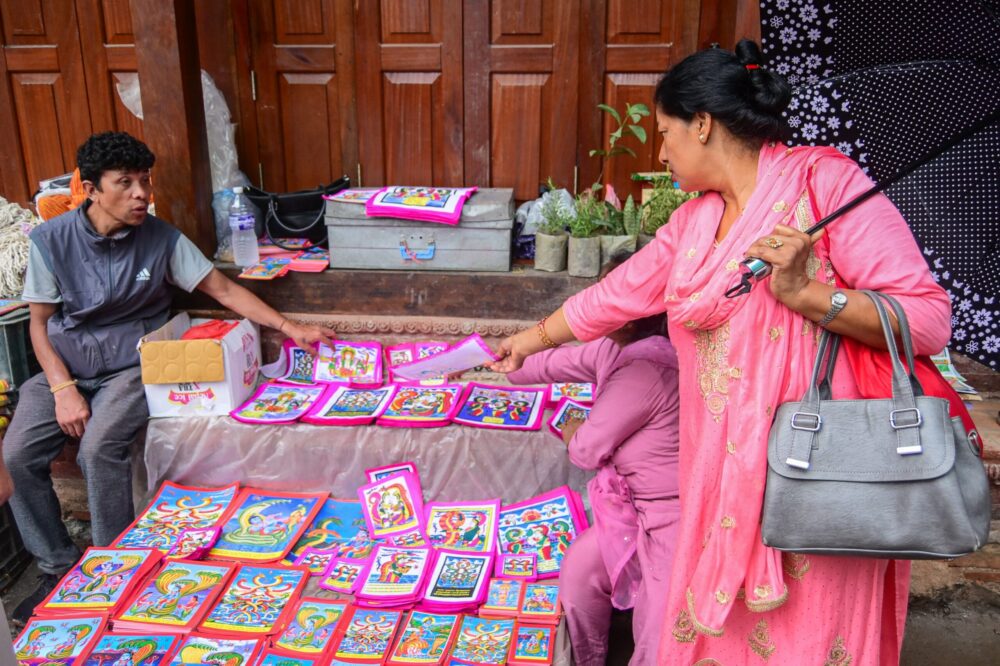
Kathmandu. Nag Panchami is being celebrated today by worshiping the serpent as per tradition and sticking it on the main door of the house. This festival is celebrated every year on the day of Shravan Shukla Panchami.
Religious scholar and member of The Nepal Panchang Judging Committee Prof Dr Devmani Bhattarai said that it is a religious belief that by pasting the picture of the snake in this way, the snake, snake and scorpion will not only cause trouble in the house throughout the year but also avoid the fear of fire, cloud and lightning.
“The practice of nag puja started from the Vedic period. According to Vedic beliefs, the snake is considered the ‘king’ of snakes. If the snake is angry, there is a shortage of water, so there is a tradition of worshiping the snake for water as well. As mentioned in barahapurana, this day is famous for nag puja because of brahma’s dialogue with Nagaraj on Shravan Shukla Panchami,” he said.
There are snakes in every house. Dr Bhattarai said that the tradition of worshiping the snake is continued in the religious belief that if the snake sitting under the foundation of the house gets angry, the foundation of the house will be broken. The practice of considering the serpent as Vishnu and Shiva has been there since vedic times. He said that lord Shiva wears a garland of serpents and Lord Vishnu sleeps on the bed of shesh naag on water with a hooded umbrella, so both the gods are considered as serpents.
Lord Ganesh, who has the right to worship first, has a snake in one hand. Shri Ramachandra’s brother Lakshmana and Krishna’s brother Balarama, who were born as incarnations of Lord Vishnu, are also considered as incarnations of Sheshnag. It has been mentioned in various Puranas that both of them were born to help Shri Ram and Shri Krishna, who were born as incarnations of Lord Vishnu to protect the gentleman by destroying the wicked.
It has been described in various Puranas that Shri Krishna suppressed Kalinag as a child. The statue of Buddha, who was born as the ninth incarnation of Lord Vishnu, has the shape of a snake in the form of a crown on his head. Matsyendranath has a garland of Karkotak nag on his neck. Jain tirthankaras also have a serpent-shaped crown on their heads.
It is mentioned in the Scriptures that Pandu’s sons Arjuna and Chandragupta II married Nagkanya. Dr Bhattarai said that it has been believed in our society since time immemorial that Lakshmi resides in the house in which the snake is worshiped.
There are various legends about how and why Nag Panchami was celebrated. One of these is a famous legend. A farmer was digging his field when he found three cubs and killed them. When the child’s mother came looking for shelter, she was angry with the farmers when she saw that all her children were dead. Nagini, who was angry, immediately killed the farmer but did not get rid of the anger, so she went to the farmer’s house and killed his wife and two sons.
Incidentally, the farmer’s daughter managed to escape as she was out of the house. Nagini also searched for the farmer’s daughter and found her on the way and tried to kill her. Nagini kindly left the farmer’s daughter after the farmer’s daughter pleaded in many ways that I would worship you and let her eat milk.
The farmer’s daughter, who was happy to be saved from the face of death, worshiped Nagini with shodashopachara and also gave milk in the bowl. Nagini, who was pleased with the prayer of the farmer’s daughter, said that I was happy with your devotion, after which she took the opportunity and asked for a boon to give life to my parents and brothers.
A delighted Nagini saved the farmer’s family by saying tathastu. According to religious scholar Prof Dr Bhattarai, the day nagini saved the farmer’s family is Shravan Shukla Panchami i.e. today, so it has been a tradition of worshiping the snake and sticking it at home since that time.
Guru Gorakhnath sat on the seat of nine serpents and did penance for twelve years and thus there was no rain while pressing the serpent, so Guru Matsyendranath of Gorakhnath was called to Nepal. It is also mentioned in the scriptures that after gorakhnath got up from the guru’s arrival, he showered water free from the serpent.
The snake wears the most precious gem in the world on its head. Nag loves the fragrance and music of Shrikhand. It is also believed that the snake, which lives in the summer, comes out on Shravan Shukla Panchami i.e. this day due to the coolness of the rainy season.
Although there are twelve names of serpents, there is a tradition of worshiping eight serpents of eight clans since Vedic time. On this day, eight serpents namely Ananta, Vasuki, Padma, Mahapadma, Takshak, Kulir, Karkat and Shankh are worshiped by the Brahmin priest and hung on the door of the house. On this day, it is believed that after planting a snake in the house, one should not dig in the fields and do not kill snakes, snakes and other animals.
Today, special worship is performed at Nagpokhari and Taudaha of Kathmandu, Siddhapokhari of Bhaktapur and Nagdaha, Kund and Nag places across the country.
It is believed that the sage established the tradition of worshiping the snake species after scientific research confirmed that the poisonous substances present in nature are exploited by snakes, snakes and other creatures and do not affect humans and other species. After Nag Panchami, the festival season of Vedic Sanatani Hindu religion begins.



















प्रतिक्रिया दिनुहोस्