


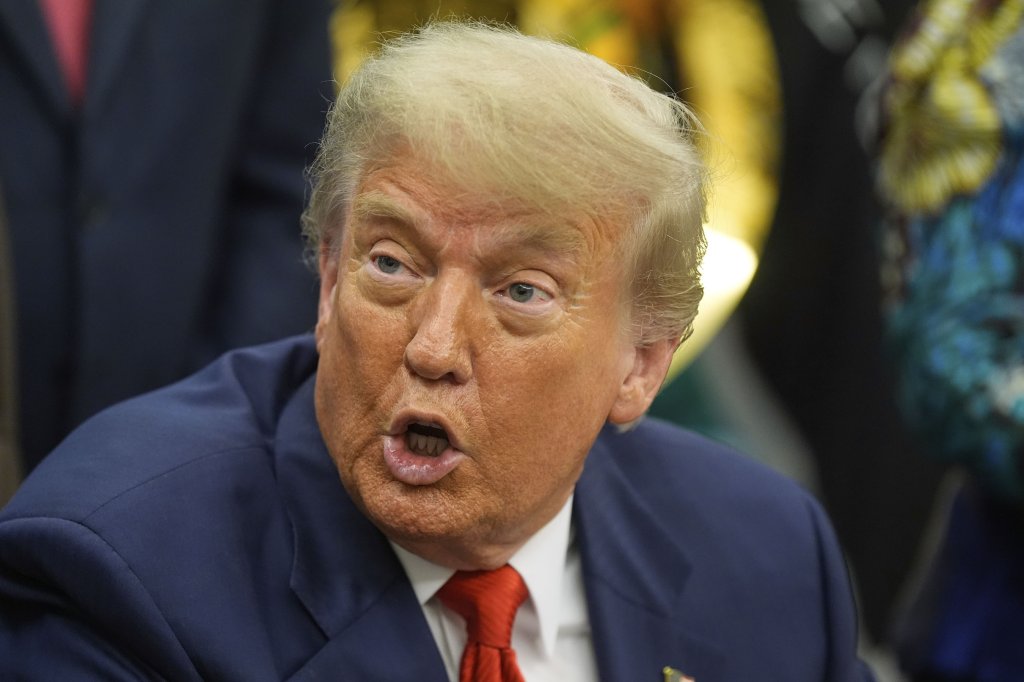
Washington. Us President Donald Trump began imposing high import tariffs in dozens of countries on Thursday. However, the economic consequences of his months of tariff threats have begun to create visible damage to the U.S. economy.
After midnight, goods from more than 60 countries and the European Union (EU) came under customs duty of 10 percent or more. Products from the EU, Japan and South Korea are taxed at 15 per cent, while imports from Taiwan, Vietnam and Bangladesh are taxed at 20 per cent. Trump also expects the EU, Japan and South Korea to invest hundreds of billions of dollars in the United States.
“I think this growth will be unprecedented,” Trump said on Wednesday afternoon. But he could not give a definite figure for revenue. “We don’t even know what the final number is in terms of customs rates,” he said.
Despite the uncertainty, the Trump administration is confident that the introduction of his sweeping tariffs will provide clarity about the path to the world’s largest economy. Now that companies understand the direction america is heading, the administration believes they can increase new investments and start jobs that can rebalance the U.S. economy as a manufacturing power.
But so far, as both companies and consumers prepare for the impact of the new taxes, there are signs of self-made wounds in america. What the figures show is the US economy, which changed with Trump’s initial rollout of tariffs in April. It was an event that led to market drama, negotiation periods and Trump’s final decision to launch his global customs on Thursday.
John Sylvia, CEO of Dynamic Economic Strategy, said economic reports show that jobs have stopped, inflationary pressures have risen and home prices in key markets have started to decline since April.
“A less productive economy requires fewer workers,” Sylvia said in an analysis note, “but there is more, higher customs prices reduce the real wages of workers.” The economy has become less productive and companies cannot afford to pay real wages as before. The action results. ’
Still, the final changes to customs are unknown and may play out in months, not years. Many economists say the U.S. economy risks slowing down rather than collapsing immediately.
“We all want it to be made for television where it’s an explosion — it’s not like that,” said Brad Jenson, a professor at Georgetown University. ’
Trump has consistently promoted customs duties as a way to reduce the trade deficit. However, importers tried to evade the tax by importing more goods even before the tax was imposed. As a result, the $582.7 billion trade imbalance in the first half of the year was 38 percent higher than in 2024. Total construction spending fell 2.9 percent compared to last year, and factory jobs promised by Trump have so far resulted in job losses.
The leadership as of Thursday fits the chaotic nature of Trump’s customs, which have been rolled out in various forms, retreated, delayed, increased, imposed by letters and hysterically re-negotiated.
The process has been so chaotic that officials at key trading partners were unclear whether customs would start on Thursday or Friday at the start of the week. The language of the July 31 order delaying the start of customs from August 1 says that higher tax rates will start in seven days.
On Wednesday morning, Kevin Hassett, director of the White House National Economic Council, was asked if the new taxes began at midnight on Thursday and said journalists should check into the U.S. Trade Representative’s office.
On Wednesday, President Trump announced an additional 25 per cent tariff on oil imported from Russia, taking the total import duty to 50 per cent.
New Delhi: India’s top exporters’ body on Thursday said the latest US tariffs will impact nearly 55 per cent of the country’s external shipments to the US and force exporters to lose their long-term customers.
“It is not practical to absorb this sudden increase in costs. The margin is already thin,” S C Ralhan, president of the Federation of Indian Export Associations, said in a statement.
Import duties on pharmaceutical products are still coming and Trump announced a 100 percent tariff on computer chips. This could leave the U.S. economy in place of suspended animation waiting for impact.
The president’s use of a 1977 law to declare an economic emergency to impose customs duties is also under challenge. The judges said the upcoming ruling from last week’s hearing in the US Appeals Court could force Trump to seek other legal justifications if he exceeded his authority.
People who worked with Trump in his first term doubt that everything in the economy will run smoothly. Former Republican House Speaker Paul Ryan, who has emerged as a critic of Trump, expressed such doubts.
“There is no logic for this except that the president wants to raise tariffs based on his whims, his views,” Ryan told CNBC on Wednesday. ’
Nevertheless, the stock market has remained strong during the recent customs drama. The S&P 500 index rose more than 25 per cent from its April low. The revival of the market and income tax cuts on Trump’s tax and spending measures, signed into law on July 4, have given the White House confidence that economic growth will accelerate in the coming months.
So far, Trump still predicts an economic boom. However, the rest of the world and American voters are anxiously waiting.
“There’s one person out there who can be careless about the uncertainty he’s creating and that’s Donald Trump,” said Rachel West, a senior fellow at The Century Foundation, who works on labor policy at the Biden White House. ’

















प्रतिक्रिया दिनुहोस्