


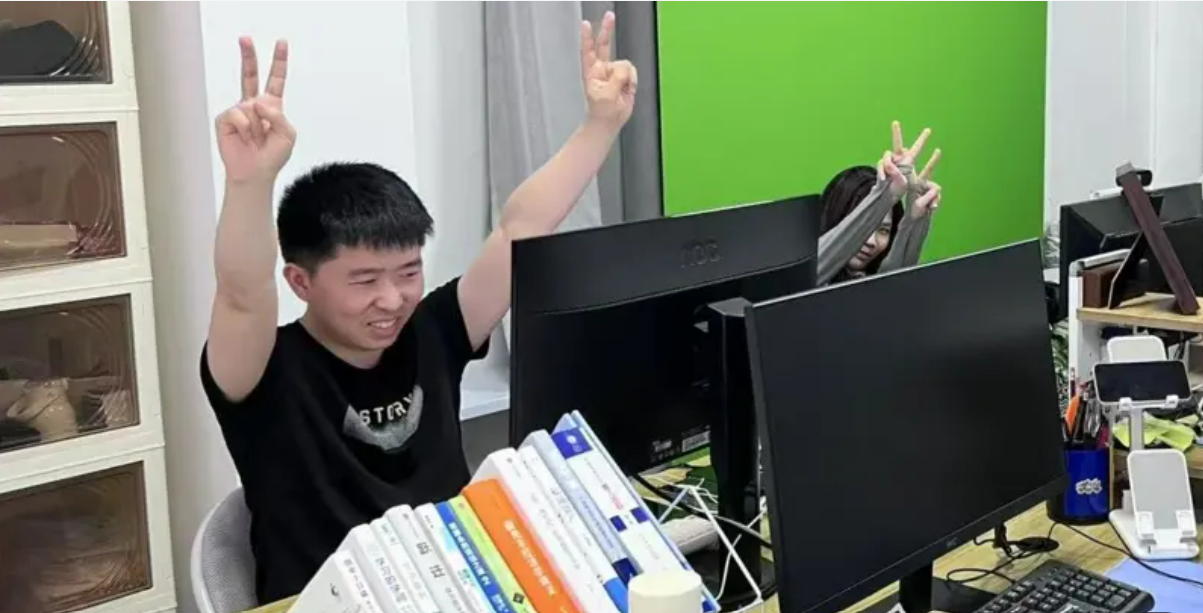
BBC. No one wants to work without pay, and even worse is to give money to their own accommodation to do the work.
But in China, there is a growing trend among young people and the unemployed to pretend that they work for them by paying for them. The number of companies providing such services is also increasing.
This trend has increased amidst China’s slowing economy and the job market. Since it’s hard to find a real job now, some think it’s better to pay for money than to stay at home empty.
Shui Zhou, 30, lost his food business last year. In April this year, he started paying 30 yuan ($4.20) a day to the ‘Pretend to Work’ company that operates a fake office in Dongguan city. Dongguan is 114 kilometers north of Hong Kong.
Shui lives there with five ‘colleagues’, all of whom are doing the same thing. Shui says, “I feel happy. It feels like we are working together in a group. ”
Such fake offices are now opening in many big cities of China. These include cities such as Shenzhen, Shanghai, Nanjing, Wuhan, Chengdu and Kunming. They often look like full-fledged offices, with computers, internet connections, meeting rooms, and tea-coffee rooms.
Not only can those who stay in these offices spend time, they can also try to find jobs using computers or start their own startups. It costs 30 to 50 yuan per day. Sometimes lunch, snacks and some drinking materials are also available at the same fee.
The popularity of such offices has increased at a time when the unemployment rate of youth in China is more than 14 percent. This means that even people who have graduated from the best universities are struggling for jobs.
According to Chinese government data, the number of graduates entering the job market this year is expected to reach 12.2 million. This is the highest number so far.
Dr Christian Yao, a senior lecturer at the School of Management at Victoria University of Wellington in New Zealand, is an expert on China’s economy. He says, “It has become very common now that economic change, the imbalance between education and the job market, young people need places where they can think about their future or work small during the transition.” ”
Dr. Christian Yao says, “Companies pretending to work are one such temporary measure. ”
Shui Zhou came to know about the company that “looks like it works” on social media platform Xiaohongshu. According to him, he felt that the environment in the office would improve self-discipline. Shui has been going there for more than three months.
Shui sent office photos to his parents, and he says his parents now worry less about his employment than ever before.
Although there is no fixed time to come and go, Shui usually reaches the office between 8 a.m. and 9 a.m. Sometimes he stays there until 11 p.m. and doesn’t return home until the manager of the company leaves.
He says other people there have now become his friends. According to Shui, when someone is busy looking for employment, he works hard, but in his free time, he does everything, chats, jokes and plays sports. They usually eat together after work. Shui loves this ‘team spirit’ and is happier now than ever.
What is the reason for coming to the fake office?
Xiaowen Tang hired a workstation from a company that appeared to have worked for a month in Shanghai earlier this year. Tang, 23, graduated last year and has yet to find a permanent job.
According to his university rules, within a year of graduation, students must enter into employment contracts or give an internship certificate, otherwise they will not receive a diploma certificate.
Xiaowen Tang sent a photo of the office to the university as proof of the internship. In fact, Tang used to sit there for the fake office’s daily fees and write online novels, which earned her some money. Tang says, “If you have to do drama, do drama till the end. ”
Dr. Biao Xiang, director of the Max Planck Institute for Social Anthropology in Germany, says that the tendency to “look like working” in China stems from a sense of “frustration and helplessness” resulting from a lack of employment.
“A working drama is something that young people seek for themselves, so that they can create some space for themselves by distancing themselves from mainstream society,” he says. ”
Feiyu, the owner of a company that “looks like it works” in Dongguan city, is 30 years old. “I’m not selling workstations, but I’m selling respect and telling you that you’re not a useless person. ”
Feiyu had also faced unemployment in the past. His retail business was shut down during the Covid pandemic. “I was very depressed and a little suicidal,” he recalls. He says, “You want to change the situation, but you are helpless. ”
In April this year, he advertised ‘Pretend to Work’ and within a month all the workstations were filled. Now new interested candidates will have to apply. Feiyu says 40 percent of his clients are recent graduates. These people come here to show their old teachers proof of internship, while some of the remaining customers come here to deal with parental pressure.
The remaining 60 percent of the customers are freelancers. Many of them are digital nomads. Among them are those who work for big e-commerce companies and write online content. The average age of customers is about 30 years, while the youngest customer is 25 years old.
Officially, such people are called ‘Flexible Employment Professionals’. This includes ride-hailing and truck drivers.
Feiyu says there are doubts about whether this business will be profitable in the long run. Instead, he wants to see it as a social experiment. “It’s a lie to preserve respect, but it gives some people a chance to find the truth, if we’re just helping to enhance acting skills from it, we’re confused,” he says. ”
He says, “Only then will this social experiment be truly successful, if we help turn their fake office into a real beginning.” Shui Zhou is now spending most of his time improving AI skills.




















प्रतिक्रिया दिनुहोस्