


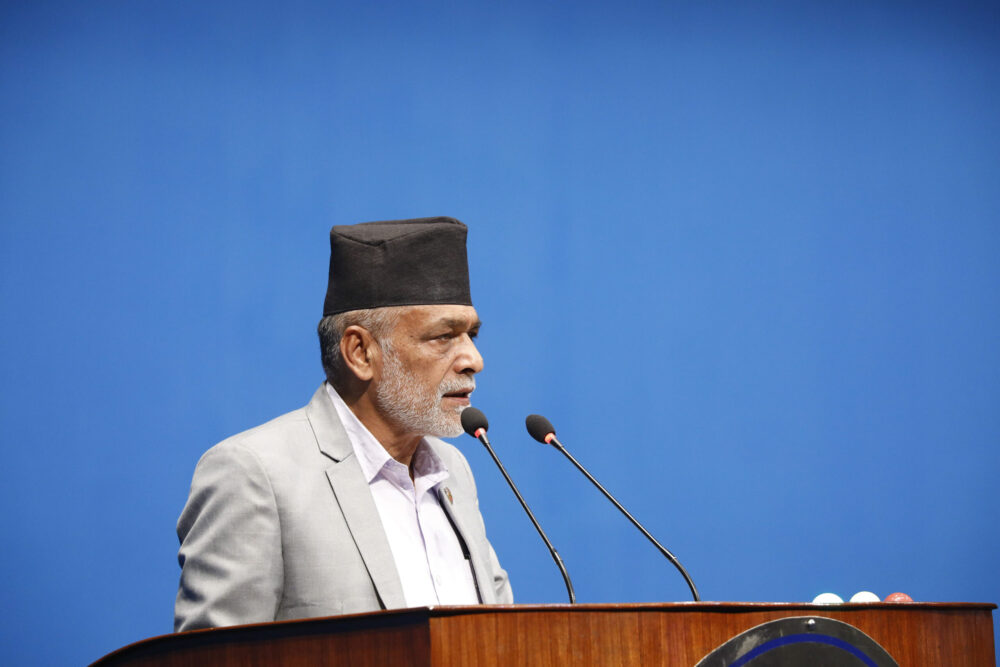
Kathmandu. Minister for Agriculture and Livestock Development Ramnath Adhikari has said that ease of supply of fertilizers is a top priority. In a meeting of the House of Representatives today, he said the main task of the ministry was to ease the supply management of chemical fertilizers to be distributed on subsidy.
“In the last one year since I took charge of the ministry, the supply of fertilizers has improved significantly and legal and procedural reforms have been made to ease the supply and distribution system,” minister Adhikari said. ’
According to him, the annual demand for fertilizer is around 1.3 million tonnes. Stating that the government has plans to supply 600,000 tonnes in the current fiscal year, Minister Adhikari said that the budget available could not bring fertilizers to meet the demand due to excessive subsidy on fertilizers.
At present, there is 82 per cent subsidy on urea, 64 per cent on DAP and 49 per cent on potash fertiliser. Arrangements have been made to distribute 90 per cent of the fertilizer procured on a scientific basis through the state government so that it will be supplied more,” he said, adding, “The quota of the state will be determined on the basis of cultivable land, the condition of irrigation facilities, crop density, the status of consumption of fertilizers in the past and the quantity demanded now.” The remaining 10 per cent is kept as buffer stock and that too on the recommendation of the Provincial Fertilizer Management Committee. In this way, the quota allocated to the state is allocated to the local levels on the basis of the fertilizer. ’
According to him, cooperatives and agrovets and private firms, which have taken more than 11,000 dealerships from 64 fertilizer depots across the country, take the fertilizer and sell it to the farmers. Around 2,000 to 2,500 metric tons of fertilizer dealers are still receiving from the depot every day.
Minister Adhikari shared that initiatives have been taken to amend some provisions of the Public Procurement Act, 2063 BS in view of the impractical provisions of the Fertilizer Purchase Act, 2063 BS.
He said that now all the process related to purchase and distribution of fertilizers can be monitored online, orientation has been started directly and virtually with the concerned officials of the state and local levels about the implementation of the working procedure and fertilizer management information system.
“This year, we have imported a total of 491,000 metric tonnes of fertilizer, which is an all-time high. Similarly, for the first time, almost all of the fertilizer subsidy budget received by the ministry (Rs 26.83 billion out of Rs 27.36 billion) has been spent, which comes to 98 percent. However, there is a situation where chemical fertilizers are not available as per the demand of the farmers,” said Minister Adhikari, adding that tenders for 300,000 tonnes have already been floated for this fiscal year after obtaining source consent from the Ministry of Finance. Although the supply of DAP and potash fertilizers is good at this time, the situation of urea supply is somewhat weak. ’
According to him, the demand for fertilizers has increased more than three times in the last two decades, so the consumption of fertilizer has increased with the expansion of commercial agriculture and the consumption and demand of fertilizers has increased significantly with the increase in the cultivation of hybrid maize and hybrid rice.
“Although subsidized fertilizers are targeted for crops like rice, wheat and maize, which are considered important from the point of view of food security, there is a high demand for fertilizers for tea, sugarcane, banana, fisheries, etc. these days. Similarly, chemical fertilizers are also used in grass and jungle niguro,” minister Adhikari said, adding, “On the other hand, at least eight fertilizer factories have been destroyed due to the recent Israeli-Iranian war, which has affected the global fertilizer supply chain.” At the same time, large fertilizer-producing countries have tightened fertilizer exports, and the price of fertilizers in the international market is increasing high due to the increase in the price of natural gas. ’
According to him, the international market price of urea fertilizer, which was around $ 420 per tonne last year, has now crossed $ 600.
According to Minister Adhikari, the smooth supply of fertilizers is challenging as the price of fertilizers may increase further in the coming days and the supply of fertilizers in the international market may decrease.
According to him, the Ministry is preparing a strategy and action plan for sustainable supply and distribution management of fertilizers and organic farming campaign.

















प्रतिक्रिया दिनुहोस्