


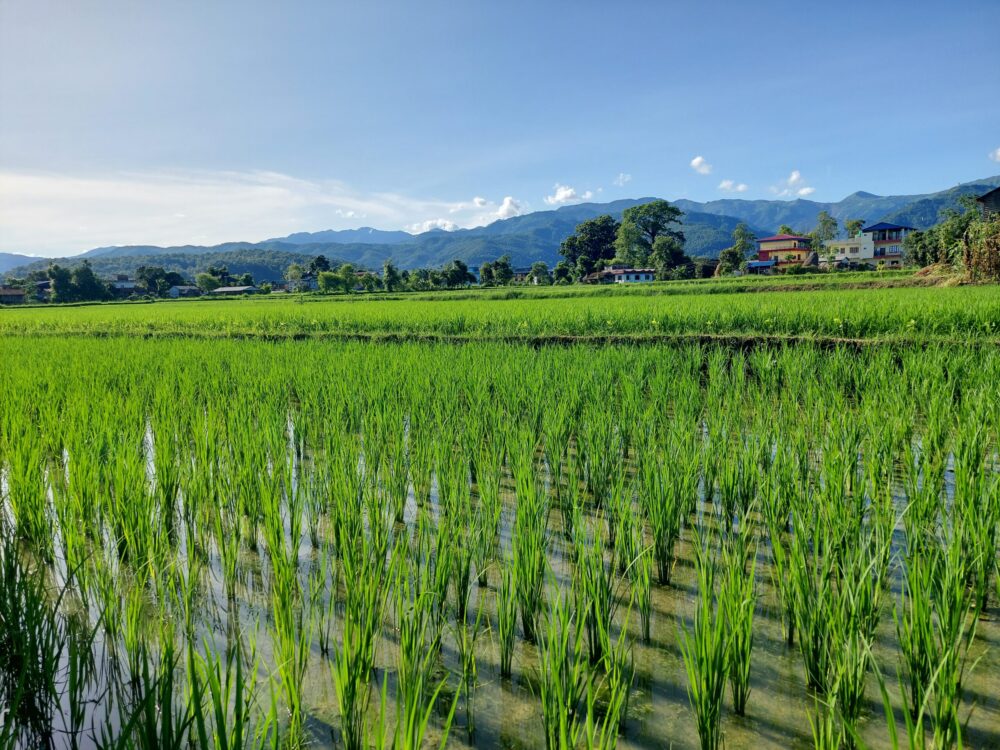
Mahottari. Around 75 saplings have been planted in Mahottari due to favourable rainfall in the last week of July. Paddy has been cultivated in about three parts of the land after heavy rains in the last week of July. According to agriculture knowledge centre Mahottari office, only 30 per cent sowing was done till the second week of July, which has reached around 45 per cent by the end of the third week.
Information Officer at the Office, Aviral Kumar Mahato, who is also a crop expert, said, “In the last week of July, the sky water also supported, the farmers made a lot of use of the options of underground water resources, it helped to increase the sowing.” Paddy sowing in Mahottari, which lags far behind other districts of Madhes, has gained momentum since the beginning of the third week of July. Motor pumps and pumpsets from wells, deepborings and shallow tubewells brought relief to the farmers who were planting saplings.
“Till the second week of July, we had to run more than three hours of motor pumps and pumpsets to stir a kattha, but since then it started raining a little bit, it became easier as the drawn water started coming quickly,” said Sanischar Bantar of Siddhapur of Bhangaha-5. The local farmers here are now happy that the sowing has also been completed in their settlement. Since mid-July, the farmers here are now hopeful of paddy entering the country due to the daily water. Farmers say that the rain after mid-July has become like nectar for paddy cultivation. Ram Narayan Jha, a neighbour of Bantar, said, “Paddy was sown due to sorrow. ’
Although planting in the far north, eastern and central parts of the district is good, there is still insufficient water in the southwestern region. Out of the 15 local levels in the district, five municipalities, including Manarashishwa, Samsi, Ekdara and Sonma÷ are facing water scarcity. “We did not have water, the underground water resources were not reliable, so the sowing took place after planting,” said Chandra Bhushan Mauwar of Sandha Basti of Manarashishwa Municipality. ’
In some parts of the district, farmers have planted paddy in most parts of the district. Information Officer at the Agriculture Knowledge Centre, Mahottari, Mahato, said, “With the onset of the third week of July, the sowing has gained momentum after it started raining a little bit, and the farmers have increased the pace of planting as the irrigation of groundwater has become easier and less expensive after the rain started raining.” According to Mahato, the rain in the last week of July has brought a lot of relief to wake up the paddy planted earlier and increase the sowing. So far, 33,350 hectares of land has been planted in the district. This is about 75 percent of the total 45,000 hectares under paddy cultivation.
According to farmers, water drawn from wells, shallow tubewells and deepborings since mid-July has helped to move more fields in less time. According to the farmers, the water drawn underground has helped to move the fields quickly. Ram Autar Mahato, a farmer of Premnagar of Bardibas-7, said, “Somehow paddy was sown, the water drawn from motor pumps and pumpsets was mixed with rain. According to Mahato, it has been raining almost every day since July 15 and there is hope that paddy will enter the house as soon as the saplings of the previous fields have turned green.
Even after the end of July, the farmers are still stuck in planting. According to agriculture experts at the Agriculture Knowledge Centre, Mahottari, the sowing will continue for a maximum of two÷ to three days. Information Officer at the Office, Mahato, said that considering the preparedness of the farmers, the planting is expected to reach 80 percent.
However, crop experts have advised the farmers not to extend the sowing of the original seed for more than one÷ or two days if the crop is not grown this time. This time, due to the prolonged drought, the farmers are still sowing the seeds that should be planted by July 15. According to the farmers, they still have to plant seeds as the previous saplings were not planted. This time, the farmers had to keep the bed repeatedly when the seeds dried up several times in the bed. Later, due to lack of seeds, some farmers could not increase the sowing even when the water was favorable.
Agriculture experts have advised the farmers to be aware of the possibility of an unnatural outbreak of pests and diseases as the sowing has been delayed this time and seek immediate advice. Similarly, Information Officer Mahato, who is also an agriculture expert, advised the farmers to pay immediate attention to the management of weeds in the saplings before mid-July.
The established schedule of winter paddy cultivation in Madhes including Mahottari has been lagging behind due to lack of water and lack of reliable seeds on time. There is a traditional schedule to plant a bed for winter paddy cultivation by the third week of May, the first royal seed seed can be planted by the third week of June and kharuan (pen, paddy seed seed will be planted after planting it) by mid-July.
The farmers said that they had to eat hunder due to lack of water, seeds and fertilizers in this schedule. The farmers have demanded the government of all three tiers to ensure an environment with water, fertilizers and seeds required for paddy cultivation on time.

















प्रतिक्रिया दिनुहोस्