


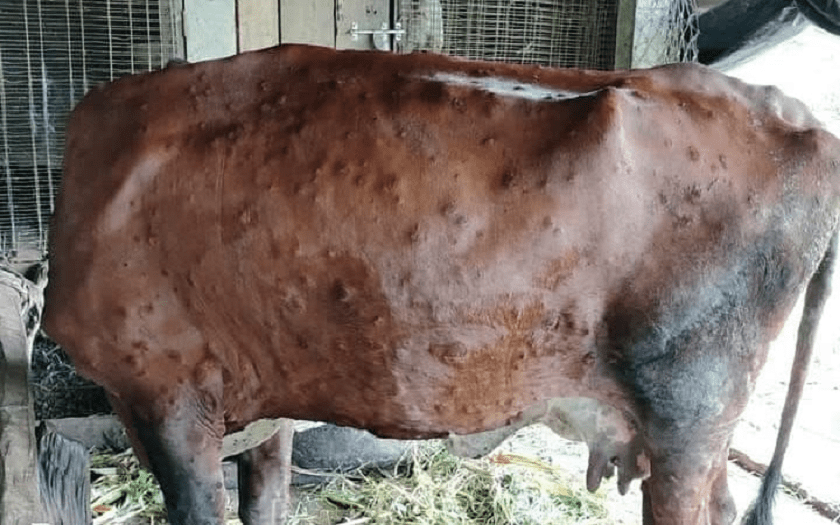
Kavrepalanchowk. In some wards of Banepa municipality, ‘lumpy-skin’ infection has been detected in cattle. According to the Animal Service Office, Kavrepalanchowk, the infection has been confirmed in some milch animals of ward no. 12 and 14.
Dhulikhel, Panchkhal and Mandandeupur of the district have also been found infected and samples are being collected to send them to the laboratory for testing. Taraman Tamang, a technician at the office, said that for the past six months, 25 local level animals of Kavrepalanchowk and Sindhupalchowk districts have been vaccinated against lumpy skin.
One cow in ward no. 11 and one cow in ward no. 12 of Banepa tested positive for lumpi-skin, said Chiranjeevi Sharma, chief of the municipality’s animal service section. According to him, after the lumpy-skin infection was confirmed in the animals of these two places, the cows and buffaloes around the area have been repeatedly vaccinated. Sharma said 16,000 animals in Banepa municipality were vaccinated against lumpy skin in the last six months.
According to the District Livestock Service Office, 1,274 animals out of 28,656 animals infected with lumpy skin died in Kavrepalanchowk last year. Some of the 13 local levels in the district had provided relief to the farmers who had lost their livestock.
The disease was first confirmed in Morang in 2077 BS in Nepal. Since then, milk production has decreased drastically due to the spread of the disease in different districts of all the seven provinces of Nepal. According to Dr Prakash Adhikari, the ability to give milk to cows and buffaloes infected with this disease decreases by up to 70 percent.
If the disease is seen in cows and buffaloes, symptoms of fever, nausea, low consumption of food, decreased milk production, severe roundness of one to five centimeters on the skin, lesions inside the lips, mouth and nose, excessive amount of fluid coming from the eyes and nose, resin removal, hearing of lymph nodes and eventually death.
Similarly, the virus that causes lumpy skin disease survives for a long time in the environment of the shed. Proper burial or burning of animals that have died due to this disease should be done as soon as possible. Insects such as mosquitoes, insects, and fleas transmit the disease from diseased animals to healthy animals.
The disease, which is more common during the rainy season, can be transmitted through the direct infection of organic juices such as pus, blood from the horns, milk and wounds of the sick animal. It has also been found that the disease is transmitted through transportation of infected cattle, community grazing areas and food and water eating areas, natural or artificial insemination.

















प्रतिक्रिया दिनुहोस्