


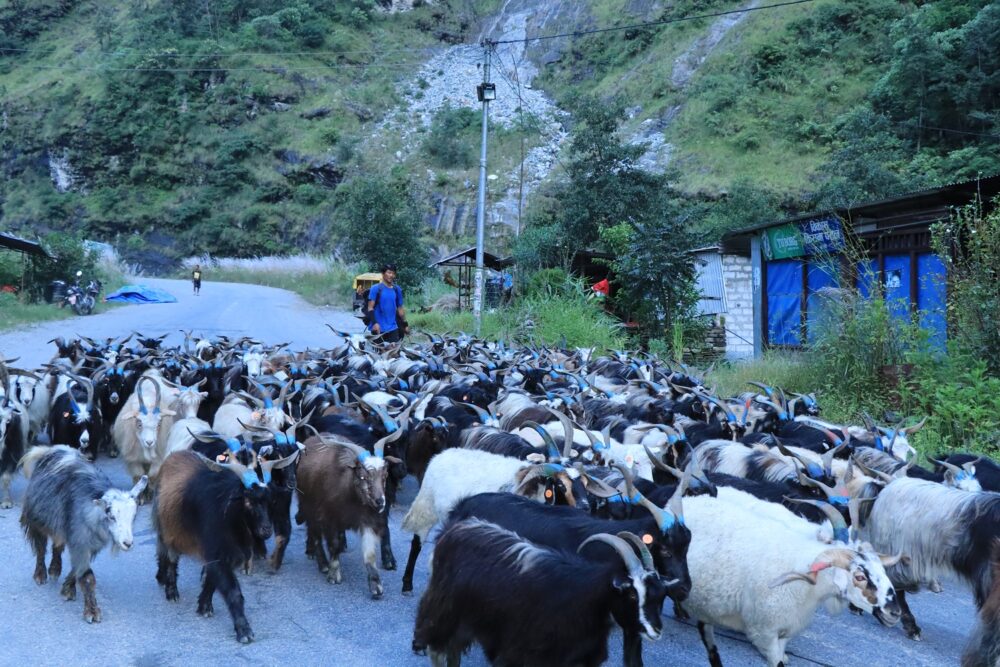
Myagdi. As the Dashain festival approaches, the sheep and mountain goats reared in the mountainous region have started declining. Farmers and traders have reached different markets of the country with flocks of sheep and mountain goats. When the mountain sheep and mountain goats come down to the market, the Dashain festival gives a glimpse of the arrival.
The sheep and mountain goats brought from Mustang to Baisari of Raghuganga Rural Municipality in Myagdi via Beni-Jomsom road route are being transported in trucks and containers to Pokhara and Kathmandu and other big cities. As of Thursday, 1,300 sheep and mountain goats have been supplied to Kathmandu and additional 1,700 are in the process of being delivered, said Gyan Kumar Shrestha, founding president of Nepal Cattle Purchase and Sale Association.
“Mustang, Jumla and Dolpa are the main source of sheep and mountain goats that come to Kathmandu, Pokhara, Chitwan and Butwal for the Dashain festival,” said Shrestha, who has been selling sheep and mountain goats for the past 20 years. ’
A team led by Shrestha has reached Baisari of Myagdi on Thursday to transport 465 sheep and mountain goats from Namgyal of Lomanthang rural municipality-3 in Mustang district. Sanjay Budha, a resident of Kaike Rural Municipality-2, Sahartara, said that he had trekked for 25 days to Pokhara to sell 160 mountain goats.
“We have come to sell the mountain goats reared by the farmers at an altitude above four thousand meters above sea level,” he said, adding, “It has been our traditional occupation to take the mountain goats to the market by walking them through cliffs, streams and narrow roads.” ’
Traders from Dolpa, Jumla and Upper Mustang are busy selling sheep and mountain goats while traders from different cities of the country are bustling in Jomsom. In Mustang, mountain goats are sold for Rs 32,000 to Rs 37,000 depending on the size. Shrestha said that the live mountain goats will be sold at Rs 1,300 per kg when they reach Kathmandu last year.
The Mustang-based Veterinary Hospital and Livestock Service Experts Centre has estimated that 3,000 sheep and mountain goats would be sold from Dolpa and Jumla this year. Chief veterinary doctor at the centre, Lalmani Aryal, said arrangements have been made for sending the sheep and mountain goats to the market after examining their health in Jomsom.
On the occasion of festivals, it is customary to consume the meat of mountain mountain goats grazed in a herb-rich bookie. Mountain goats up to the age of five years are considered to be consumed for meat. Tenzing Gurung, a farmer of Namgyal in Mustang, said he is making a living from mountain goat farming. He said he sold 50 mountain goats this year. Pokhara is a big market for Mustang sheep and mountain goats. Sheep and mountain goats are also consumed in the markets of Myagdi, Baglung, Parbat, Syangja, Tanahun and Lamjung.
As many as 50,000 mountain goats have been reared in Waragung Mukti Chhetra, Gharpajhong, Loghekar Damodar Kund and Lomanthang rural municipalities of Mustang. Mountain goat farming is the main source of income for farmers in Upper Mustang. The fur that comes out of the body of the mountain goat is used as a raw material for pashmina. The main challenge for mountain goat farmers is to protect them from the attacks of snow leopards and buffaloes.
Similarly, there is a shortage of food for sheep and mountain goats as grass has grown less in the mountainous region due to lack of snowfall. There is also the problem of sheep and goats dying due to lack of food due to excessive snowfall in winter.













प्रतिक्रिया दिनुहोस्