


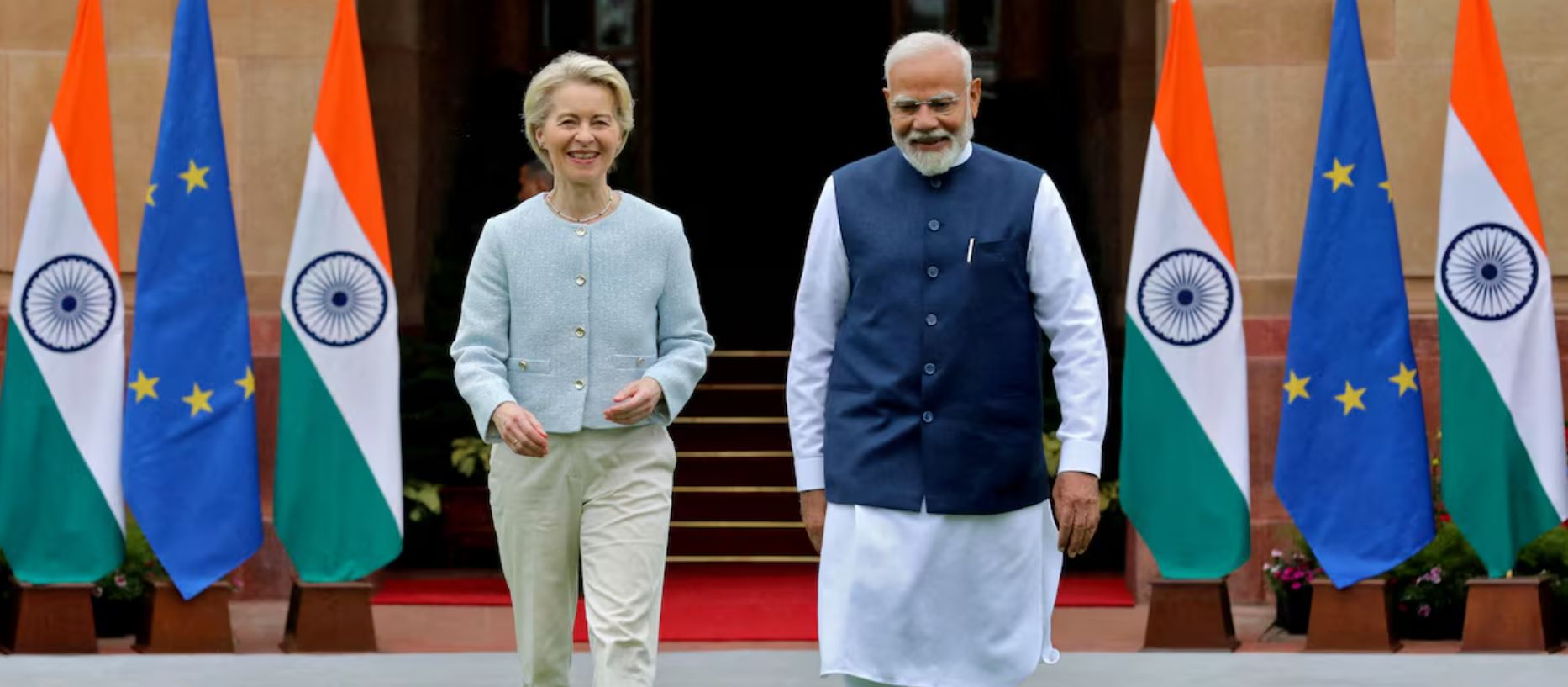
Kathmandu. After nearly two decades of negotiations between India and the European Union (EU), a much-awaited trade deal has finally been concluded. In a high-level meeting in New Delhi on Tuesday, the leaders of both sides prepared to formalise the agreement, describing it as the “mother of all agreements”.
European Commission President Ursula von der Leyen and European Council President Antonio Costa met Prime Minister Narendra Modi on Tuesday morning. Prime Minister Modi said the agreement signed on Monday will help both India and the EU to deal with challenges posed by the world’s two major economies — the United States and China.
“People around the world are looking at this agreement as the mother of all agreements,” Modi said before the meeting in New Delhi. According to him, this agreement will open up new possibilities and opportunities for about 1.4 billion citizens of India and millions of people of the EU. The Prime Minister noted that the agreement represents around 25 per cent of global gross domestic product and around one third of the world trade.
The EU leaders, who attended India’s Republic Day parade as chief guests on Monday, held official talks with Prime Minister Narendra Modi on Tuesday morning. The EU sees India, the world’s most populous country, as an important and strategic market for the future.
At the same time, New Delhi sees the EU as a key source of investment needed to boost its fast-growing infrastructure, technology transfer and create millions of new jobs. The agreement is expected to further strengthen the mutual dependence and trust between the two sides.
Bilateral trade in goods between India and the EU reached 120 billion euros (about $139 billion) in 2024, EU data showed. That’s an increase of nearly 90 percent over the past decade. In addition, there was an additional transaction of about 60 billion euros (969 billion euros) in the services business.
Under the agreement, India is expected to further open up its market to key European products such as cars and wine, on the condition that products in sectors such as textiles and pharmaceuticals get easier access to the European market. President von der Leyen said the EU will have the highest level of access to the traditionally protected Indian market and hoped European exports to India would be doubled.
According to him, the agreement will give the EU a significant competitive advantage in key industrial and agricultural commodity sectors. For India, key industries such as textiles, gems and jewellery, leather goods, and services will get a big boost, he said.
The EU is expected to reduce tariffs on automobiles, wine and food exports to India. However, sources familiar with the talks said some of the more complex issues such as the EU’s carbon cap tax on steel were discussed intensively until the last minute.
The deal comes at a time when both Brussels and New Delhi are looking for new and reliable markets amid pressure from US tariffs and Chinese export controls. It is also expected to sign a separate agreement on security and defence cooperation to facilitate movement of seasonal workers, students, researchers and highly skilled professionals.
“India and Europe have made a clear choice — a strategic partnership, a choice of dialogue and openness,” President von der Leyen wrote on social media. ”
According to the International Monetary Fund, India is moving towards becoming the fourth largest economy in the world this year. India, which for decades relied on Moscow for key military equipment, has in recent years been trying to reduce its dependence on Russia by diversifying imports and ramping up domestic production. The agreement is strategically important for both sides as the EU seeks a similar balance in its dependence on the United States.















प्रतिक्रिया दिनुहोस्