



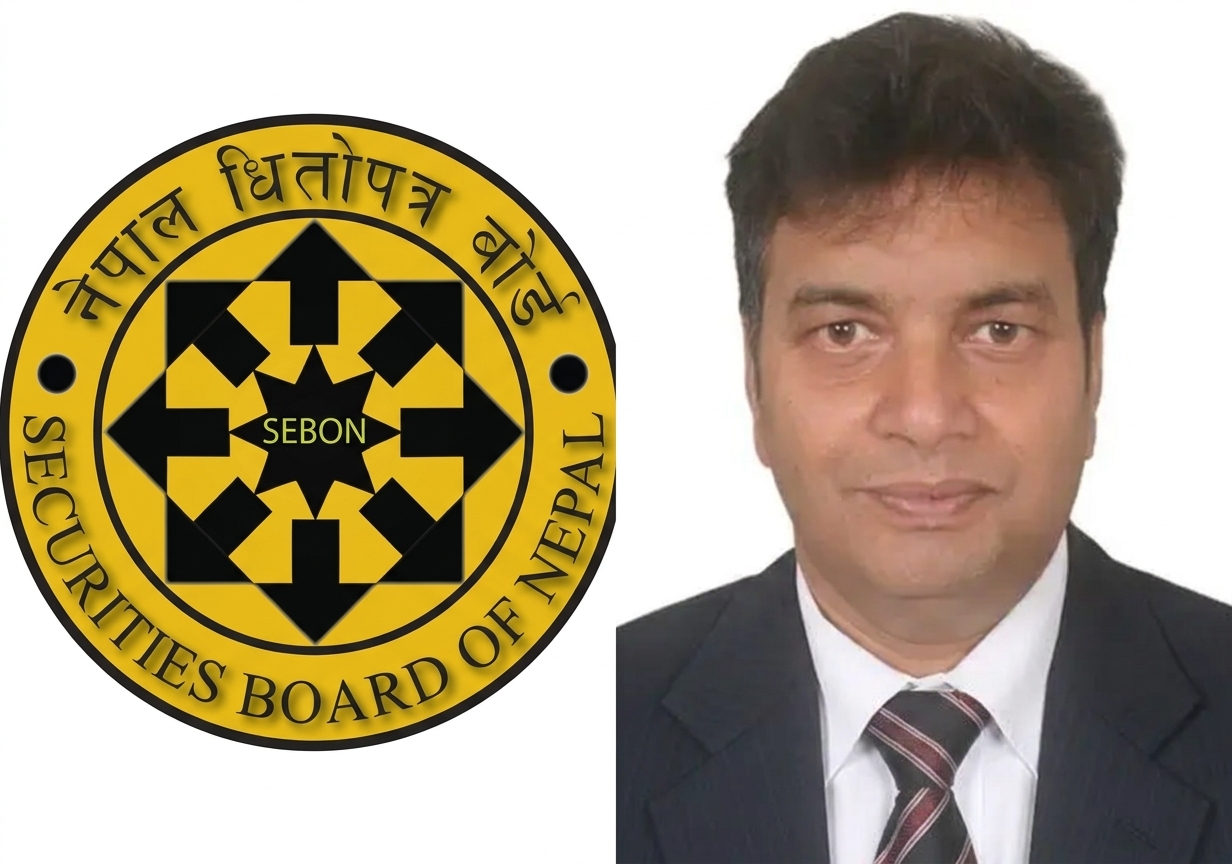
Kathmandu. Gopal Bhatta has been appointed as the chairman of the Securities Board of Nepal (SEBON). Bhatta, who was appointed as the chairman of SEBON on June 19, has published about 600 pages of documents related to capital market reforms, policy formulation and regulatory system.
Since his appointment as the chairman, Bhatta has unveiled 6 important action plans including concept paper, white paper, policy, roadmap and draft of regulations related to market reform. He also assured the investors that if the policies are not implemented on time, the ordinance will be implemented. Likewise, he has also continued to meet and hold discussions with the concerned sector for capital market reforms.
However, investors say that even though a large number of policies and documents have been made public in a short period of time, their direct impact has not been seen in the market. On June 19, the last trading day before Bhatta Sebon was appointed as the chairman, the NEPSE index was above 2700 points. By August 19, the index had dropped to 2629 points. Since Bhatta became the chairman, the NEPSE index has decreased by 71 points.
While the release of a large number of documents in a short period of time has shown Sebon’s activism, investors say that in the current situation, the market needs more concrete steps to address their effective implementation and declining investor confidence.
The ‘Concept Paper on Policy, Legal, Structural, and Technical Arrangements for Margin Lending, Securities Lending and Credit Transaction and Short Selling in Nepal’, is the largest document published under the leadership of Bhatta. The concept paper is of 168 pages.
The document made public by the board has proposed policy, legal and technical provisions for the systematic operation of margin trading, securities lending and borrowing and short selling in the market.
Likewise, the board has published a 112-page document titled ‘White Paper on Primary Capital Market Development of Nepal, 2083’. The white paper has been brought with the objective of making the primary market more systematic, transparent and investor-friendly.
SEBON has also published a 54-page document titled ‘Price Regulatory Framework for Nepal Securities Financial Services, 2083’. Similarly, a 53-page draft of ‘Capital Market Reform Policy-2083’, an eight-page draft of ‘Margin Credit Transaction Regulations-2083’ and a 120-page document named ‘Nepal’s Capital Market Roadmap 2083’ have been made public.
Likewise, SEBON has also released its Capital Market Policy and Programme for the fiscal year 2083÷84. The document is 80 pages long. In the last two months, the board has released nearly 600 pages of policy and reform material.
Tara Prasad Phulel, an investor, said that although the release of policies, plans and road maps is positive in itself, the main question now is how they will be implemented. According to him, Nepal’s capital market has been witnessing problems like policy instability, regulatory delays, lack of development of market infrastructure, and fluctuations in investors’ confidence for a long time.
According to Fullel, the main problem seen in the market right now is the lack of trust of investors in the government. According to him, although the government has brought various policies and programs, there is a difference in words and actions which has not created an environment of confidence among the investors.
“The time has come to not only bring the policy but also show its results in practice,” says Fullel, “Although the chairman of Sebon has presented various documents, roadmaps and policies for market reform in recent times, the market has not been able to move according to it.” ’
According to him, the interest rate in the banks and financial system is historically low and there is sufficient liquidity. Banks are also trying to provide loans at comparatively cheaper interest rates. “But even in such a situation, investors do not have enough confidence to increase investment in the capital market,” he says. According to Fullel, investors are more interested in the stability of policy and regulatory decisions, the government’s clear approach to the market, and their implementation.
On the other hand, investors are of the view that although it is natural for the government to take legal action against illegal activities and money laundering, its impact should not reach the investors who are investing legally. According to them, there is a need to create an environment where legitimate investors can trust their investments and transactions to be safe and orderly.
Fullel also pointed out the need to adequately involve investors’ representative organizations in policy formulation and discussions. According to him, failure to effectively convey investors’ problems and grievances to the concerned bodies is also one of the problems of the market.
In the past, investor-representative institutions played the role of a bridge between the regulator, the government and the investors. Therefore, in the coming days, it seems that Sebon and the government should give adequate space to the representatives of investors in the discussions on policy making and market reform.
In particular, the real impact of the issues mentioned in the documents made public now will be seen in the market. The systematic introduction of instruments such as margin trading, securities lending and credit trading, and short selling can create new trading opportunities in the market.
Similarly, primary market reforms can help new companies and investors to join the market. However, Fullel says that the market will not improve only by making the document public. “Clear timelines, determination of responsibilities, coordination among bodies concerned and continuous monitoring of implementation are necessary for market reform,” he says.

















प्रतिक्रिया दिनुहोस्