



Kathmandu. The government has proposed to amend 59 laws with the aim of promoting private sector investment and attracting foreign investment. The government is preparing policy and legal reforms with the goal of seeking foreign investment worth about $17 billion by collaborating with the private sector.
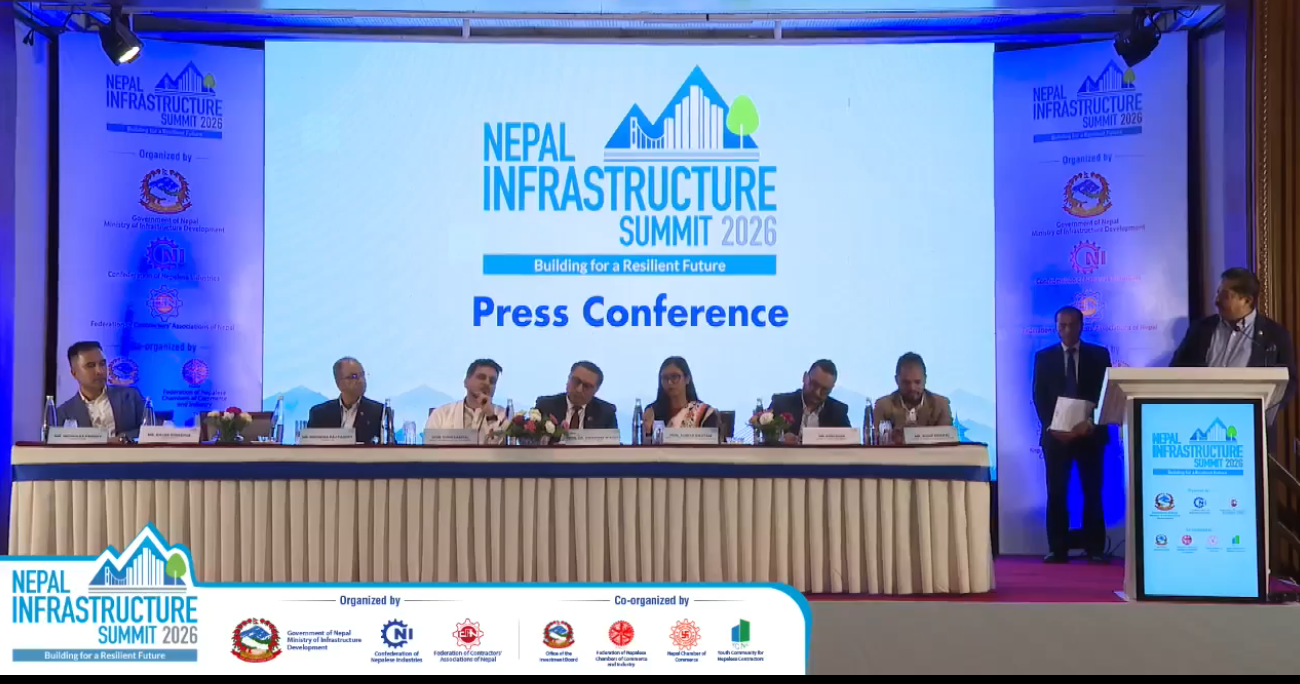
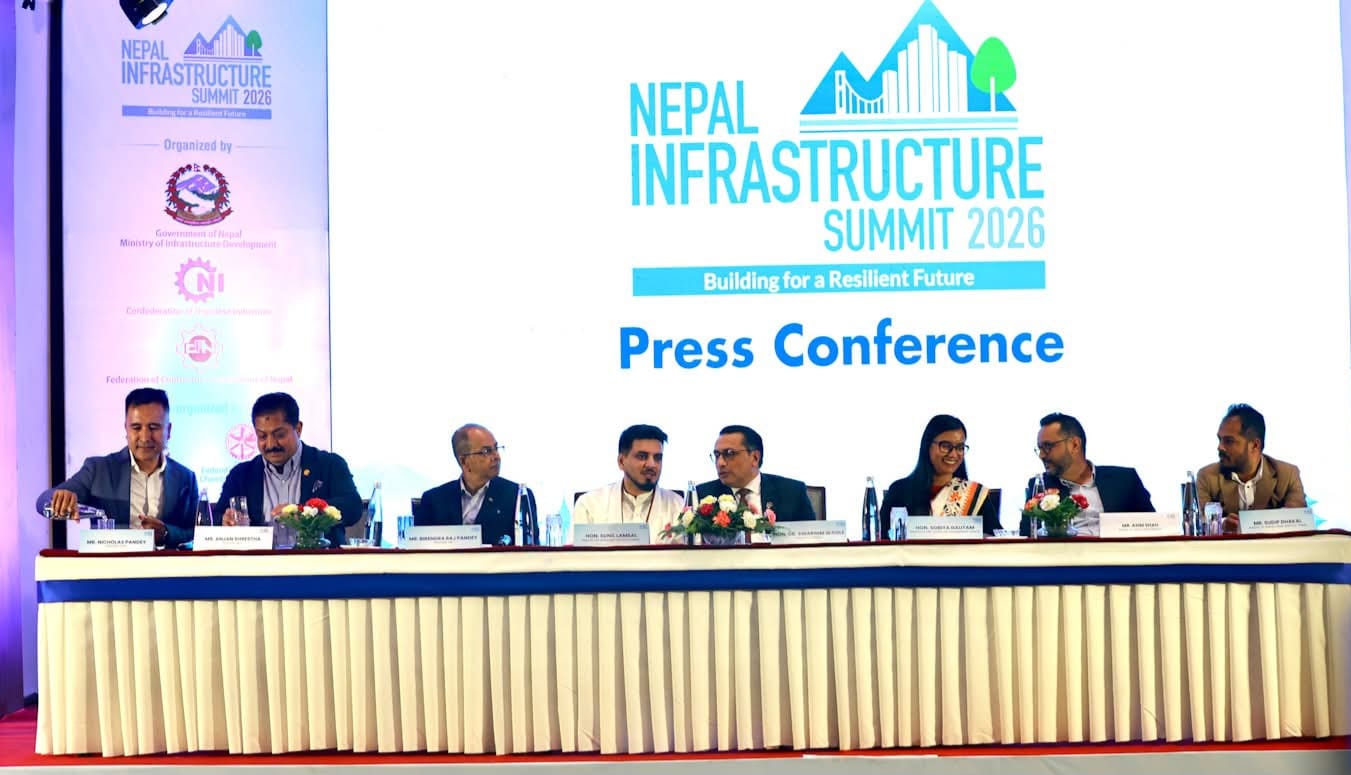
At a press conference held at Soaltee Hotel in Kathmandu on Thursday, three ministers of the government and two advisors to the Prime Minister shared the same platform with the representatives of the private sector and made public the preparations for the conference. Finance Minister Dr. Swarnim Wagle, Minister for Physical Infrastructure Sunil Lamsal, Law Minister Sovita Gautam, Chief Political Advisor to Prime Minister Balendra (Balen) Shah Asim Shah and Policy Advisor Sudip Dhakal were present.TAG_OPEN_p_97
President of the Federation of Nepalese Chambers of Commerce and Industry (FNCCI) Anjan Shrestha, President of the Confederation of Nepalese Industries (CNI) Birendra Raj Pandey and President of the Federation of Contractors’ Associations of Nepal Nicholas Raj Pandey were present in the meeting.TAG_OPEN_p_96
Prior to this, the Confederation of Nepalese Industries (CNI) used to organize the infrastructure conference in its annual calendar. Since the government’s participation was limited to the co-organizer, this time the Balen government has decided to take ownership of the conference and organize it jointly with the private sector. The conference aims to strengthen the cooperation between the government and the private sector and to develop infrastructure and attract foreign investment.
Although the government is trying to find investment in collaboration with the private sector, the morale of the investors has been weak in recent times. It is challenging for the government to win the trust of the investors when some of the policies and decisions of the government have not been able to assure the private sector.
Prime Minister Balen Shah and Finance Minister Dr. Wagle has been meeting and discussing with the representatives of the private sector, but the incidents of arrests and investigations related to the private sector have created doubts among the investors. Although the falling interest rate should create a positive environment for investment, the decreasing capitalization of the stock market indicates that the morale of the investors is weak. The fact that the total capitalization of the stock market has decreased by about Rs 4 trillion after the formation of the Balen government can also be taken as a basis to measure the psychology of the investors.
In such a situation, the government has tried to seek investment through infrastructure conference in collaboration with the private sector and to facilitate the investment environment through legal reforms.TAG_OPEN_p_92
987 suggestions from the private sector, 59 amendments to the law
}
Presenting a detailed working paper on law reform, Prime Minister’s policy advisor Sudip Dhakal said that 59 law amendment proposals have been prepared based on the suggestions received from the private sector.TAG_OPEN_p_90
According to him, 987 suggestions have been received from the private sector for law reform. Based on these suggestions, proposals have been put forward to amend 326 sections of 59 laws and add 168 new sections. The government is planning to make legal reforms in the areas of investment, industry, business, bank and financial sector, tax administration, infrastructure, land management, energy, labor and dispute resolution.TAG_OPEN_p_89
The proposed amendment bill incorporates 112 Sections of 8 Acts related to Investment and Industry, 75 Sections of 8 Acts of Bank and Finance and Capital Market, 69 Sections of 8 Acts of Tax and Revenue and 57 Sections of 8 Acts Related to Infrastructure, Energy and Public Procurement Acts.TAG_OPEN_p_88
Similarly, 56 sections of nine acts related to land, city and housing, 37 sections of six acts related to digital economy and competition, 37 sections of five acts related to dispute resolution and good governance, 35 sections of five acts related to forest and environment and 16 sections of two acts related to labor and social security have been proposed.TAG_OPEN_p_87
The most likely amendments are 55 sections of the Industrial Enterprises Act, 28 sections of the Income Tax Act, 24 sections of the Arbitration Act and 21 sections of the Companies Act. Similarly, 19 sections of the Insurance Act and 18 sections of the Payment and Settlement Act are proposed to be amended.TAG_OPEN_p_86
Reforms from industry expansion to tax refunds
}
The government has proposed to remove the provision of prior approval for capital or capacity expansion of an industry and provide information within 30 days. The goal is to simplify the process of registration and renewal of industries, bring flexibility in company management and reduce administrative hassles in the operation of industries.
TAG_OPEN_p_84 It has been proposed to reduce the time limit for tax assessment from four years to two years. The process of refund of Value Added Tax (VAT) will also be simplified. If VAT is not reconciled for more than six consecutive months, it is proposed to refund the amount within four months and to the exporters who are electronically verified, within 15 days.
It has also been proposed to remove the provision of sending money abroad and bringing it back to Nepal while converting foreign loans into shares. The government hopes that this will make it easier for foreign investors to expand their investment in Nepal.
It has been proposed to facilitate the receipt and payment of foreign currency to the companies exporting information technology services. Nine types of payments, including software, cloud, domain, hosting, cyber security and digital advertising, have been proposed to be made within the prescribed limit without the prior approval of the Rastra Bank.
Similarly, an industry producing solar or wind energy for its own purpose will not need a license up to the specified capacity.
Facilitation of land acquisition and delimitation
} It has been proposed to remove the legal complexities seen in the acquisition and use of land for large infrastructure projects, industries, new cities and housing projects.
There is a proposal to waive the land ceiling for approved industries and infrastructure projects, to facilitate the arrangement of lease and transfer and to prepare a legal basis for keeping the land and project rights as collateral for the protection of the lenders.
In the full application regarding the exemption of the land, it has been proposed that a decision should be taken within 60 days, the compensation should be completed within 60 days and the compensation should be paid within 30 days. The decision on the change of land use has been set within 30 working days.TAG_OPEN_p_78
The government has also adopted a policy to increase the participation of the private sector in new cities, integrated townships, urban redevelopment and joint housing construction. It is proposed to give permission for construction of buildings as per the approved criteria within 15 working days and approval for joint housing construction within 30 working days.
Creditor protection in project construction
}
It has been proposed to clarify the right of the lender to raise investment in infrastructure projects. The legal basis for a direct agreement between the public body, the project company and the lender will be prepared.
Provision has been proposed to inform the lender before cancelling the project contract, provide an opportunity to rectify the errors and give the responsibility of operating the project to a qualified replacement.
A legal provision will be created to accept project rights, lease rights and commercial receivables as collateral. This is expected to make it easier for foreign lenders to invest in large infrastructure projects and energy projects.
The proposal to expand the participation of the private sector in power generation, transmission, trade and energy storage has also been included. It is proposed to make a decision on the power purchase agreement within 90 days, provide open access to the transmission system and restructure the Nepal Electricity Authority in a phased manner.
Separate contract disputes from criminal cases
The government has also proposed to address the uncertainty of tax determination that investors have been raising for a long time and the risk of criminal prosecution in contract disputes.TAG_OPEN_p_72
There is a proposal to set up an independent administrative review unit to resolve disputes related to tax. It has been proposed that disputes related to income tax, VAT and excise duty should be decided within 60 days.
Similarly, it has been proposed that contractual disputes should be resolved in accordance with civil law and only minor errors, technical disputes or delays in payment without dishonest intention should not be treated as criminal offenses related to contracts.TAG_OPEN_p_70
Provision has been proposed that the decision taken in good faith and with record within the jurisdiction will not be considered as an offence only because it is found to be wrong later. However, it is proposed that the right of the investigating agency to take action against bribery, collusion and fraud will remain the same.
Government services through one-door system
Integrated electronic investment facilitation system for investors has been proposed. Foreign investment, foreign loan, transfer of technology, registration of company and industry, payment of fees, status of application, letter of approval and grievance management will be integrated into a single system.
} Verifiable documents in the government’s electronic records cannot be requisitioned and a provision has been proposed to explain the reasons and legal grounds for rejecting the application.
The goal is to shorten the administrative process by setting deadlines in the services of forest, environment, electricity, mines, town development, tax administration and various government bodies.
{{TAG_OPEN_p_65} The government has said that the reform proposal will uphold the public interest, forest and environment protection, workers’ rights and constitutional rights of the federal structure. The proposal does not include a provision that the approval will be automatically approved only because the deadline has been exceeded or the application has been made.
Implemented only after it is passed by Parliament
The proposals to amend the laws put forward by the government are now in the preparation and proposed stage of reform. These provisions will come into effect only after the legal process is completed and approved by the federal parliament.
The first 100-day action plan for the implementation of the proposed reforms has also been put forward. In the first 30 days, it has been proposed to determine the harmony and responsibility between the Acts and Regulations, the action plan of the electronic service within 31 to 60 days and the trial implementation within 61 to 100 days.
Electronic tax system reform is targeted to be implemented within 6 to 9 months and one-door revenue administration within one year. It is proposed to issue necessary directives and procedures of the Rastra Bank within 90 days.
{{TAG_OPEN_p_61} The government has proposed not to consider only the amendment of the law as the achievement of reform and to regularly monitor the adherence to the deadline of the decision and make public the progress of the system.













प्रतिक्रिया दिनुहोस्