

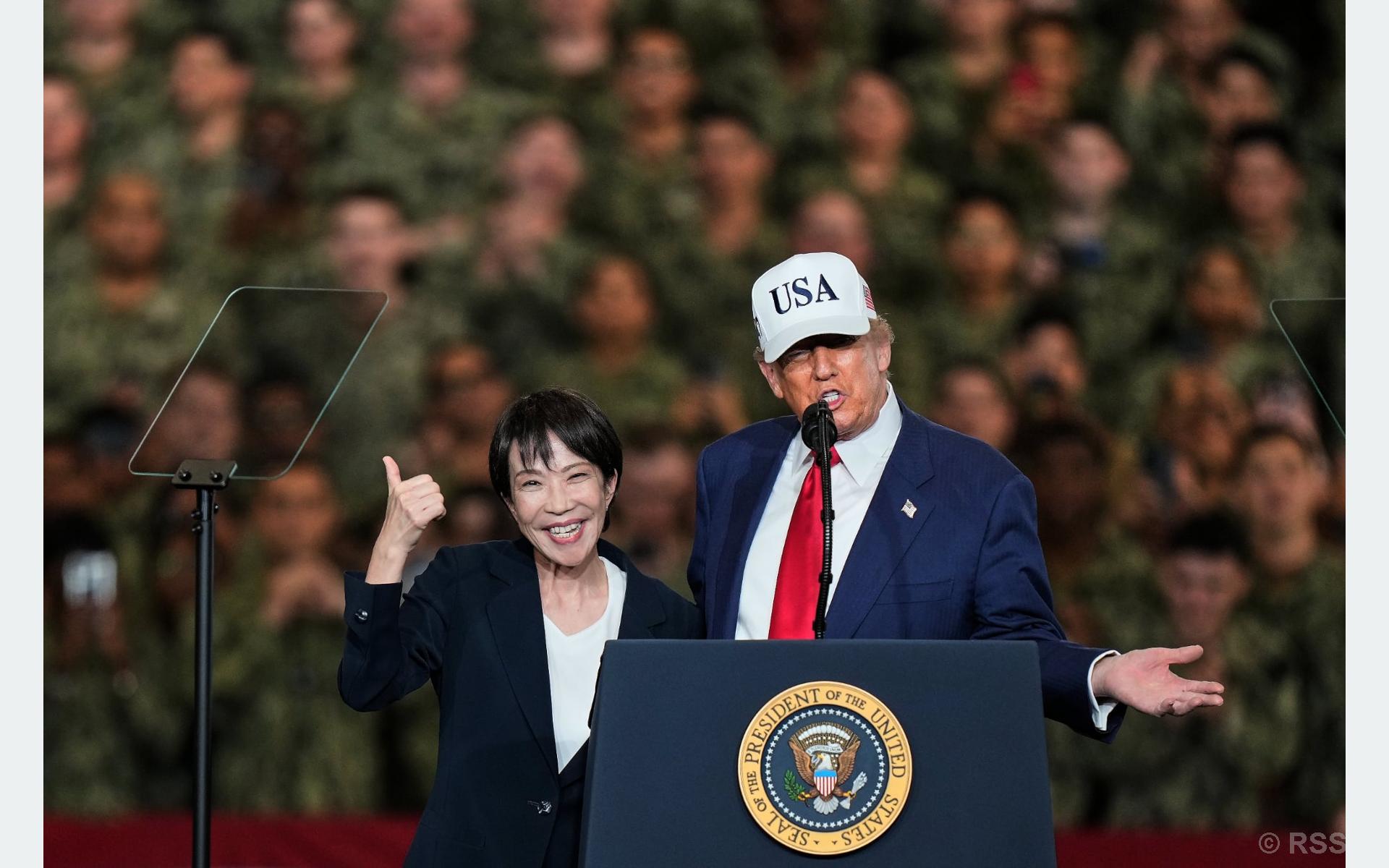
Kathmandu. Japanese Prime Minister Sane Takeichi and U.S. President Donald Trump met at the White House in a high-stakes diplomatic dialogue amid heightened war in the Middle East and mounting international pressure on the strategic Strait of Hormuz. The meeting highlights a sensitive aspect of U.S.-Japan relations at a time when efforts to secure waterways that are the main pulse of the world’s energy supply have failed.
The meeting, which was earlier expected to focus on general bilateral coordination and relationship strengthening, has been complicated by the war with Iran and the security crisis it has created. Trump has publicly expressed frustration with Japan’s allies, including Japan, for not providing the necessary support to protect the Strait of Hormuz. When he didn’t get help, he said the U.S. was capable of it.
Takeichi acknowledged it would be “very difficult” to meet Trump before leaving for Washington. Japan has rejected an offer to send its warships to the U.S.-Israeli military mission. This has increased the tension in security coordination between the two countries. Kurt Campbell, president of the Asia Group and a former U.S. diplomat, said Trump was likely to exert a high level of pressure on Takaichi, a rare meeting with such a sensitive one.
Campbell said Takaichi sought to find a balanced way to present Japan as a partner in the U.S. Plan for the Middle East, which he hoped would provide an opportunity to present Japan’s concerns on regional issues, including Taiwan, to the U.S. in a balanced and effective manner.
But Japan’s constitutional limitations complicate such cooperation. Since World War II, the constitution has prohibited the use of military force except in the defense of its territory, limiting Japan’s military as a “self-defense force”. However, analysts say there is still the possibility that Japan could do so, such as demining the sea or having a limited naval presence. But in order to be directly involved in U.S. military operations, the provision of “collective self-defense” must be activated. This is a very sensitive issue politically.
Takaichi said he plans to focus the meeting on trade, security and strategic cooperation in the Indo-Pacific region. Takaichi, who first met Trump in Tokyo in October, is Japan’s first female prime minister and a close aide of former Prime Minister Shinzo Abe. He is known for his outspoken support for Taiwan, which is believed to have added sensitivity to relations with China.
Ahead of the meeting, Japanese officials said they would discuss ways to further strengthen U.S.-Japan ties and cooperate in energy, critical minerals and regional security. But the issue of helping to secure the Strait of Hormuz seems to overshadow those agendas.
The global effects of the Iran war have also put Takaichi in a difficult position. Japan has been gradually beefing up its security preparedness around the East China Sea, seeing China as an emerging security threat. But there are growing concerns that the US move some of its troops to the Middle East could weaken the balance of power in East Asia.
Takaichi is likely to subtly raise the issue of troop transfers with Trump, especially as China has stepped up its exercises around Taiwan. According to analyst Christopher Johnstone, such a situation increases the risk that the US will become entangled in the Middle East again and the deterrence capacity in East Asia will decrease.
Thus, when the security of the Hormuz, the impact of the Iran war, and strategic competition with China come together, the Trump-Takaichi meeting is not just a test of bilateral talks but a test of the larger geopolitical balance.














प्रतिक्रिया दिनुहोस्