

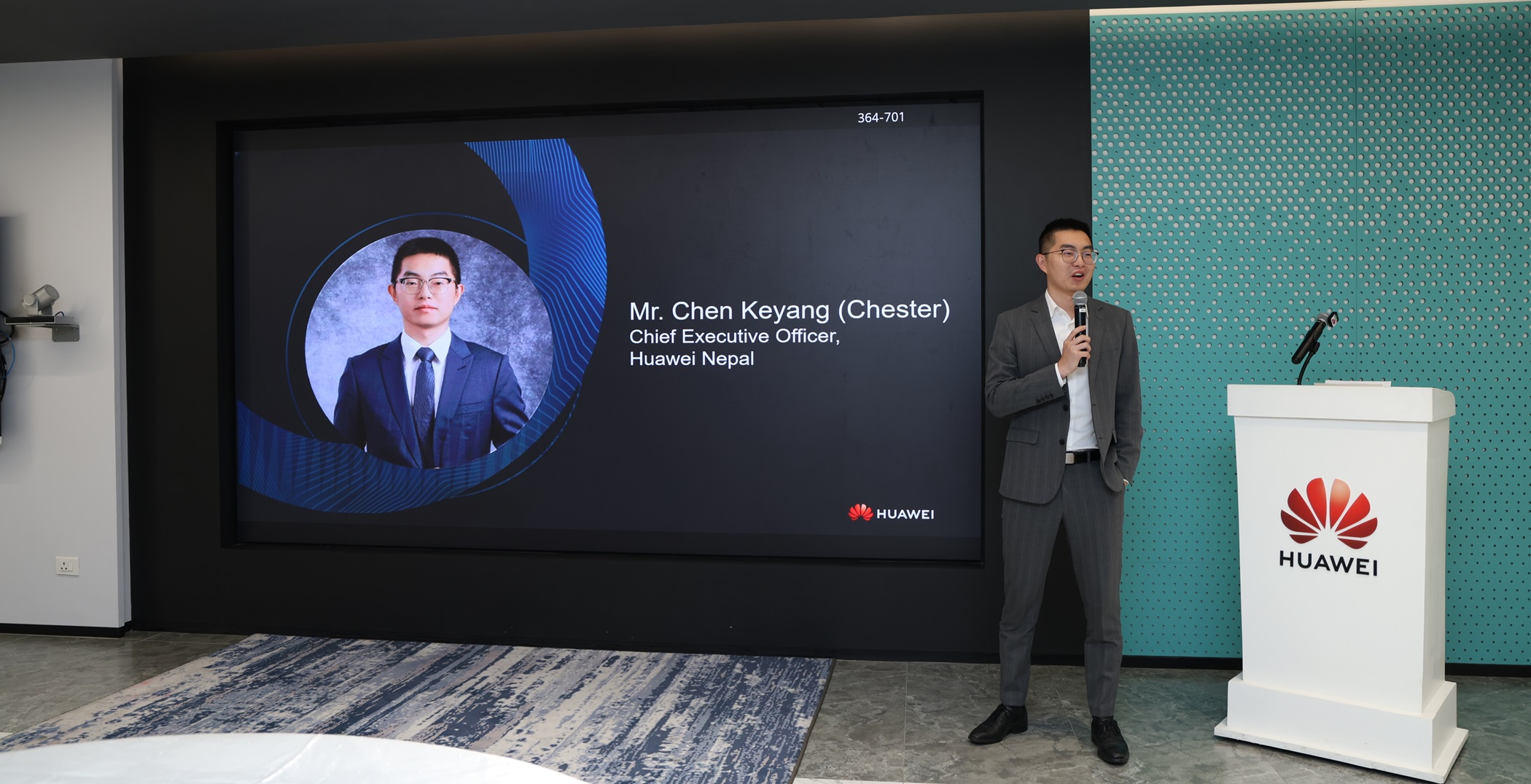
Kathmandu. Technology Journalists’ Forum (TJF) and Huawei Nepal jointly organized a program titled ‘Tech Forwards Media Dialogue 2026’. In the program organized at Huawei Tower in Hattisar on Thursday, technology experts and media persons discussed the impact of information technology, digital transformation and artificial intelligence (AI).
Welcoming the participants, Chen Keiyang (Chester), CEO of Huawei Nepal, said, “We are excited about the technological advancement in Nepal. He pointed out that Nepal lags behind its neighbors in ICT development despite having adequate skilled manpower. “But it is also an opportunity because there is more room for improvement here than in other countries,” he said, adding that sustainable and organic growth of the telecommunications sector in Nepal should be emphasized. For this, the joint efforts of regulators, government, telecom operators, Huawei and media will be important. “Development of only one aspect cannot make the entire industry strong,” he said.
On the occasion, discussions were held on possibilities, challenges and necessities of operation of 5G mobile internet in Nepal. There was a discussion on why the expansion of 4G infrastructure is important for the launch of 5G. Experts have said that non-stand-alone technology will be an alternative to developing stand-alone 5G infrastructure immediately in a country like Nepal due to investment, geographical complexities and other factors. Non-stand-alone is an option to expand the service by installing 5G equipment on the 4G infrastructure. It does not create a separate new core network while providing 5G services. Rather, it is considered to be the core network and infrastructure of the current 4G LTE. Therefore, experts say that the expansion of 4G is important for 5G.
According to the participants, Nepal, which was successful in bringing 3G in the first phase of the world, was slow in 55 years. Many believed that the delay in the release was due to the lack of coordination between the regulator Nepal Telecommunication Authority and the telecom service provider and the government.
On the occasion, TJF President Purna Duwal shed light on the current status and future of technology journalism. According to him, such programmes would be important for the change in media with digital transformation, the need for factual and accountable journalism and capacity building of technology journalists. “Technology and media have complemented each other in today’s era,” he said, adding, “The role of technology journalism has become more important for disseminating accurate information and increasing digital literacy.” ’
The program featured presentations and talks on topics such as AI, data center, 5G, renewable energy, mobile broadband, among others. Pradeep Panhur, Director of Huawei Enterprises, in a presentation on “AI Trends and Enterprise Solutions,” mentioned that the use of AI in business is growing rapidly. He said that the use of AI will increase productivity, manage costs and improve decision-making.
Similarly, Rohit Chandra Shah, Data Center Expert gave a presentation on ‘Next Gen Data Center Solution for Accelerating Digitalization’. He talked about the importance of data centers in the digital economy. He stressed the need for secure, sustainable, high-efficiency data centers for digital data management. Similarly, Prabhat Regmi made a presentation on the topic ‘5G Trend and Innovation’ and elaborated on the changes brought by the technology in communications, industry and service sector. He said that the use of 5G will take Smart City, Internet of Things (IoT), automation and digital services to new heights.
Participants of the program talked about the linkages between technology and media, challenges and opportunities of digital transformation. The participants had inquired about the issues such as factual information dissemination, cyber security, data privacy, especially in the digital age.
On the occasion, TJF Vice President Ganesh Subedi pointed out the need to increase collaboration between technology and media, enhance capacity of technology journalists and expand digital literacy. “Events like these not only create new opportunities for knowledge sharing but also help strengthen the overall digital ecosystem.” ’
At the end of the program, Mr. Asit Adhikari, Corporate Affairs Manager of Huawei Nepal, said that Huawei has been providing services in Nepal for the past 27 years. Currently, Huawei employs more than 207,000 people, serving more than 170 countries around the world. “Our objective is not only to contribute in the areas of business but also in the areas of social and corporate responsibility,” he said, adding, “We have been supporting social and economic transformation in Nepal as well.” ’















प्रतिक्रिया दिनुहोस्