



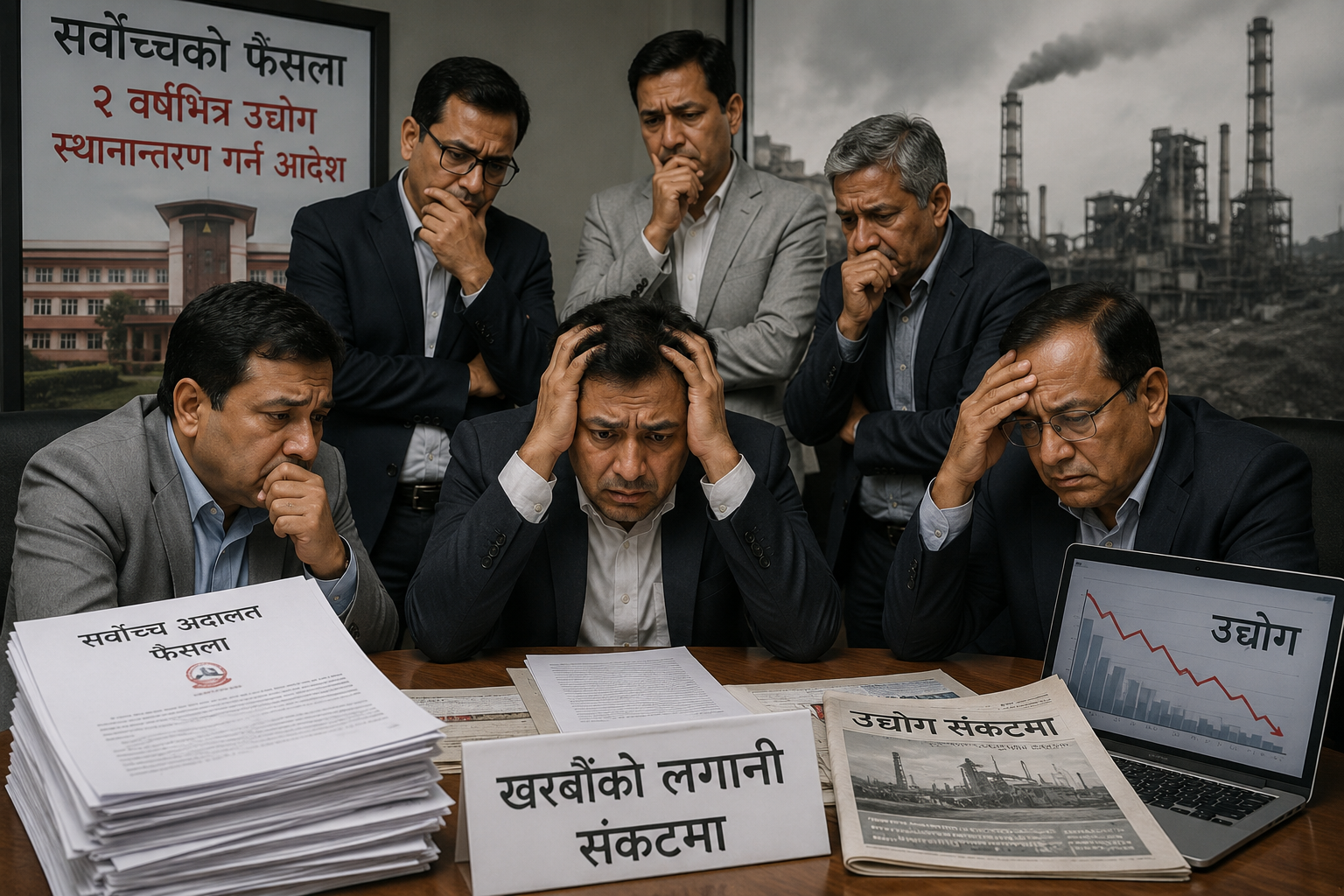
. On August 27, 2002, the Supreme Court issued a mandamus order to relocate the industries located in Lumbini district within two years. The Supreme Court (SC) has ordered the management of industries located in Lumbini area elsewhere to reduce environmental pollution.
The Supreme Court has given the verdict on August 2 TAG_OPEN_p_84 4 when the KP Sharma Oli-led government is in power. The government has directed the Office of the Council of Ministers, the Ministry of Home Affairs, the Ministry of Industry, the Lumbini Development Trust and other bodies to vacate the industries to implement the decision. The Supreme Court’s verdict implementation Directorate has directed the government to vacate all industries and factories located within 15 kilometers of Lumbini, the birthplace of Gautam Buddha.
Then on September 23 and 24, the ‘Genji Movement’ took place.TAG_OPEN_p_83 The political and administrative situation of the country has changed after the movement. Since the formation of the new government through elections, the number of arrests of various individuals associated with the private sector on various charges has been increasing. In recent weeks, large and medium-sized businesses have come under investigation for financial crimes, banking irregularities, fraud and money laundering.
The war between the US, Israel and Iran has pushed up the prices of most commodities.TAG_OPEN_p_82 As a result, industrialists and businessmen are unable to run their businesses. On the other hand, an industrialist says that the government’s decision has added to the frustration among the industrialists.
“The war between the US, Israel and Iran has led to a rise in commodity prices, which has made it difficult for industrialists to run their business,” said one industrialist. ”
More than TAG_OPEN_p_80 40 industries in the region are facing crisis due to the Supreme Court’s decision. More than 50 industries including cement and brick factories are likely to be affected. The industrialists had demanded the government one after the other, saying that the industries operating in the area would be in crisis.
“But the government changed. The current government has become more aggressive towards the private sector,” said an industrialist.
The Federation of Nepalese Chambers of Commerce and Industry (FNCCI), Lumbini Province Committee, Butwal Chamber of Commerce and Industry, Siddhartha Chamber of Commerce and Industry, Lumbini Brick Industries Association, Lumbini Province Committee among others have demanded the government to establish a separate industrial zone with infrastructure to relocate the industries with investment of billions of rupees.TAG_OPEN_p_78
The Lumbini Province Committee of the Federation of Nepalese Chambers of Commerce and Industry (FNCCI) has said that the court’s order has created an environment of insecurity and uncertainty among the industrialists and entrepreneurs.TAG_OPEN_p_77 The federation has claimed that the situation of relocation or closure of industries operating as per the rules with investment of billions of rupees has pushed the industry sector towards crisis.
The association claims that the industry will be in crisis if the industries that are operating at less than half of their capacity are relocated amid the sluggish economic situation and the price rise caused by the war. The industrialists have concluded that if the government does not provide proper compensation and concessions, the morale of the industrialists will be seriously damaged and the employment of thousands of workers will be in crisis.
Raghu TAG_OPEN_p_75 Nandan Maru, president of Nepal Cement Manufacturers Association, said that the Supreme Court’s mandamus has discouraged industrialists.
“It was necessary to think about this issue when the Government of Nepal issued the license to operate the industry,” he said, “This was the Lumbini area at that time also.” It would have been different if it had been announced now and not Lumbini area earlier. There has been no change in geography since the government issued the license. ”
He accused the government of distributing licenses for its own interests and later putting the industrialists in crisis.TAG_OPEN_p_73
The initial investment of the industries currently operating in the area is in billions of rupees. He said that the civil cost of the industries in the area has also reached billions.
“Industries that have come into operation with billions of investments cannot be asked to stand up and go. This is not a small cottage industry,” Maru said. This decision of the government and the Supreme Court is not business-friendly. ”
He alleged that the industrialists have been asked to remove the industry without making criteria while operating the industry.TAG_OPEN_p_70 According to him, the government has issued directives to put the investment of private sector industrialists and general public at risk.
Some of the companies currently operating in the area have been converted into public companies. Ordinary investors have also invested in these companies. According to Maru, the Supreme Court’s order has increased the possibility of industrialists fleeing.
He said that the risk of exodus of industries from Nepal has increased as the policies are brought in such a way that the industries that have been brought into operation after completing the policy process are frequently frightened.TAG_OPEN_p_68
} “Earlier, the number of workers and students going abroad from the country was increasing. ”
Foreign investment coming to Nepal has started coming out of Nepal in recent times. Most of the investors who have invested in Nepal’s commercial banks have sold their shares and exited. Experts in the concerned sector have been saying that the number of investors is increasing due to lack of good investment returns. Industrialists believe that the Supreme Court’s order has shocked the investors who want to invest in Nepal.
According to Pashupati Murarka, former president of the Federation of Nepalese Chambers of Commerce and Industry (FNCCI), the government should have made arrangements for the relocation of the industries.TAG_OPEN_p_65
“The Supreme Court has asked the industries that are operating to stand up within two years. It would have been better if the order had been issued so that the industrialists could also implement it,” he said, adding, “We are ready to get up to 60 per cent of the cost of the industry.” But the government should provide both space and subsidies to relocate industries. ”
He said that the government should designate areas for the relocation of industries.TAG_OPEN_p_63 He said that the industrialists are ready to shift away if more than 60 per cent subsidy is provided to industries operating in Lumbini area worth Rs 14 billion. He also suggested that the deadline of two years given by the Supreme Court should be extended to five years.
According to the Supreme Court’s order, about a dozen cement factories in the Lumbini area are on the verge of being displaced.TAG_OPEN_p_62 Goenka Group’s steel and cement industries, Reliance Paper Mills, Reliance Cement, Siddhartha Cement, Arghakhanchi Cement, Shree Ram Cement, Jagdamba Cement, Bishal Cement, Brij Cement and Supreme Cement, among others, will be affected by the floods. The steel and cement industries of the Jagadamba Group also have to be relocated. Khagendra Sharma, secretary of Siddhartha Chamber of Commerce and Industry, said that there are flour industries in the area.
Netra Prasad Acharya, president of Siddhartha Chamber of Commerce and Industry, said that the Supreme Court’s decision has put the industry sector in a serious crisis.TAG_OPEN_p_61
“Earlier, the government had allowed industries to operate within eight kilometers as per the master plan, but now such industries are allowed to be operated only within 15 kilometers,” he said.TAG_OPEN_p_60 The 15 km range is too long. ”
The Supreme Court’s judgment is as follows
The Supreme Court (TAG_OPEN_p_59 SC) has said that Lumbini, the birthplace of Gautam Buddha, is listed as an international peace and meditation centre and the operation of industries there has affected the environment. Stating that another Lumbini cannot be built if the Lumbini area is destroyed, the Supreme Court has ordered to relocate the industries and not allow the operation of new industries that affect the environment.
“The Lumbini area is under the obligation of Nepal which was accepted as a member country under the UNESCO World Heritage Convention in 1972 in 1978,” the SC order states, “Therefore, it is necessary to be sensitive to suggestions and decisions regarding the protection and promotion of the historical, archaeological, religious and cultural sites enlisted in the World Heritage Sites.”TAG_OPEN_p_58 ”
According to the Supreme Court, the cement industries around Lumbini and other polluting and carbon emitting industries have affected historical structures like the Ashoka Pillar and sacred sites.TAG_OPEN_p_57
The Supreme Court has said that there is a risk of removing Lumbini from the World Heritage List if the impact of polluted air is not minimized in time.TAG_OPEN_p_56 The Lumbini area is also considered important in terms of biodiversity. There are 16 wetlands in Lumbini. These areas are home to various birds including cranes. According to the latest research, 652 of the 690 cranes found in Nepal are in the Lumbini area.
The Supreme Court has concluded that the increasing pollution in the Lumbini area has seriously affected the habitat of endangered birds.TAG_OPEN_p_55
On November 2 TAG_OPEN_p_54 6, 2006, the Industrial Promotion Board (AIPB) had taken an important decision for the protection of environment in the Lumbini area. The decision concluded that the industries established around the places of tourist and religious importance enlisted in the World Heritage List were polluting the Lumbini area.
Lumbini Development Trust, various organizations and stakeholders had demanded that no new industries should be registered and permitted in the area.TAG_OPEN_p_53 The apex court has ordered the industries to be shifted from the wall to the Indian border and within a radius of 15 km to the east, west and north.
No new TAG_OPEN_p_52 carbon emitting industries can be set up within 800 meters on both sides of the road along the Lumbini-Bhairahawa corridor.
{{TAG_OPEN_p_51} The industries registered and operating before November 28, 2066 should also be relocated.
Polluting industries should operate their industries only after fulfilling the criteria set by the Environment Protection Act. The policy has been adopted that the industries fulfilling the criteria have to be transferred within two years and permission will not be given for capital increase, capacity expansion and power capacity development of industries in that sector.
Arrangements have been made to include representatives of Lumbini Development Trust in the IEE committee required for the establishment of small and cottage industries in the Lumbini area.
} Industries registered within 15 kilometers but not in operation should also take necessary measures to control pollution before resuming their industries. It is stated in the order that the industries not abiding by the set standards should be shifted to another place within the stipulated time.
The Supreme Court (TAG_OPEN_p_47 SC) has ordered the government not to allow the establishment of new dust, smoke and carbon emitting industries within 15 kilometers of the Lumbini conservation area from the wall to the Indian border and in the east, west and north.
} Similarly, the government has been directed to provide necessary concessions if the industries want to operate tourism-friendly business on the vacant land after the relocation.
The Supreme Court (SC) has ordered the government to prohibit the operation of more than 19 tons of public vehicles within 800 meters of the road along the Lumbini-Bhairahawa corridor.TAG_OPEN_p_45















प्रतिक्रिया दिनुहोस्