

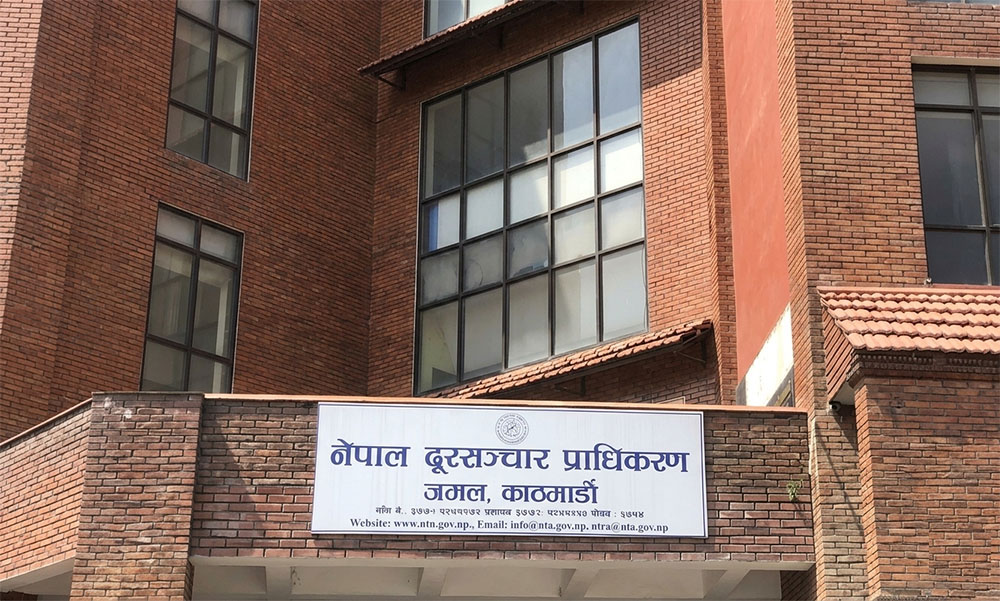
Kathmandu. Nepal Telecommunication Authority (NTA) has published a draft of its Mobile Broadband Improvement Plan (Nepal’s Road to 5G) with an aim to expand 5G services across the country within a decade by transforming Nepal’s telecommunications sector into high-speed mobile broadband. The plan, which is seen as a roadmap for the launch and expansion of 5G services in Nepal, has a long-term goal of reaching out to 5G in urban areas this year and throughout the country by 2035.
The draft prepared by the NTA based on the present status of mobile telecommunication service in Nepal, the growing demand of mobile data services, international practice, the details received from the service providers and the discussion with various stakeholders has requested the concerned parties to provide their feedback, suggestions and suggestions within 15 days. The proposed roadmap targets to make average speed of mobile broadband to at least 20 Mbps by 2027, 100 Mbps in municipal areas by 2030 and 5G services by 2035.
The government is working to see a significant improvement in Nepal’s telecommunication service in the current fiscal year 2083/84. Minister for Information and Communications, Dr Bikram Timilsina, has directed the Ministry and its subordinate bodies to expand the access of telephone and internet service and to bring about a remarkable change in quality improvement.
Along with this priority of the government, the authority has also directed the service providers to submit a concrete action plan for the operation of 5G. On August 7, the NTA directed mobile service providers to prepare and submit a phased action plan with the goal of starting 5G services from major urban areas. It has also asked to give priority to the accessibility and quality improvement of 4G services across the country.
According to Min Prasad Aryal, director of the Nepal Telecommunication Authority, preparations are underway to expedite the allocation and allocation of frequencies required for the operation of 5G. He said that the service providers should also show the necessary preparation and readiness in the context of the government and regulatory bodies ready for the operation of 5G. Whether to use a separate technology-based infrastructure for 5G or upgrade the existing infrastructure to introduce new technology is related to the technical and commercial decision of the service provider. However, he said that the authority is ready to manage the required frequency from the point of view of regulation.
With the development of mobile services, data consumption in the Nepali telecommunications market is increasing rapidly. According to NTA, mobile data traffic in Nepal has increased by around 30 to 40 percent annually in recent years. As the demand for data is projected to increase rapidly in the coming days, there will be a need for more spectrum, small cells, high-capacity wireless networks, and modern mobile technology.
Feasibility testing of 5G services in Nepal began in 2023. Nepal Telecommunication Company Limited (Nepal Telecom) was provided 60 MHz spectrum in 2600 MHz band and conducted a 5G trial. The NTA has achieved data speed up to 1 Gbps during the test in Babarmahal and Sundhara of Kathmandu and Pokhara and Birgunj. The test highlighted the potential of using midband spectrum in urban areas, the importance of readiness for the backbone network and the need for scalable spectrum management in the future.
Nepal needs to manage and gradually replace existing mobile technology for 5G expansion. Currently, the service providers mainly operate 2G, 3G and 4G networks. The addition of 5G will require the operation of four generations of mobile networks at once, which will increase infrastructure, spectrum and operating costs.
According to the draft of the authority, the current 3G data user is less than three percent. But the spectrum and operating costs for 3G deployment have been constant. Therefore, a strategy has been proposed to phase out 3G services and focus the available resources on 4G and 5G. The draft has proposed to shut down 3G services from 2027 to replace 3G services and to launch campaigns and promotional packages by service providers to shift consumers to modern technology. It has also proposed to stop the import of new 3G handsets and equipment.
Another major challenge in the expansion of mobile broadband in Nepal is the limited spectrum available. Currently, about 238.2 MHz of mobile spectrum has been allocated to service providers, but there is pressure on the available spectrum due to the limited limits in different bands and the operation of different generations of technology from the same source.
According to NEA, about 35 percent of the cells are currently in the state of maximum physical resource block use. There is a need to expand network capacity to meet the growing data demand. For this, it has been proposed to provide additional spectrum so that 4G services can utilize the full potential of the existing bands and carrier aggregation will be mandatory.
The authority has concluded that a network based only on traditional ‘macro cells’ is not enough for 5G. As data traffic is increasing exponentially, especially in urban areas, there is a need to expand ‘small cells’ such as micro, pico and femto cells. In dense urban areas, the goal is to improve network capacity, effective utilization of spectrum and access through small cells.
Similarly, it has been proposed to use Fixed Wireless Access (FWA) as an effective means of broadband expansion in remote and semi-urban areas where fiber expansion is economically or geographically difficult. Measures have also been proposed to reduce the cost of expanding the new network through infrastructure and road infrastructure sharing. Despite the expansion of fiber infrastructure in urban and major highway areas, there is still dependence on microwave links due to geographical difficulties and high cost in remote and mountainous areas. Therefore, according to the location and geographical situation, the capacity of both fibre and microwave backhaul should be increased, the draft has pointed out.
According to the IMT-2020 standards of the International Telecommunication Union (ITU), 5G is the fifth generation mobile technology. It aims to provide high data speeds and the ability to connect multiple devices at once. It has a maximum data speed of up to 20 Gbps and download time can be about 4 milliseconds on mobile devices and even lower on special devices. Therefore, 5G services are not only mobile internet but also an essential infrastructure for industrial automation, smart agriculture, telemedicine, smart tourism, disaster management, automated systems and other digital services.
Nepal’s 5G rollout has moved from 2023 trials to commercial readiness. On the one hand, the government has forwarded policy and institutional preparations with the goal of launching 5G in urban areas within the current fiscal year, while on the other hand, the regulatory telecommunication authority has asked for a phased action plan from the service providers.
Now, frequency allocation, investment and technical preparation of service providers, nationwide expansion of 4G, systematic displacement of 3G, expansion of fibre and broadband infrastructure, promotion of small cell and FWA and transfer of consumers to new technologies need to be carried out in parallel. KATHMANDU: Nepal is preparing to enter a new phase of mobile broadband with immediate goal of launching 5G services in urban areas and expanding the countrywide by 2035 as a long-term goal.













प्रतिक्रिया दिनुहोस्