Investment in data centers is increasing, can Nepal become a regional hub?
लगानी न्यूज
Kathmandu. In 2006, mathematician and data scientist Clive Humby described data as the new oil. That is, he said, that in the modern economy, data (information) has started to have the same power and value as oil. In the industrial era, oil was the main source of the economy, cars, industry, transportation were all dependent on oil. But now, in the digital age, that role has been taken over by data.
In today’s global market, it is said that whoever controls the data will have more influence on the economy of the future. That’s why they are investing billions of dollars in data centers from the US, China, Europe to the Middle East.
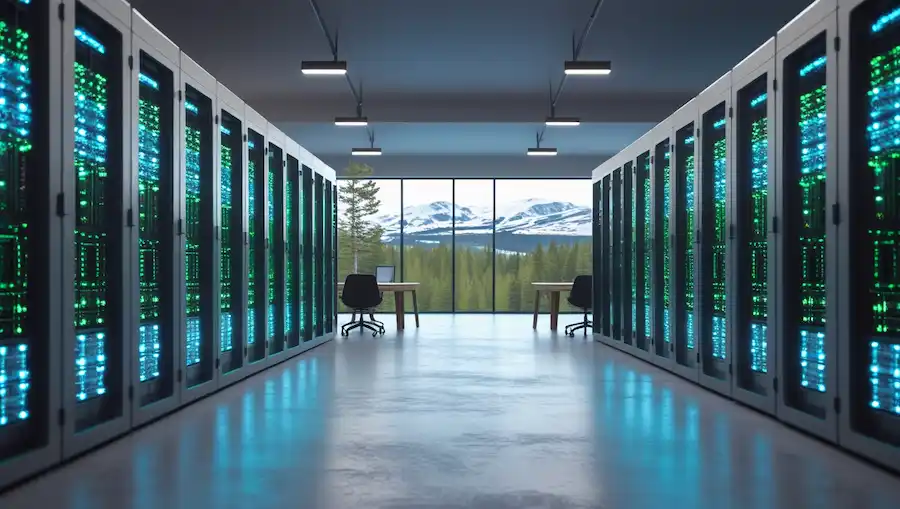
TAG_OPEN_div_143 The importance of data centers is increasing in Nepal as well. As the use of technology increases and every sector is dependent on technology, the investment in data centers, its importance and necessity is increasing.
On May TAG_OPEN_div_141 7, some Nepalese entrepreneurs announced the construction of a data center called Tier-4 Hyperscale Bichuten Data World in Kathmandu and Birgunj. The company has already announced to invest around Rs five billion in both the places.
Not only that, Finance Minister Dr. Swarnim Wagle also met with the investors of Bichuten Data World and pledged that the government would provide necessary support for the construction of the data center.TAG_OPEN_div_139 Minister for Information and Communications, Dr Bikram Timilsina, has said that the government would study the possibility of foreign investment in the construction of data center in Nepal. He said that the government has prepared a study plan to study the interest and possibilities of multinational companies in the data center.
The use of digital is increasing rapidly in Nepal.TAG_OPEN_div_137 Banking transactions are being done on mobile phones, government services are going online, video content is on the rise, social media is being used, and the number of people using artificial intelligence (AI) is growing. Data that was considered common until a few years ago has now reached the center of the economy, trade, security and government services. The data center is the basis for protecting, processing and operating this data.
Rohit Chandra Shah, director of Huawei Technology, who has been working in Huawei Nepal for the past 10 years, said that the importance of data is increasing not only in Nepal but all over the world.TAG_OPEN_div_135 Shah is Nepal’s first Accredited Tyre Specialist (ATS).
} “Now every sector is becoming technological, it has increased the importance of data center, earlier it was used only by telecom companies but now data center has become necessary for every sector,” he said.
According to Shah, Huawei has been providing data center solutions in Nepal for a long time.TAG_OPEN_div_131 “Huawei has been providing all services from data center construction, we have built more than a dozen data centers, small and large, now we are focusing on AI data center,” Shah said.
The
data center is not just a server building. In the future, data centers will become the backbone of AI, cloud computing, 5G, smart cities, automated industries, and digital economy. In particular, Huawei emphasized energy efficiency, smart management, high-efficiency computing and ‘green data center’.
“One digital KYC of the bank has increased from one to 15 MB. The more the use of digitalization increases, the more the need for a data center will increase,” said Shah, “The importance of the data center is that when there is a problem in the data center, the whole system will be affected.” ”
Data Center Status in Nepal
Currently, both the government and private sector are investing in data centers in Nepal.TAG_OPEN_div_123 The government is also forwarding the policy of taking government services online under the ‘Digital Nepal’ campaign. Government data management is being done through the National Information Technology Center and plans are also being made to expand the government cloud system in the future.
TAG_OPEN_div_121 The Government of Nepal is operating an Integrated Data Management Center in Singha Durbar. The data center was built in 2009 with the grant from the Korean government, and has been responsible for all the work from domain registration to website hosting, providing the IT infrastructure required for the government agencies’ electronic services, operation and management of the Singha Durbar network infrastructure, and backup of government data.
Apart from this, the government organization of Nepal Telecom’s data centers located in Jawalakhel and Bhairahawa as well as the telecom and internet service providers like H&Ncell, WorldLink are expanding their data infrastructure.TAG_OPEN_div_119 Ncell’s data center at Nakkhu, NEA’s data center at Syuchatar and Worldlink’s data center are among the big ones in the country.
Nepal can become a regional hub{
According to experts, Nepal’TAG_OPEN_div_115 s data center industry is still in its infancy. However, experts say that Nepal can become a regional ‘hub’ for data centers. They believe that Nepal can become a data center center not only due to the investment in data center in recent years, the interest shown by foreign companies but also due to the availability of cheap energy and geography.
Nabin Agrawal, Managing Director of Bichuten Data World, acknowledged TAG_OPEN_div_113 that Nepal could become the hub of a data center. “Investment in data center is increasing due to the increasing use of technology, we have decided to invest in this area after carrying out research for one and half years.
When the climate in Nepal is colder, less energy is consumed for cooling.TAG_OPEN_div_111 The operating cost is also low compared to other countries, and if we can provide service at a very low cost, Nepal can be developed as a regional data hub, said Shah, director of Huawei Technology.
Data center industries around the world are now moving towards a new cooling system because GPU servers used for AI produce a lot of heat.TAG_OPEN_div_109 Since AI data centers consume a lot of energy, power management and heat control will be the most important topics.
The company is now increasing investments in cloud computing, AI infrastructure, smart energy systems, and data center solutions worldwide.TAG_OPEN_div_107 Currently, Huawei claims to be the only one developing a “one-stop solution” for AI data centers. Under this, the company has made a strategy to connect the electricity system, backup power, smart monitoring, network, humidity management and cloud system into a single structure.
Future datacenters will be fully automated. With the help of AI, it will be able to monitor temperature, power consumption, network status and potential risks. This will reduce operating costs and make the data center more secure and energy efficient.
Huawei has also emphasized the concept of ‘modular data center’ by
. This means that it can be expanded, built quickly and operated at a lower cost. The company says that such a model can be useful for developing countries.
The company has also paid special attention to the electricity system used in the data center. The company seems to be focused on developing a highly reliable UPS system and backup solution as even a few seconds of power outage in the data center can cause a huge financial loss.
TAG_OPEN_div_99″Currently, there are data centers up to Tier 3 in Nepal, the construction of hyperscale data centers has not been completed, although it seems that it is in the process of being built,” said Shah, “Huawei is also developing according to this and using advanced technology to build data centers.” According to him, the big data of Nepali users is dependent on foreign servers and international cloud platforms, if a data center is built in Nepal, data security and data sovereignty can be maintained.
Data Center parameter
}
Earlier, there was no special law regarding the construction of data centers. However, the government recently released Data Center and Cloud Services (Operation and Management), 2081. Accordingly, data centers are now being operated.
TAG_OPEN_div_93 The Uptime Institute is a global standard for data centers. This is an international organizational standard. This criterion assesses a data center’s reliability, security, and uptime. Simply put, it checks how reliable a data center is and how long it can operate without interruption.
This organization has developed a system to classify data centers into four levels (Tier 1 to Tier 4).TAG_OPEN_div_91 Tier one is the most basic level, with limited infrastructure and a low backup system, which can lead to minor maintenance or technical disruptions. Even if there is some improvement in Tier Two, complete safety is not ensured.
Tier 3 is considered to be a high reliability level, where service can be operated continuously even during maintenance, due to adequate backup systems and redundant infrastructure.TAG_OPEN_div_89 Banks, telecommunications, and large digital service providers often use this level of data center. Ncell’s data centers at Nakkhu and Syuchatar of Nepal Electricity Authority fall under Tier III. Tier four is the highest level, where if one system has a problem, the next backup will not be activated immediately and the service is interrupted, ensuring almost 100% uptime. Recently, it was announced for the construction of Tier Four Data Center in Nepal.
The Uptime Institute’s certification is very important in the field of banking, telecommunications, e-governance and cloud services as it certifies the reliability of any data center to international standards.TAG_OPEN_div_87
The other is an ANSI (American National Standards Institute) standard data center. Building Industry Consulting Service International (BICSI) is another standard. These international organizations provide standards, training and certification related to information and communication technology (ICT) and indoor technical infrastructure.
How challenging is ?
Data center construction is a very expensive infrastructure. The cost is very high because of the need for high-capacity electricity, cooling system, cyber security, network and skilled technical manpower. Nepal still faces challenges related to power supply stability, high-quality internet, international connectivity, and cybersecurity.
On the other hand, there are no clear legal provisions and policies regarding data yet fully developed. In the future, the issue of where to store data, how to protect it, and how much access to foreign companies will be more sensitive.
With the expansion of AI, the risk of cyber attacks is also increasing. Therefore, along with the construction of data centers in the future, there is a need to give equal priority to the development of cybersecurity infrastructure.















प्रतिक्रिया दिनुहोस्