

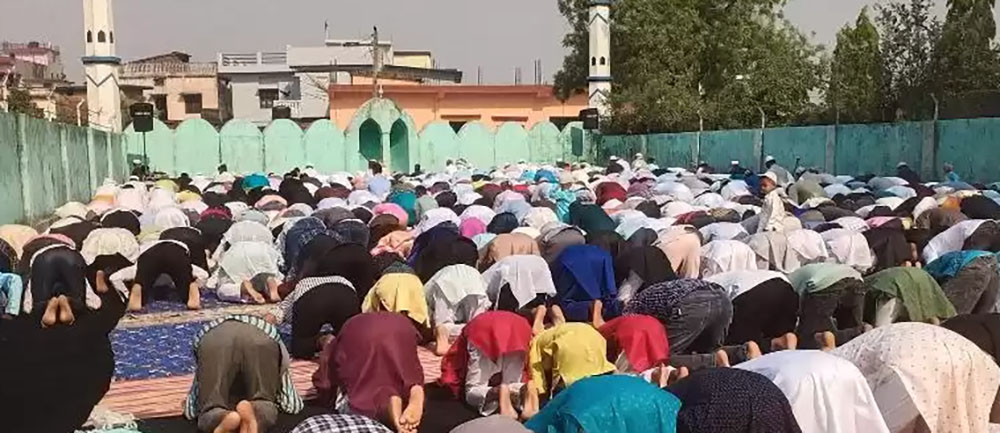
Kathmandu. KATHMANDU — The Muslim community across the country is celebrating their second biggest festival, the Bakar-Eid (Eid-ul-Zoha), across the country today.
Eid al-Fitr is celebrated on the 70th day of Ramadan. It is customary for the Muslim devotees to take a bath early in the morning and then go to the nearby mosque or Idgah to offer collective Namaz. After reading the Namaz, greetings are exchanged with each other.
On this occasion, Muslim devotees throng the Nepali Jame Masjid, Kashmiri Masjid and other mosques and Idgahs across the country. According to Nirdosh Ali, former chairman of the Muslim Commission, the festival is being observed commemorating the time when Ibrahim was ready to sacrifice his son Isma’el–Salam at the command of Allah at the command of Allah as per the Hijri calendar.
Muslim cleric (cleric) Rahmat Ali said the lineage of Ibrahim, which formed the basis of the historic Bakar-Eid festival, continued with the birth of Muhammad (peace and blessings) in Mecca in 571 AD. He said that he composed the holy book called Hadith, making an important contribution to the passing of this festival and religion from generation to generation.
“Salallah, who was born in Mecca and moved to Medina at the age of 53, has a history of being taught in a Muslim religious school (madrasa). In memory of this, a big fair is held at both these pilgrimage sites in Saudi Arabia,” Maulana Ali said.
The Ministry of Home Affairs has been arranging two-way air tickets to go to Mecca and Dina on the occasion of the festival. Even the pilgrims who are not allowed to go to Mecca celebrate Bakar-Eid at their doorsteps. The main purpose of this festival is Hajj. In this festival, Muslims sacrifice animals that are considered legitimate to please Allah.
According to religious beliefs, Allah’s Apostle Ibrahim Ali Salam was ordered to sacrifice his son Ismail to his wife Hazra at the age of 90. There is a religious belief that if Allah pleases, it is not the sacrifice of Ismail, but the sacrifice of Dumba raised in heaven (Janant). That is why Muslims say that the practice of sacrifice has been maintained.
It is said that childless Ibrahim prayed to Allah for a child. Muslims believe that Allah should sacrifice in a dream as a test for him, in accordance with Ibrahim’s promise that Allah will sacrifice him if he gives him happiness.
There is a legend that he wanted to persuade Allah by sacrificing his most beloved child in the end when Allah did not please him even after sacrificing many animals. At this time, after his test proved to be successful, it is said that the sacrifice of Dumba (sacrifice) was not a man in the place where he was sacrificed.
According to tradition, the meat is divided into three parts. According to the Muslim religious belief, one part should be given to the poor and poor families, another part to one’s friends and the third part to oneself. Accordingly, the first day of Bakar-Eid is being celebrated today.
The festival is being observed for three days by the Muslim community. According to the Nepali Jame Masjid, it is the custom of Muslims to sacrifice on all three days. The government has declared a public holiday today on the occasion.












प्रतिक्रिया दिनुहोस्