

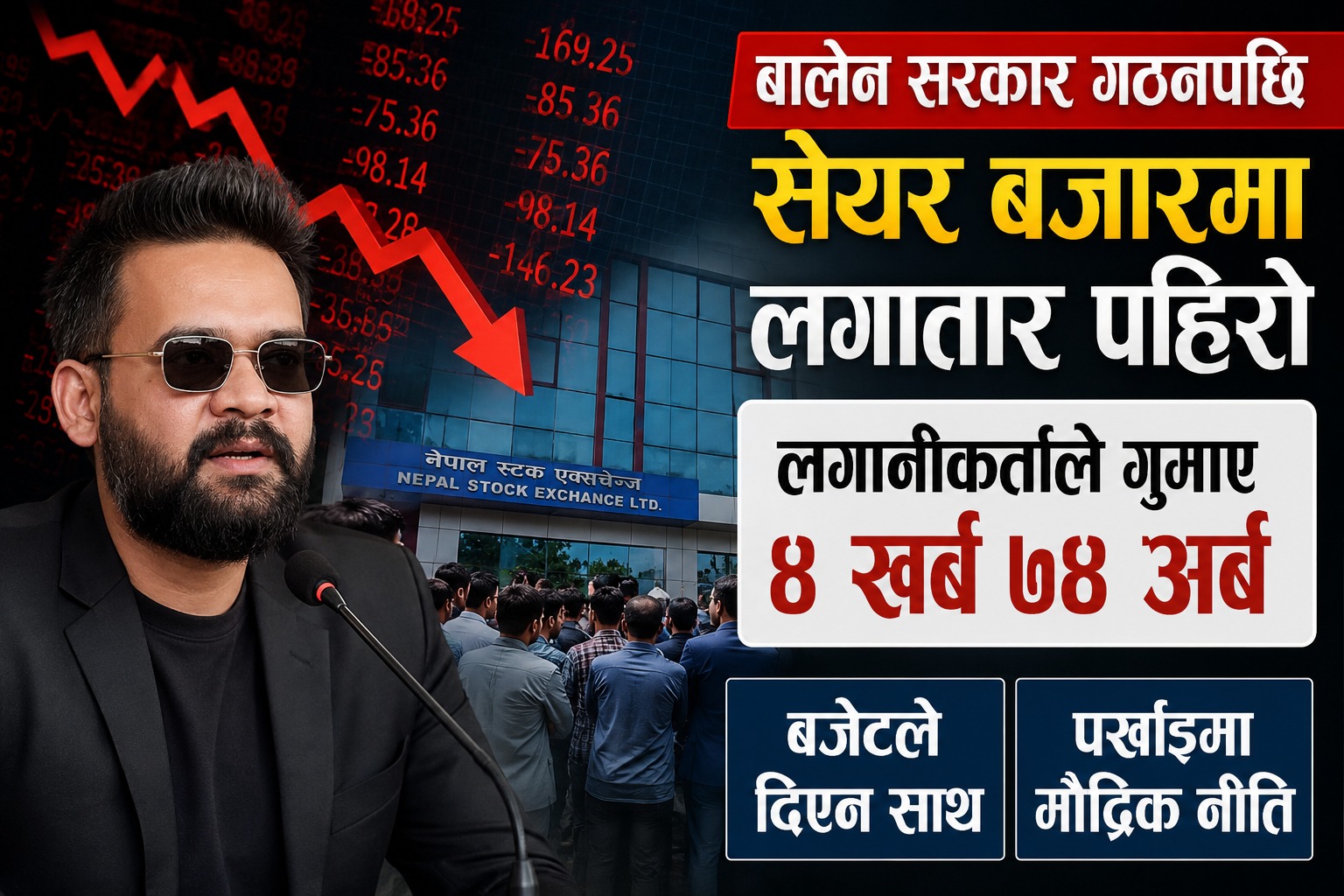
Kathmandu. The formation of a new government after the Genji movement was expected to bring policy stability, revive capital markets and boost investor confidence. However, the Nepal Stock Exchange (Nepse) index has been continuously on a downward trend during the three months of the formation of the new government under the leadership of Balen.
Although the government has made several important policy provisions for capital market reform from the election manifesto to the budget for the coming fiscal year 2083/84, it has not been able to make a positive impact on the stock market.
On the other hand, lawmakers of the ruling party are also reassuring investors by urging investors to remain optimistic about the market and not to sell shares in panic. Hari Dhakal, a lawmaker of the Rastriya Swatantra Party, expressed confidence that the share market would pick a positive rhythm in the coming days and urged the investors not to sell their shares in panic. However, the government’s policy arrangements and the reassurance of the ruling party lawmakers have not been able to generate the expected enthusiasm in the market.
Since the formation of the government, the stakeholders of the capital market have been demanding that Finance Minister Dr. He has been meeting with Dr. Swarnim Wagle from time to time to draw attention to the problems seen in the market, policy confusion and the need for reform. Shortly after the formation of the government, the office-bearers of the Nepal Stock Brokers Association had reached the Finance Ministry in April last year and held discussions with Finance Minister Wagle.
During the meeting, the demands included the implementation of the recommendations of the capital market reform taskforce along with the continuous fall in the share market, declining morale of investors, expansion of the scope of broker business, making the market more transparent and technology-friendly. On the occasion, Finance Minister Wagle assured that the government was positive towards capital market and that investors need not panic and necessary policy-level reforms would be forwarded with priority.
Similarly, the office-bearers of the Brokers’ Association met Finance Minister Wagle again and discussed the issues related to capital market reform, even as the budget for the coming fiscal year 2083/84 was being prepared. During the meeting, they urged the government to include capital market-friendly policies and systems through the budget, to take decisions to boost the morale of the investors and to expedite the reform agenda that has been left for a long time.
Various investor organizations, including brokers, have also been suggesting the government to reform the stock market time and again. Finance Minister Wagle also said that the government was committed to the development of the private sector and capital market and expressed commitment to address the issues of reform through the budget and upcoming policy programmes. However, its positive impact has not been seen in the stock market. According to stock market expert Rajan Lamsal, the main reason for investors not being active in the market is money laundering.
The Department of Money Laundering (PMLA) has brought most of the employees, businessmen and people directly or indirectly involved with the stock market under the purview of the investigation and indicated that the rest will also be brought under investigation. This has created an atmosphere of fear among the employees and businessmen, so they are not willing to invest in the stock market.
Since the formation of the new government under the leadership of Balen on March 23, the NEPSE index has decreased by 229.60 points. The total market capitalization of the listed companies decreased by Rs 360.11 billion during the period, the data showed. 
The stock market, which was at 2950.16 points on March 27, was 300.00 points in three months. Down 65 points to 2649. 51 points remained. Similarly, the market capitalization of the market capitalization has decreased to Rs 4.534 trillion as of June 27 from Rs 509.38 billion on March 27.
Investors have assets worth Rs 474.69 billion in the market. As a result, investors’ morale towards the stock market is weakening. 
The government has been announcing that it has been trying to address many of the demands raised by the investors for a long time through the budget for the coming fiscal year, keeping the stock market reform at the center.
The government has decided to treat capital gains tax as the final withholding tax, one of the most important of them. The government hopes that this will end the tax confusion that has persisted in the past. However, experts in the concerned sector have been saying that there is still confusion in this system. As a result, there is no positive atmosphere in the stock market, says Lamsal.
Similarly, the budget has announced to amend the law to allow Non-Resident Nepalis (NRNs) to invest legally in the secondary market. If this system is implemented, foreign currency and new investment are expected to come to Nepal. Likewise, NEPSE will be restructured to operate intraday tracing, short selling and derivatives equipment in a phased manner. These arrangements are considered important in the direction of modernizing the capital market according to international practice.
The government has also proposed a policy to enhance institutional capacity of the Securities Board of Nepal (SEBON), make its trading system technology-friendly and further strengthen the investor protection mechanism. It has also been clarified that a zero-tolerance policy will be adopted against illegal activities such as share cornering and insider tracing in the market. This is expected to make the market more transparent and credible.
Similarly, the government has proposed that the Nepali companies listed in the budget through the budget for the coming fiscal year can be listed in the foreign securities market by issuing Global Depository Receipt (GDR). Investors see this as an important step to connect Nepal’s capital market with the international market.
Similarly, the government has announced that the government will retain 66 percent ownership in Nepal Telecom and the remaining shares will be sold to the general public. The government has announced through the budget that it will issue IPOs of companies including National Life Insurance Company.
Similarly, the government’s policy of merging Hydroelectricity Investment and Development Company Limited (HIDCL) with another financial institution with similar objectives in order to make the infrastructure sector more effective in the interest of the stock market. This has strengthened the possibility of merger with Nepal Infrastructure Bank (NIFRA).
What will be the part of the implementation of the provision made by the government in the budget? People in the concerned sector are of the opinion that there is no enthusiasm in the stock market due to this strangeness. Similarly, Lamsal believes that the government’s action against money laundering has also not shown enthusiasm in the share market.
Similarly, investors are in a wait-and-see situation to see what monetary policy the central bank will arrange for the coming fiscal year. Investors and brokers have already suggested what the monetary policy should be for the coming fiscal year. Investors say that if the monetary policy is in place, there will be a positive environment in the stock market.














प्रतिक्रिया दिनुहोस्