

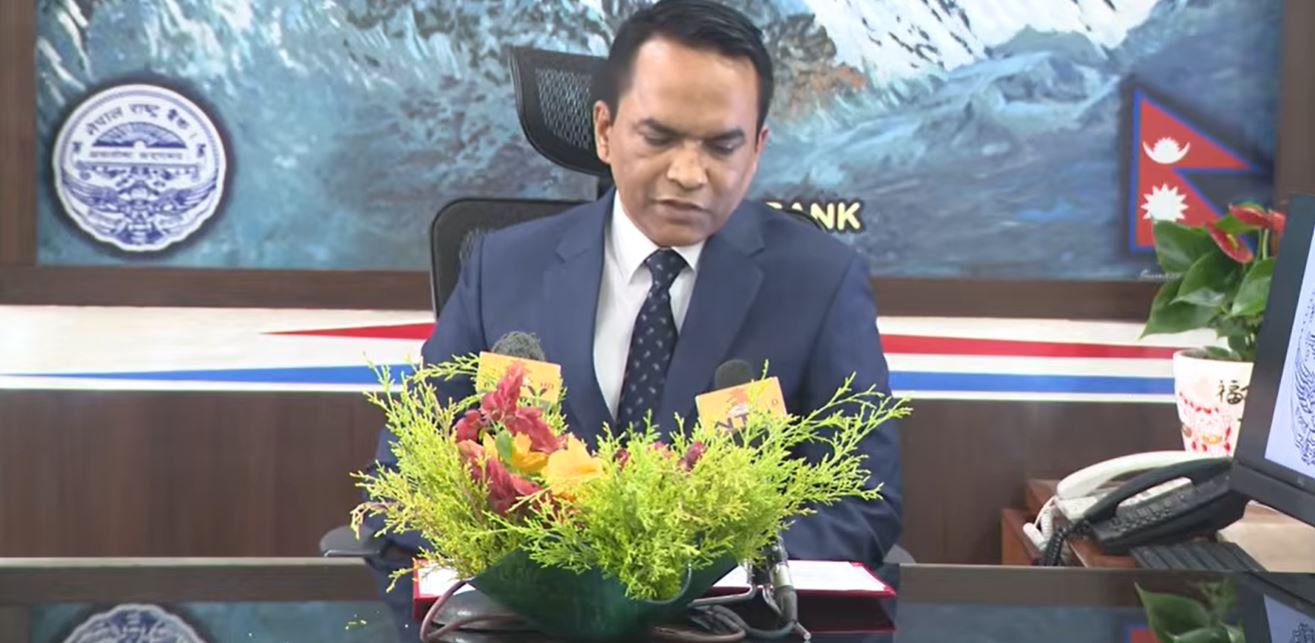
Kathmandu. KATHMANDU: Nepal Rastra Bank (NRB) has released the Monetary Policy for the fiscal year 2083/84 BS today.
The Monetary Policy unveiled by the Nepal Rastra Bank (NRB) has made one and a half dozen provisions in it.
The monetary policy states that commercial banks will be encouraged to invest in foreign government bonds to facilitate liquidity flow management through the purchase of foreign currency and will make sterilized interventions at the time of purchase of foreign currency.
Accordingly, the regulatory provisions to encourage banks, financial institutions and non-bank financial institutions to expand their services in the targeted areas will be gradually implemented after completing the ongoing study on the classification of banks and financial institutions.
Monetary policy has a dozen and a half arrangements
Monetary Policy Direction
Although there is some pressure in inflation due to external pressures, it is expected to ease gradually. Given that the current foreign exchange reserve situation is favourable and the macroeconomic scenario is favourable, the government has continued the cautiously flexible course taken to boost the morale of the private sector while maintaining a low-cost economy to support the goal of high economic growth.
Structure and Goals of Monetary Policy
– Monetary liquidity and foreign exchange will be managed to achieve 7 percent economic growth by maintaining inflation of around 5.5 percent in the fiscal year 2083/84 and sufficient foreign exchange reserves to sustain the import of goods and services for at least seven months.
– The stable exchange rate of the Nepali rupee with the Indian rupee has been taken as a curb of the monetary policy and it has been kept unchanged as an interim goal.
– Open market transactions will be conducted in such a way that the interbank rate will be maintained at par with the policy rate by keeping the weighted average interbank rate of the banks and financial institutions as the operating goal of the monetary policy. For this, depending on the nature of liquidity, different duration instruments will be used for structural liquidity and regular and contingent liquidity management.
Monetary instrument
– The policy rate, fixed deposit facility rate and bank rate under the interest rate corridor have been kept unchanged.
– The existing provisions relating to mandatory cash ratio, statutory liquidity ratio and permanent liquidity facility have been continued.
– In order to facilitate liquidity flow management through the purchase of foreign currency, commercial banks will be encouraged to invest in foreign government bonds and a policy arrangement will be made to sterilize the purchase of foreign currency.
Macroprudential regulation and financial stability
– The practice of using macroprudential regulatory tools will be continued on the basis of the experience that monetary policy alone is insufficient to mitigate such risks when there are signs of systemic risk in any sector of the economy.
– In order to make the dissemination of monetary policy more effective, a policy will be adopted to improve the quality of services received by the consumers by reforming the financial sector and reducing the financial cost through branch management and digitization of banks and financial institutions.
– Regulatory provisions will be gradually implemented to encourage banks, financial institutions and non-bank financial institutions to expand their services in the targeted areas after completing the ongoing study on the classification of banks and financial institutions.
Special policy provisions will be made to eliminate the situation of creating unlimited liability from personal guarantee as a security of loans, to reduce the situation of obstruction in access to banking services due to blacklisting due to cheque dishonor, to manage the non-performing loans in sick industries, to revive the loans under pressure, to determine the limit of share mortgage loan on the basis of the strength of the institution and to ease the loan-value ratio of large electric vehicles used as public vehicles ।
– Directives to banks and financial institutions will be simplified to emphasize simplified regulation and strong supervisory functions, removing linguistic complexities and duplication. In the first phase, the directives related to credit flow, interest rates and financial customer protection will be rewritten.
– The integrated circular issued by the bank to the institutions carrying out foreign exchange transactions will be simplified by facilitating the existing provisions related to foreign exchange exchange.
– A study will be conducted on the conduct of peer-to-peer transactions based on the individual credit scoring system.
– The national commitments issued by the Government of Nepal, one hundred agendas related to governance reforms and the programs related to Yes Bank mentioned in the budget statement will be gradually implemented in coordination with the concerned bodies.
Future Guidance
Although there is some pressure in inflation due to external pressures, it is expected to ease from next month. As inflationary pressures are expected to ease gradually, the overall price situation next year is likely to remain within the range projected by the Bank.
If inflationary pressures increase, the public and private sectors are unable to reap the expected benefits from a low-cost economy with sufficient liquidity, and challenges to macroeconomic stability are seen, the monetary policy line will be reviewed and the existing interest rate corridor will be gradually narrowed as needed.
– The comprehensive prudential regulatory tools adopted by the Yes Bank will be adopted with a policy of not modifying except in urgent cases. This is expected to maintain policy stability and manage market expectations.












प्रतिक्रिया दिनुहोस्