Monetary policy to compensate for the 7 percent economic growth taken by the government: What did the private sector, stock investors get?
व्यक्तिगत जमानीबाट असीमित दायित्व सिर्जना हुने अवस्था हटाउने प्रावधानलाई प्राथमिकता: प्रवक्ता पौडेल
लगानी न्यूज
. KATHMANDU: Nepal Rastra Bank (NRB) has brought a flexible monetary policy to compensate for the government’s target of 7 per cent economic growth rate in the coming fiscal year.
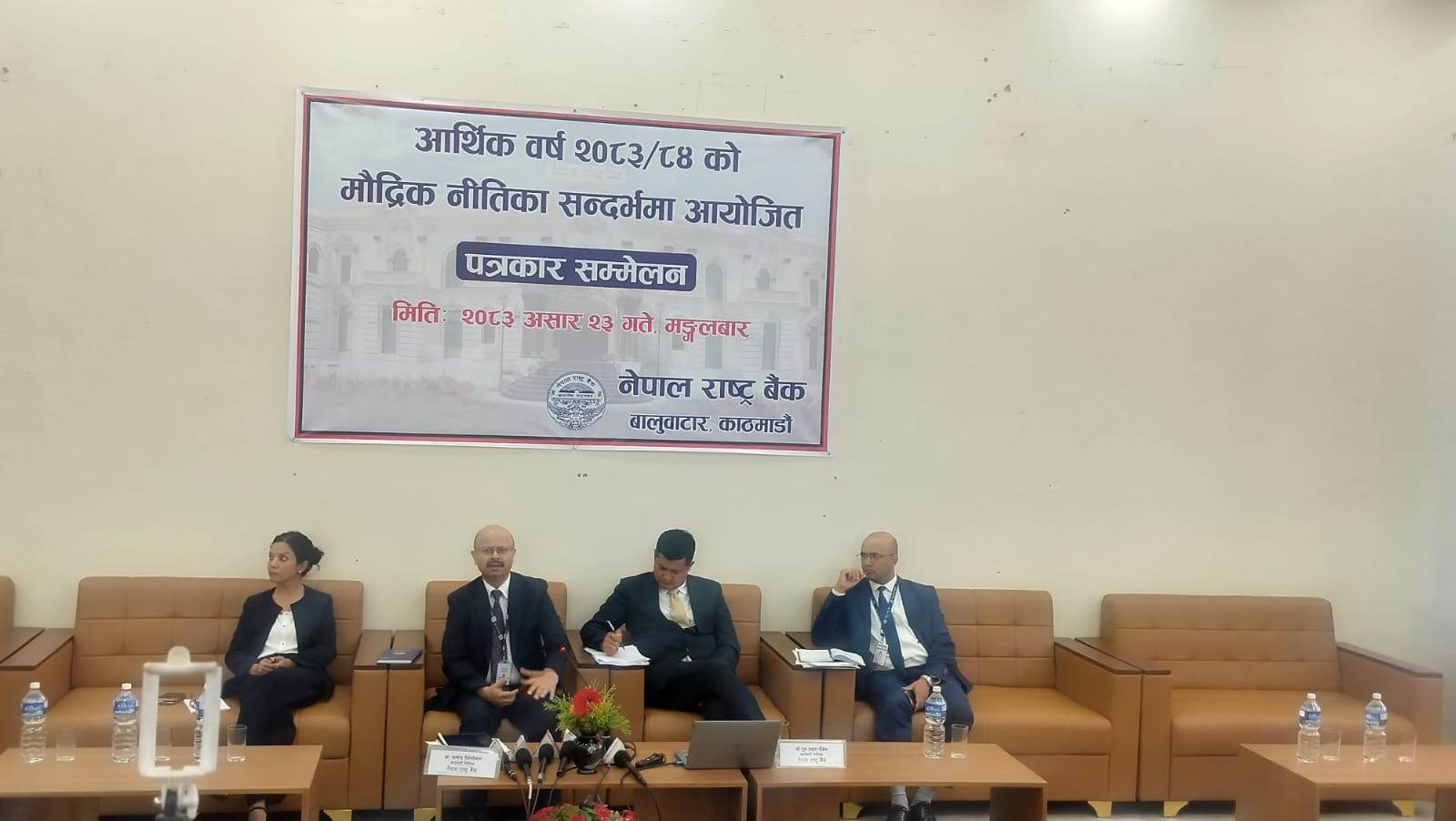
Unveiling the Monetary Policy for the coming fiscal year TAG_OPEN_div_71 2083/84 BS, Governor of Nepal Rastra Bank Dr Bishwanath Poudel said that the monetary policy has been brought to support the economic growth of the government.
Stating that the banks and financial institutions have extended loans worth around Rs 600 TAG_OPEN_div_69 0 billion, Governor Poudel said that the government would meet the target of economic growth by expanding loans by 11 percent or Rs 652 billion in the coming fiscal year.
Nepal Rastra Bank (NRB) Spokesperson Guru Prasad Poudel said that the monetary policy has been brought to support the government’s 7 percent economic growth.TAG_OPEN_div_67 “The monetary policy has been brought in a way to complement and support the policies, programmes and budget unveiled by the government in the coming fiscal year.
TAG_OPEN_div_65 The Nepal Rastra Bank (NRB) has prioritized the provision in the Monetary Policy to remove the situation of creating unlimited liability from personal guarantee as a guarantee of loans. Spokesperson Poudel said that this provision would make it easier for the borrowers to some extent.
The monetary policy also mentions some easing to reduce the situation of blacklisting and obstruction in the access to banking services due to disrespect of cheques. Spokesperson Poudel said that it would be easier for the entrepreneurs and entrepreneurs to make legal provisions in a different way instead of being blacklisted due to disrespect of cheques.
The Nepal Rastra Bank (NRB) has adopted a policy in the monetary policy to promote the sick industries with new plans, ideas and vision.TAG_OPEN_div_61
Executive Director of the Nepal Rastra Bank (NRB), Dr Satyendra Timilsina, said the monetary policy was brought to encourage those who came up with a new vision and vision to restart the sick industries through the monetary policy.TAG_OPEN_div_59 “We have introduced this policy to manage the non-performing loans of the sick industries as well as to revive the non-performing loans and bring the institutions back to their previous state,” he said. ”
The Nepal Rastra Bank (NRB) has made a special policy arrangement to determine the limit of share mortgage loan on the basis of the strength of the institution and to facilitate the loan-price ratio of large electric vehicles used as public vehicles.TAG_OPEN_div_57
} The monetary policy includes the policy of reducing the financing cost to the banks and financial institutions through digitalization and transferring the result to the customers and enhancing the quality of services received by the consumers. Likewise, a policy has been adopted to gradually implement regulatory provisions to encourage banks, financial institutions and non-banks and financial institutions to expand their services in the targeted areas by completing the study on the classification of banks and financial institutions.
Spokesperson Poudel said that the government is trying to present the monetary policy for the coming fiscal year on the basis of three different documents.TAG_OPEN_div_53 “In the past years, everything was brought by incorporating everything in one place but in the monetary policy of the coming fiscal year, three different documents have been presented separately,” he said.
The central bank has separately released the Monetary Policy Review, Macro Economic Report, Analysis and Outlook for the fiscal year 2082/83 and the Monetary Policy 208 TAG_OPEN_div_51 2/83 separately.
The central bank has forwarded the policy to manage monetary liquidity and foreign exchange required to achieve 7.0 percent economic growth by maintaining inflation of around 5.5 percent in the fiscal year 2083/84 and sufficient foreign exchange reserves to sustain the import of goods and services for at least seven months.TAG_OPEN_div_49
} The Monetary Policy has introduced the policy of conducting open market transactions by keeping the weighted average interbank rate of the banks and financial institutions unchanged and keeping the interbank rate equal to the policy rate. Similarly, the monetary policy states that instruments of different duration will be used for structural liquidity and regular and emergency liquidity management depending on the nature of liquidity.
The Nepal Rastra Bank (NRB) has kept the policy rate under the interest rate corridor, fixed deposit facility rate and bank rate unchanged in the monetary policy for the coming fiscal year.TAG_OPEN_div_45 Likewise, the monetary policy has given continuity to the existing provisions relating to mandatory cash ratio, legal liquidity ratio and permanent liquidity facility.
Nepalese banks can invest in foreign bank funds
The Nepal Rastra Bank (NRB) has made a policy of encouraging commercial banks to invest in foreign government bonds to facilitate liquidity flow management through the purchase of foreign currency for the first time through the Monetary Policy.TAG_OPEN_div_41
Executive Director Timilsina said that arrangements are being made for the banks and financial institutions of Nepal to invest in the securities and bond funds of the central banks of foreign countries.TAG_OPEN_div_39 The Nepal Rastra Bank (NRB) has included in the monetary policy to conduct necessary study on the operation of ‘peer-to-peer’ transactions based on the personal credit scoring system.
In addition, the monetary policy states that the national commitments issued by the Government of Nepal, 100 agendas related to governance reforms and programs related to the Yes Bank mentioned in the budget statement will be gradually implemented in coordination with the bodies concerned.TAG_OPEN_div_37










प्रतिक्रिया दिनुहोस्