

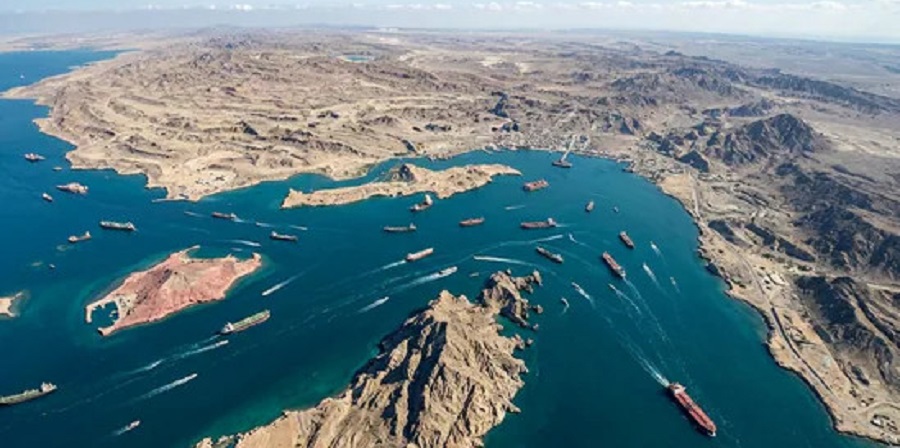
Kathmandu. The United States carried out air strikes on Iranian military installations on Wednesday morning after three commercial ships were attacked in the Strait of Hormuz.
At the same time, Iran has been seen firing missiles at Bahrain and Kuwait. The latest developments have dealt a serious blow to efforts toward a ceasefire and risks pushing the Middle East back into full-scale conflict.
The U.S. military said Tehran had retaliated against three commercial vessels operating in international waters.
With the attack, Washington also revoked permission to openly sell crude oil to Iran under an interim deal. Iran has strongly opposed the US move and has warned that it will take all necessary measures.
A missile warning was issued for Bahrain, home to the U.S. Navy’s Fifth Fleet, and Kuwait, a key U.S. military base. Preliminary reports have emerged that Iran has targeted both countries.
The incident took place during the funeral of Iran’s Supreme Leader Ayatollah Ali Khamenei. The funeral of Khamenei, who was killed in the early stages of the war on February 28 at the age of 86, is scheduled to take place on Thursday. The funeral was expected to allow the full reopening of the Strait of Hormuz and move forward in talks over Iran’s disputed nuclear programme. But the latest attacks have added uncertainty to such a possibility.
The speaker of Iran’s parliament, Mohammad Bagher Qalibaf, took to social media X to attack the US and its allies, saying Tehran would not bow to any pressure.
According to US Central Command, Iran’s air defense systems, radars and more than 60 high-speed small boats used by the paramilitary Islamic Revolutionary Guard were targeted in the attack. The US claims that the boats were involved in intercepting merchant ships in the Strait of Hormuz.
“This phase of the operation has been completed and the United States is ready to take further steps if necessary,” the Central Command said.
Iran has acknowledged the attack but has not released the casualties. According to state media, explosions were heard in the areas of Bandar Abbas, Qassem and Sirik. Iran’s Central Military Command has called the US action an act of terrorism and has threatened to give a decisive response. It also reiterated its stance that it does not accept any foreign interference in the management of the Strait of Hormuz.
Similar attacks and US retaliation took place in the Strait Valley late last month. At that time, there were attacks on Bahrain and Kuwait. The incident took place when US President Donald Trump was in Turkey for the NATO summit.
Meanwhile, the United States has revoked a license to openly export oil to Iran under an interim deal. The arrangement allowed Iran to openly sell oil in US dollars on the international market for years. Iran has been accused of selling crude oil to China at a discounted price, evading sanctions.
Britain’s maritime trade operations centre said the fire broke out when the ship hit an oil tanker as it was travelling off the coast of Oman. Iran’s state television ignored warnings and said another ship carrying liquefied natural gas (LNG) had been attacked, but did not directly claim responsibility.
The British Maritime Agency said there were two other ships with minor damage but no human casualties.
Since the start of the war, Iran has maintained strict control over the Strait of Hormuz. With about one-fifth of the world’s crude oil and natural gas transported through the sea, the instability there has a direct impact on the global energy market. The ships attacked on Tuesday used the Oman coast instead of the route assigned by Iran.
Tehran has repeatedly threatened to take action against ships that use other routes, claiming that only its approved route via Hormuz is safe.
“Iran is “fully responsible” for the attack on the Qatari tanker Al Rekayat, calling it an “unacceptable attack on international shipping and global energy security,” Qatari Foreign Ministry spokesman Majed al-Ansari said.
Iran and the United States agreed to an interim agreement allowing the ships to leave for 60 days free of charge. But the controversy has escalated after Iran proposed that the ship would determine its own route and charge for it in the future. The United States and most Gulf states have made it clear that they cannot pay any fees for using the Strait of Hormuz.











प्रतिक्रिया दिनुहोस्