

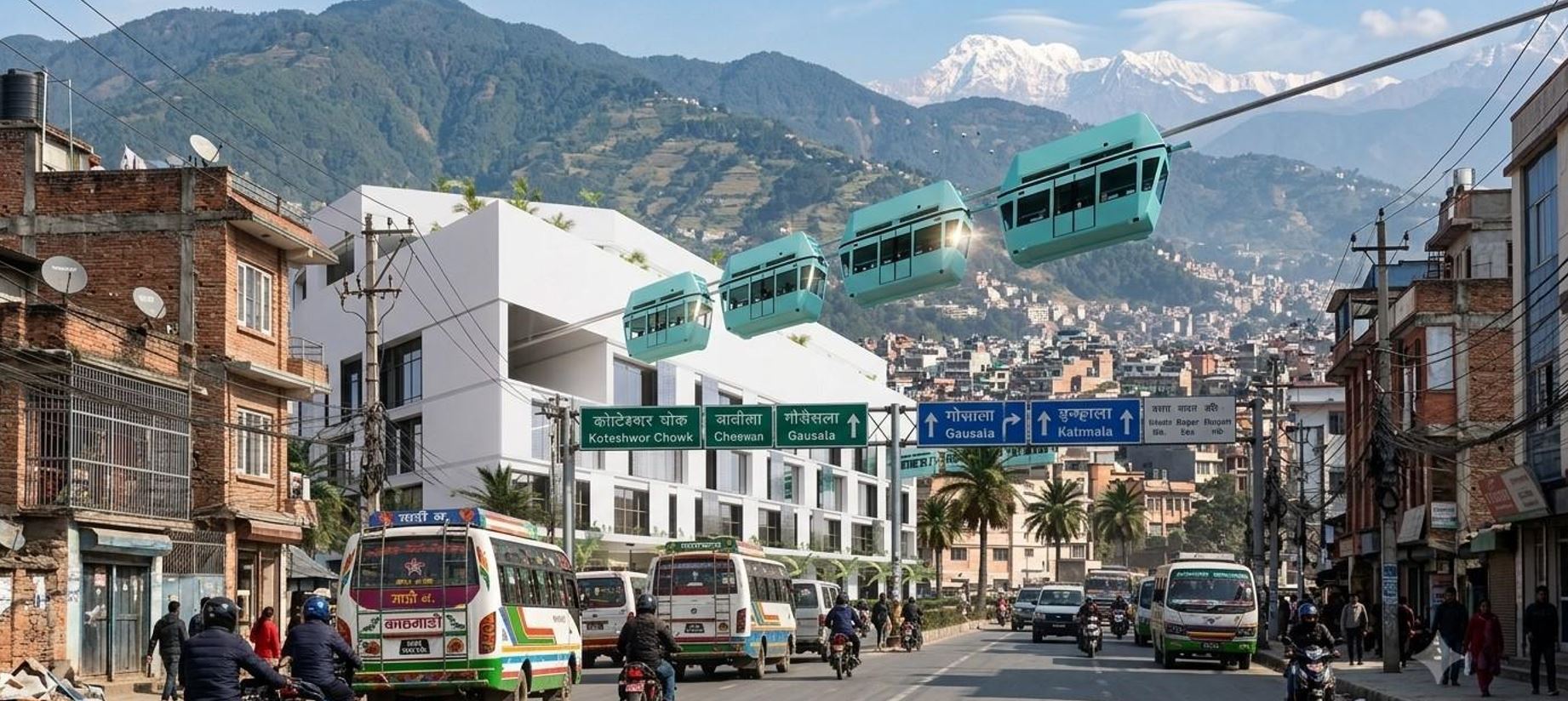
In the Kathmandu Valley, there is a queue of vehicles on the roads even before office hours start in the morning. When the office closes in the evening, the scene becomes even more complicated. The situation that takes hours to cover a distance of a few kilometers is not new to the residents of the capital.
Traffic congestion, air pollution and delay in travel have been seen as long-term challenges despite efforts to expand roads, construct new ring roads and construct new ring roads.
Not only Kathmandu, the management of public transport is becoming more challenging with rapid urbanization in major cities like Pokhara, Bharatpur, Butwal, Biratnagar, Nepalgunj.
In this context, Podway or Personal Rapid Transit (PRT) is being discussed as a possible alternative for Nepal among the modern electric public transport systems that are being used and tested by various countries of the world.
According to transport experts, the podway is not a conventional rail system, it is a public transport system that automatically transports passengers to their destinations via small electric capsules (pods). Normally, the pods, which can accommodate between two and 50 passengers, are operated by a computer system.
It is expected that the time will be saved and the service will be regular as the passengers will reach the destination directly without stopping unnecessarily in the middle of the pod. Some countries in the world are using this system successfully in limited areas.
The pod system, which has been in operation at UK’s Heathrow International Airport since 2011, allows passengers to move between the parking area and the terminal in a short period of time. It was also tested in Masdar City in the United Arab Emirates as an eco-friendly alternative to urban transport. Studies and plans for such systems are underway in South Korea, Sweden, India and other countries as well.
Nepal’s current transportation system is mainly dependent on road transport. Most of the roads cannot be operated throughout the year due to difficult geographical conditions, especially in hilly and mountainous areas. Due to its geographical location, scattered settlements and rapid urbanization, the construction and operation of road transport, which is considered the major infrastructure of development, is very expensive. Given the increasing urbanization and limited road infrastructure, it is necessary to study such alternative systems.
Although the road widening work is going on, the expansion of the road may not be enough as the number of vehicles is increasing rapidly. Since the pod can be operated on the track constructed through pillars above the ground, the need for additional land acquisition will be reduced and the congestion on the road surface can also be reduced to some extent. The distance between the support towers can be up to three kilometers, so large structures can be built in deep gorges, rivers and difficult hilly terrain.
The changes in the country’s energy sector have also increased the possibility of an electric public transportation system. There has been a significant increase in hydropower production in recent years and the government has adopted a policy to encourage electric vehicles.
It is expected that the operation of public transport using domestic electricity would help reduce dependence on imported petroleum products and help save foreign currency. Such a system is also considered important from the point of view of environmental protection.
Kathmandu Valley has been listed as one of the most polluted cities in the world time and again. Vehicular exhaust is one of the major sources of air pollution. Expanding electric public transport systems could help reduce both carbon emissions and noise pollution.
It is believed that such technology would also help implement the international commitments made by Nepal in mitigating the climate change. The podway can be used not only for passengers but also as cargo.
Another feature of this system is the fixed travel time. As there is no traffic jam on the road, office-going employees, students, tourists and service recipients can get the facility to reach their destination on time. The impact of irregularities, congestion and fuel price hike in public transport is also expected to be reduced.
It is also expected to give a new dimension to the tourism sector. If modern transportation service connecting Tribhuvan International Airport to Thamel, Pashupatinath, New Bus Park or other major tourist areas can be operational, it will be a smooth and attractive experience for foreign tourists. It has been pointed out as an international airport in Pokhara, Fewa Lake and major tourist areas and as an environment-friendly public transport within the religious area in Lumbini.
Nepal’s development can be possible through public-private partnerships, foreign investment, and technical cooperation. The Department of Transport Management has proposed a national network of 2,055 km of podway in the fiscal year 2082÷83 keeping in mind the economic, touristic and development of remote areas of the country. Legal and policy preparations are equally important to implement this technology.
Nepal does not yet have a clear legal provision regarding the operation of driverless public transport. However, some initiatives have already begun. While exploring various options of public transport, the government has taken some policy decisions considering podway service as a reliable option.
The recently approved National Transport Policy 2083 also acknowledges the need for podway services. In the budget of the fiscal year 2083/84, the government has abolished the Department of Railways and formed the ‘Railway Board’ and through this program the micro rail÷podway based on telegraph and AI technology has been included in the Kathmandu Valley.
A notice was published in the Gazette in 2080 BS based on the decision taken by 13 local levels of the Kathmandu Valley to implement this technology in the Kathmandu Valley. The High Powered Committee for Integrated Development of Bagmati Civilization had written to the Ministry of Urban Development in 2080 BS for the feasibility of operating micro-rail podway in the river corridors of Kathmandu Valley.
Similarly, the Podway technology has been included in the 16th Plan and the ‘Project Bank’ of the National Planning Commission. The Investment Board Nepal (IBN) has already made an important decision for the construction of Birgunj-Kathmandu trade corridor. Likewise, processes for expansion of Podway network in Koshi Province (7 km), Lumbini Development Trust (231 km) and Karnali Province (231 km) have been expedited.
Podway will not completely replace road transport. Instead, it can be developed as a complementary means of integrated public transport system with bus services, potentially metro or rail, ropeways, cycle lanes and pedestrians. Many cities around the world have preferred to build multimodal public transport networks rather than rely on a single system.
At a time when Nepal is prioritizing the promotion of electric vehicles, it is timely to start a study on the future public transport system. There is a need for research and debate on new technologies to address the increasing traffic congestion, pollution, dependence on fuel, and the need for safer public transport.
Podway can be an effective alternative to urban public transportation in the future if we move ahead with scientific study, clear policy, transparent investment arrangement and long-term vision based on Nepal’s geographical situation, economic capacity, passenger demand and technical preparedness.
In the journey of the country’s development, the question now is not only to build more roads but also to find a sustainable, safe and environment-friendly public transport system. The possibility of Podway starting a new chapter in urban transport management in the future cannot be ruled out if the new technology being developed in the world can be evaluated as per Nepal’s needs and capacities.
Krishna Adhikari/RSS














प्रतिक्रिया दिनुहोस्