


Kathmandu. KATHMANDU: Coordinator of the ruling Nepal Communist Party (NCP) Pushpa Kamal Dahal ‘Prachanda’ has insisted on the need of collaboration between the political parties and the media again for safeguarding democracy, republic, federalism and national independence.
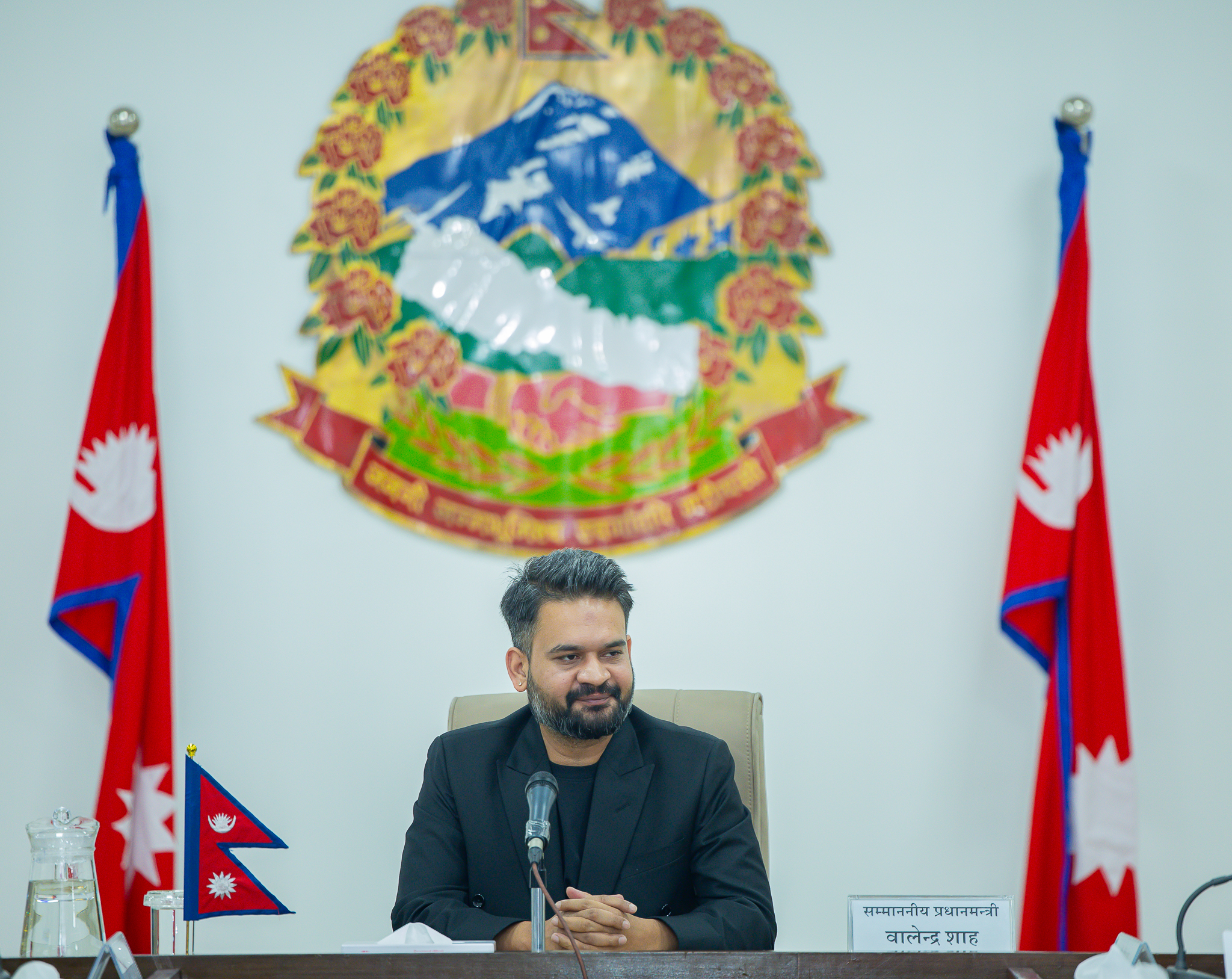
Talking to journalists on parliamentary affairs at Singha Durbar on Monday, Dahal talked about the working style of the government, character and working style of Rastriya Samajwadi Party President Rabi Lamichhane and Prime Minister Balendra Shah ‘Balen’, constitution amendment, the Genji movement of September 7 and 24, the impact of social media and AI in politics, left-democratic collaboration and the future political scenario.
‘I see myself even within the RSP’
Coordinator Prachanda said he had viewed the structure of the new parliament positively from the very beginning. Stating that the form of inclusion and proportionality has been seen in the parliament after the presence of a large number of Rastriya Swatantra Party (RSP), he said no matter which party wins, it should be seen from the perspective of ownership of constitution and change.
“Whichever party comes, I look at it with pride. I think I’m there,” he said. He, however, said he did not find the initial signs of a new government positive. Recalling that he had urged the people to be cautious of the signals given by the government in his first appearance in the parliament, he stressed the need for learning from past experiences.
‘Balen government is just a rumor that he will leave after Dashain and Tihar’
Prachanda claimed that the current government led by Balen would not be able to move forward in this style for long. He likened the government to a “ship that lost a compass at sea”.
“The government itself is immature and ideologically and politically directionless. It’s like a ship that’s lost in the sea, it’s like a compass that’s lost, so it doesn’t go very far, it can’t go that way,” he said.
He, however, rejected claims that the government would fall on a certain date or that a major political event would take place. “There is a large number of people who say that they do not go beyond Dashain and Tihar,” he said. ’
‘Government signals are not good, be careful’ {
Prachanda said that some activities and signs of the incumbent government were not positive. He recalled that in his very first address to the parliament, he had urged the government to be alert towards the signal.
“The government’s signals are not good, you should be cautious and learn from the past as well,” he said.
doubts whether the support base of the RSP will be sustainable
}
Prachanda also commented on the organization and people’s support base of the government-led RSP. He said that questions could be raised about the durability of the organization as the people connected to the street agitation and social media are not connected with the long-term political ideology and struggle. “We are afraid that we will all get lost while walking,” he said, referring to a RSP leader telling him.
He claimed that people who were attracted to the RSP in recent times are in a state of reconsideration. Prachanda said he saw a different situation in the aftermath of the agitation during his visit to all seven provinces. “It was before! In the beginning, it seemed that something would happen and now it seemed that all the remaining people would go away, but now it has stopped,” he said. He said that even in Madhes, people have started regretting choosing the RSP.
Alarm bells on national independence!
Prachanda said that in the present situation, national independence, territorial integrity and people’s sovereign rights have been challenged. “There are alarm bells on 2-3 issues. One, there is a challenge to national independence, territorial integrity and people’s sovereign rights,” he said.
Democracy, republic, inclusion and proportional representation are the achievements achieved through a long struggle, he said, adding that these should be safeguarded.
Uncomfortable not seeing an old friend in Parliament
}
Prachanda admitted that his attendance in the parliament was low in the recent period and made it clear that there was no disappointment towards the parliament because of it. According to him, he had to take rest for 15-20 days due to illness, then his visit to the state, party programs and Sri Lanka visit have reduced the number of people in the parliament.
“My attendance in parliament has decreased a bit, that’s true,” he said, “But that’s not because I didn’t come here because I was disappointed.” ’
Prachanda said that the present parliament does not have the same political experience and generational presence as in the past. He said that the absence of experienced leaders, including former prime ministers, and the presence of a large presence of the new generation makes it uncomfortable at times. “I saw my former friends, there were no one. The former prime minister had a line, but he didn’t. It was a mix of new and old, old and old, young people,” he said. However, he clarified that it would be wrong to say that this is the reason why he has stopped going to Parliament.
‘Attempt to rewrite the constitution, not amend’
Prachanda expressed serious objection to the debate on constitution amendment tabled by the government. He described it as an attempt to rewrite the constitution, not a simple amendment.
“It is not a debate paper to amend the constitution, but to amend all the provisions from the preamble to change the constitution,” he said.
According to him, some provisions could be amended on the basis of experience but the constitution itself could not be rewritten. “There can be revisions, some provisions can be amended and there cannot be rewriting based on experience,” he said.
Prachanda’s new assessment of Ravi Lamichhane{{TAG_OPEN_strong_154 TAG_CLOSE_strong_154}}
}
Prachanda said that he is in regular talks with Rastriya Prajatantra Party (RSP) President Rabi Lamichhane. He said that he has felt that political maturity has increased in recent times.
“Everyone has realized that there is comparatively political maturity in the sun,” he said.
He recalled that during Ravi’s political crisis, he had defended him from Parliament to public forums and met him in jail. “I’ve defended him a lot,” he said, “I’ve met him in jail, I’ve come out and spoken to journalists.” ’
He said that there has been some maturity in Ravi’s political behavior in recent times.
Prachanda said that the rhetoric against the ‘old parties and old leaders’ formed around September 23 and 24 has created a situation of problems for them to speak.
He complained that the tendency to present Prachanda in a negative way rather than saying that Prachanda spoke well even though he spoke well. He said that some intellectuals, administrators and journalists have also suggested that it would be better if they did not speak for some time. “If it is good, it will be broken,” he said. Curiosity can gradually increase as to why Kheri didn’t speak for a while. ’
“I’ve been told that I should speak less. Even now, you understand the matter till this morning! Please don’t speak,” he said.
But he claimed that he was not passive. He said he has been in all seven provinces of the country and is active in the party and public programmes.
Journalists and journalism are also under pressure along with the old leaders
}
He stressed the need of collaboration between the political parties, mainstream media and journalists to save the country and the system. According to him, the people’s war, the movement of 2062/063 BS and the dialogue between journalists and political parties have strengthened the change.
“The country has come back to peace due to the dialogue and cooperation of journalists and the agitators,” he said. But in recent years, social media and algorithms have challenged the role of established journalism, he said. “Along with the leaders of the old parties, you have to displace the journalists and install algorithms through social media,” he said.
‘Secularism removal debate unacceptable’
“Nepal is a multi-ethnic, multi-lingual and multi-religious country and the State should not give special protection to any religion or community,” he said. He also expressed concern over the Hindu-Muslim tension seen in Sunsari and Tarai-Madhes. He expressed dissatisfaction over the agreement reached by the government in the name of controlling tension.
“Secularism is defined by the belief that the state should not encourage anyone and not encourage others,” he said.
‘We need to review where we went wrong’
While reviewing the current political crisis, Prachanda said that the political parties should identify their own weaknesses before finding faults in others. “It’s one thing that others have made mistakes, but we have to review where we went wrong and what happened to this situation,” he said.
According to him, the political parties had moved ahead with a clear strategy from the People’s War to the peace process, the Constituent Assembly and the constitution making but then got entangled in power-centric politics.
When the constitution was promulgated, our attention was now drawn to the government. It has gone too far,” he said, adding, “We have been wandering around to become prime minister, minister, form government, topple government.” ’
‘We abandoned strategy and went to strategy’
Prachanda said that this is the main weakness of his political analysis. “We abandoned the strategy, we turned to tactics. Our opponent focused on strategy and limited tactics to tactics. As a result, we became weaker, they became stronger,” he said. According to him, the political parties were under the illusion that the nation was safe after the promulgation of the constitution and republic. “We are relieved, our nation is safe now,” he said. They are fully prepared for what to relax on. He made the remarks in the context of the involvement of the United States in the recent political developments.
Context of U.S. pressure on the peace process
Prachanda recalled that during the 12-point agreement and peace process, the then US Ambassador James F Moriarty had said that the Maoists should not be brought into the peace process. According to him, Moriarty had met leaders of various political parties in Nepal and pressured them not to compromise with the Maoists. “They were saying that the Maoists should not be brought into the peace process at any cost, they should not reach an agreement,” Prachanda said.
But due to the role of the then Indian government and Prime Minister Manmohan Singh, the US pressure could not succeed, he claimed. “America lost strategically, America lost in South Asia, we won,” he said. According to him, the political phase from peace process to constitution-drafting was possible in Nepal as the Nepali Congress, which was in power at the time in India, was liberal, democratic and secular.
‘The power to challenge us is not in ‘relax’
Recalling that they had faced blockade and attempts to stop elections after the promulgation of the new constitution, Prachanda said that the political leadership has become complacent after that.
According to him, the long-term strategic preparation was weakened when the political leadership took the achievement as the final victory. “We were more involved in the game of forming and toppling the government thinking that we had accomplished so many big things,” he said. ’
Political Ground Social Media
Prachanda said that street agitation alone will not be enough. He said that social media, AI and digital platforms have become new grounds for political influence.
“Now that public meeting is not going to do anything. Nothing will be achieved by taking out a procession,” he said, “Sitting in a room using mobile and using a computer at home can spoil people’s minds.” ’
He admitted that political parties have been slow to understand the impact of digital medium. “People are walking with us in processions, but their brains are gone. We didn’t know as much as we should,” he said.
Dialogue with NC-UML to save the provincial government
Prachanda said although they were not interested in changing the provincial government in the beginning, they had agreed to cooperate with the UML in the province government seeing that the opponents of federalism would benefit politically after the dissolution of the provincial assembly.
He argued that although NC and CPN-UML had urged to run the province government, there was no cooperation between them. He said that they have started talks saying that the situation of not even the budget being prepared in the Far-Western Provincial Assembly would strengthen the anti-federalism forces.
“The provincial assembly should be saved,” he said, “It can be a good issue for those who do not want federalism.” He further said that his efforts to form a province government with the help of NC, UML and NCP failed due to lack of preparedness for the NC leadership. He said that Nepali Congress President Gagan Thapa was adamant that a government should not be formed without an opposition.
Prachanda said that the leftist parties have agreed to cooperate in 5 provinces after they did not agree with the Nepali Congress. According to him, talks were held with the Nepali Congress and the UML in parallel. He made it clear that although it was not possible to form a coalition government in the provinces, they were not in the mood to minus the NC. “We are not trying to minimise the Congress,” he said, adding, “We are talking to Gaganji and Purna Bahadur.” ’
Contradiction between NC and UML
Prachanda said that different political currents have been seen in both the Nepali Congress and UML. He claimed that a new debate has started in the NC on the 12-point agreement, peace agreement and constitution-drafting process. “There is an attempt to create a stream that it was a mistake to compromise more with the communists,” he said.
He also said that there is a difference of opinion within the UML on the issue of leftist alliance.
TAG_OPEN_strong_143 Will the collaboration with Oli be long-term or not?
Prachanda said that the recent alliance with UML Chairman KP Sharma Oli should not be reached immediately. He said that although Oli has honestly talked about moving ahead by collaborating, its long-term form is yet to be seen. “The fact of the matter now is that he has said that he will cooperate with KP, he will be honest,” he said.
He, however, said that it will become clear with time whether Oli will use the cooperation only for managing the political turmoil within his party or for long-term political cooperation. Prachanda also urged the leftist alliance not to be taken as a power equation of any single party. Stating that dialogue was underway with the Nepali Congress as well, he underscored the need of extensive political collaboration for safeguarding democracy and the constitution. “This is not only the collaboration between the UML and the Nepali communists, it is the beginning of cooperation of all democrats,” he said.
}’Rights have no meaning if there are no nations’
He said that the political parties, journalists and conscious citizens should rise above the current power equation and give priority to the protection of national independence, democracy, republic, constitution and inclusion.
“If there is no nation, will we all survive? What is the meaning of the rights of all of us when the nation is in trouble?” he asked. He expressed the belief that the country could return to the democratic direction if national unity was maintained by protecting the recent political achievements. “We should be united,” he said, “I think there will be a change soon, there will be a change in the democratic direction.” ’












प्रतिक्रिया दिनुहोस्