

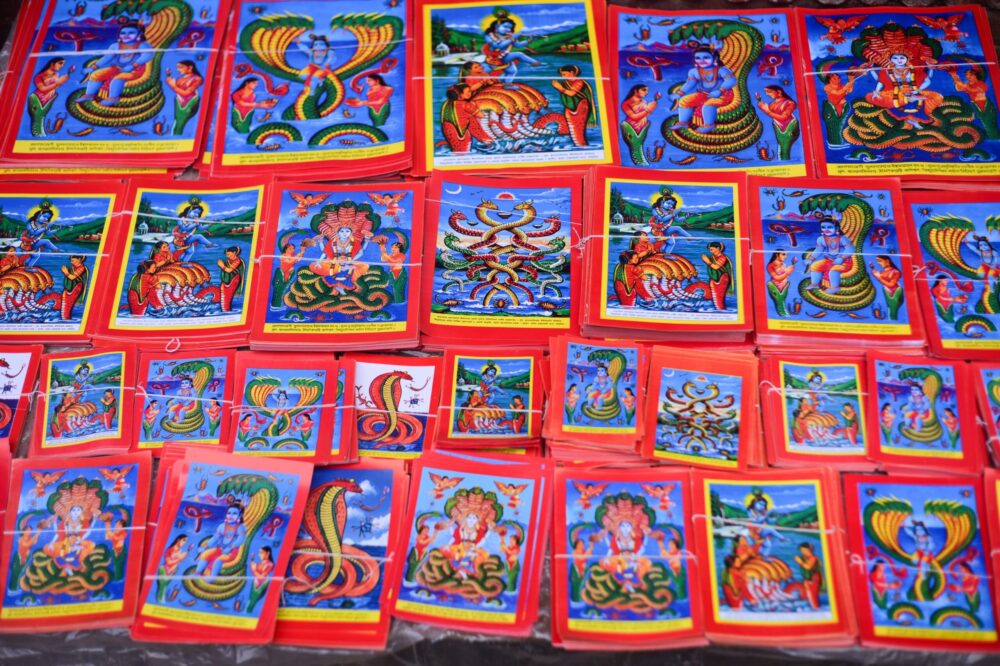
Kathmandu. The Nag Panchami festival is being observed today by worshipping the snake. This festival is celebrated by pasting the photo of the snake on the main door of the house.
Nag Panchami is celebrated every year on the fifth day of Shravan Shukla Panchami. This year, the festival falls on the first day of Bhadra as per the solar month. Former member of Nepal Calendar Determination Development Committee Prof Dr Devmani Bhattarai said there is a religious belief that pasting the picture of the snake will not only bother the snakes, scorpions and other creatures in the house throughout the year but also protect one from the fear of fire, clouds and lightning.
The practice of Nag worship is believed to have started from the Vedic period. According to Vedic beliefs, the snake is considered to be the king of snakes. If the snake gets angry, there is a shortage of water, so there is a tradition of worshiping the snake to please the snake for water. As mentioned in the Varaha Purana, this day is considered famous for snake worship as Brahma has a dialogue with Nagraj on Shravan Shukla Panchami.
There are snakes in every house. The tradition of worshipping the snake has been continued in the religious belief that if the snake sitting under the foundation of the house gets angry, the foundation of the house will collapse.
The tradition of considering the snake as Vishnu and Shiva has been going on since Vedic time. Lord Shiva wears a garland of serpents and Lord Vishnu sleeps on the bed of Sheshnag on water, so both gods are considered as serpents.
Lord Ganesh, who got the right to worship first, has a serpent in one hand. Lord Rama’s brother Lakshman, who was born as an incarnation of Lord Vishnu, and Krishna’s brother Balarama are also considered to be incarnations of Sheshnag.
It is mentioned in various Puranas that Lord Krishna had suppressed Kali Nag in his childhood. The idol of Buddha, who was born as the ninth incarnation of Lord Vishnu, has a serpent on its head in the form of a crown.
Matsyendranath has a garland of Karkotak Nag around his neck. Jain Tirthankaras also have a serpent-shaped crown on their heads. It is mentioned in the scriptures that Arjuna, the son of Pandu, and Chandragupta II married Nagkanya. It has been believed in our society since time immemorial that Lakshmi resides in the house in which the snake is worshiped.
There are various legends about how and why Nag Panchami was celebrated. One of the most famous legends is this. A farmer was digging his field when he found three baby snakes and killed them.
The mother of the child was angry with the farmer when she saw that all her children had died when she came looking for food. Nagini, who was furious with her, went to the farmer’s house and killed his wife and two sons.
Luckily, the farmer’s daughter managed to escape as she was out of the house. Nagini also went looking for the farmer’s daughter and tried to kill her on the way. After the farmer’s daughter pleaded in many ways not to kill her, I will worship you and let her drink milk, after which Nagini took pity and left the farmer’s daughter.
The farmer’s daughter, who was happy to be saved from the jaws of death, worshiped Nagini with soap and offered her milk in a bowl. Pleased with the prayer of the farmer’s daughter, Nagini said that she was pleased with her devotion and asked for a boon.
A happy Nagini saved the farmer’s family by saying ‘Aastastu’. In this way, it is believed that the tradition of worshiping the snake and sticking it in the house since Shravan Shukla Panchami i.e. today is the day when Nagini saved the farmer’s family.
Guru Gorakhnath meditated for twelve years sitting on the seat of nine snakes and as there was no rain while suppressing the snake, Matsyendranath, the guru of Gorakhnath, was called to Nepal. It is also mentioned in the scriptures that Gorakhnath got up after seeing the arrival of the Guru and freed himself from the snake and rained water.
The most valuable gem in the world is worn by the snake on the head. Nag loves the fragrance and music of Shrikhand. It is also believed that the snake that lives in the hole in the summer comes out on Shravan Shukla Panchami i.e. today due to the coolness of the rainy season.
Although the snake has twelve names, there is a Vedic tradition of worshiping eight snakes of eight clans. On this day, eight serpents – Ananta, Basuki, Padma, Mahapadma, Takshak, Kulir, Karkat and Shankha – are worshiped by Brahmin priests and pasted on the door of the house. On this day, it is believed that after sticking a snake in the house, one should not plow the fields and should not kill snakes and other creeping animals.
On this day, special worship is made at Nagpokhari and Taudaha of Kathmandu, Siddhapokhari of Bhaktapur and Nagdaha, Kunda and Nag places across the country and offerings of cow’s milk, akshata, grass, kheer and roti are offered in honour of the snake.
It is believed that the sages established the tradition of worshiping the snake species after scientific research proved that the poisonous substances in nature are exploited by snakes and other animals and do not allow humans and other species to be affected by poisonous substances. After Nag Panchami, the season of festivals of Vedic Sanatani Hindus begins.














प्रतिक्रिया दिनुहोस्