


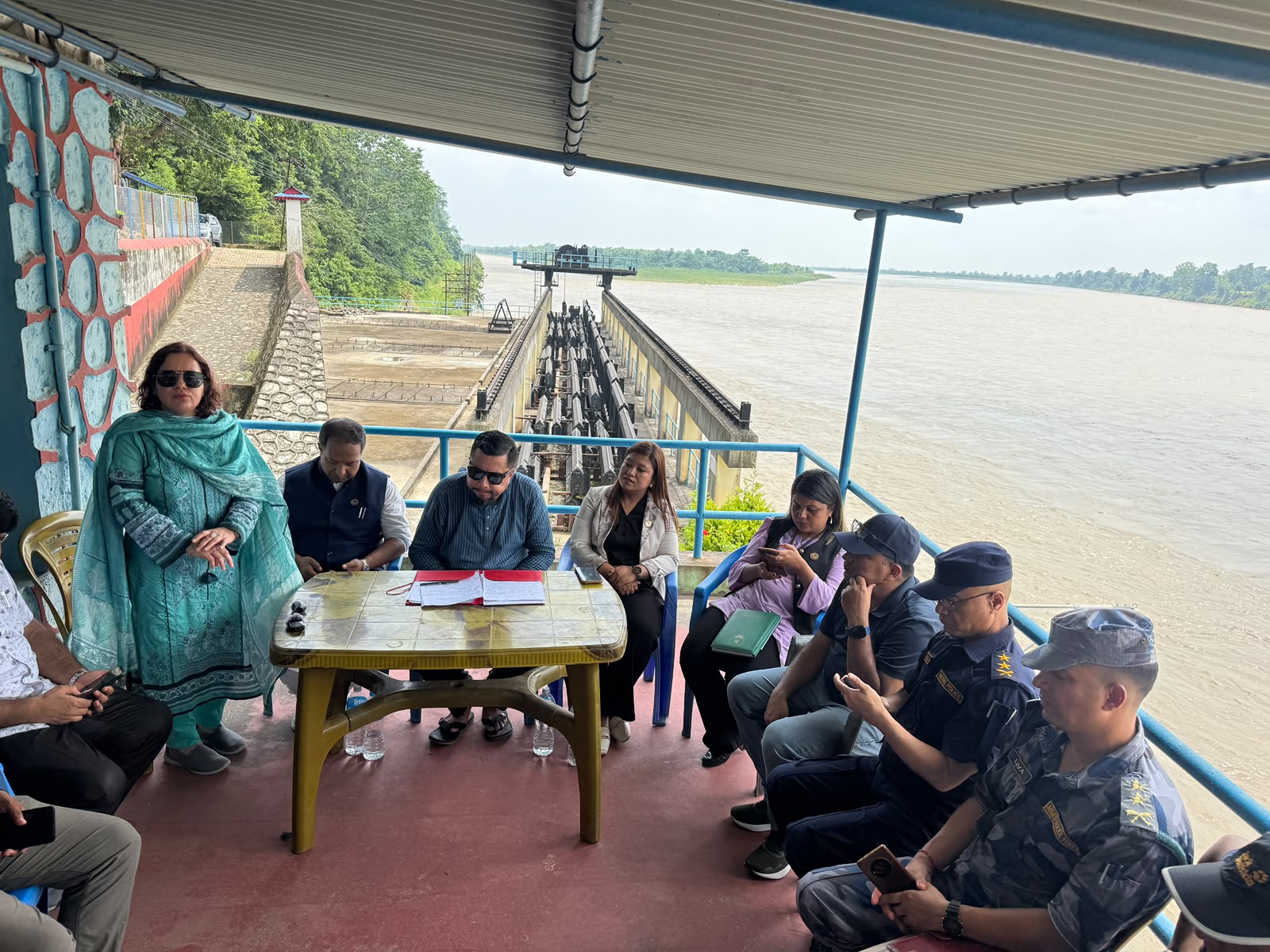
Kathmandu. Similarly, Minister for Energy, Water Resources and Irrigation, Biraj Bhakta Shrestha, viewed that big irrigation projects would help increase agro production and employment opportunities thereby reducing population migration.
Minister Shrestha said that irrigation should not be seen only as a matter of canal construction.
According to him, the investment made in the irrigation sector would be realized through agro production, adding that agricultural production, productivity enhancement and farmers’ programmes should be pursued in an integrated manner along with irrigation.
“Investment in irrigation is not enough, it should also create an environment to increase production and income,” he said, adding that the Ministry was carrying out a microscopic study on how the irrigation and agriculture programmes could be implemented in an integrated manner. ’
According to Minister Shrestha, the Sunsari-Morang Irrigation Project alone has been contributing agriculture production worth over Rs 14 billion annually. He said that this will prove that the investment made in irrigation infrastructure has been seen in the agriculture sector. He said that effective operation of the irrigation system would indirectly contribute to economic activities including energy production.
He stressed the need of making the irrigation system consumer-friendly, sustainable and ensuring the rights of locals. According to him, nature-based solutions should be given priority while developing irrigation infrastructure.
Minister Shrestha said the problem of sediment seen in irrigation and power projects was the long-term challenge. He said that measures to manage the silt flowing into the river and minimize the impact on the project should be incorporated in the design and operation of the project.
The Sunsari-Morang irrigation system is one of the important and largest irrigation systems in Nepal. The system, which covers about 68,000 hectares of command area, has a large population directly linked to agriculture and irrigation. Built between 1964 and 1975 with the assistance of the Government of India, the system has been in service for nearly six decades.
But due to its long operation, various structures of the system are getting dilapidated. Change in the course of the Koshi River, the problem of silt piling up and lack of sufficient water in the intake have added challenges to the regular operation of the project.
The water availability in the intake area of the Sunsari-Morang irrigation system has been affected due to the huge sediment flowing by the Koshi River in Chatara and the change in the course of the river. According to the project officials, it has become more challenging to maintain adequate flow in the intake area on the left bank as the main flow of the river has shifted to the right side after the construction of the Chatara bridge.
During the dry season, the amount of water available in the intake is limited to about 10 to 15 cubic meters per second. In such a situation, even if the capacity of the pond and canal can be restored through dredging, it alone will not solve the long-term problem of the project. Since the design flow of the project is around 60 cubic meters per second, it will be difficult to flow water at that capacity without ensuring a permanent diversion structure and necessary heads.
In this context, Minister Shrestha stressed the need of integrating short-term and long-term solution into a single plan. According to him, the Department of Water Resources and Irrigation should prepare and approve an integrated action plan that incorporates short-term, mid-term and long-term measures.
He said that the action plan should clearly specify the responsible agency for each work, the cost, the source of the budget, the implementation timeline and measurable achievement. He also stressed the need of coordinating the regular budget and resources including Sunsari-Morang Irrigation Rehabilitation and Improvement Programme.
Minister Shrestha made it clear that short-term measures should not be taken as an alternative to long-term structure. According to him, although dredging, spur construction and other management works are necessary for the time being, they should be complemented by long-term design and permanent structures.
“It should not send a message that the problem has been resolved after purchasing the dredger,” he said, “There should be a clear plan to build the necessary structures for a permanent solution along with short-term management.” ’
Large irrigation systems including Sunsari and Morang have been facing problems due to the situation of the Koshi River releasing a huge amount of sediment every year and the river keeps changing its course. Minister Shrestha said that clear priority should be determined on whether to give priority to the construction of new projects or to invest in the rehabilitation and upgradation of big irrigation systems in operation.
He also stressed the need for moving ahead by making an objective assessment of the need and possibility of new irrigation projects while prioritizing the conservation, rehabilitation and modernization of old irrigation systems. According to him, it would directly contribute to reducing the population migration from the rural areas if irrigation could be linked to agricultural production, employment and local economy.









प्रतिक्रिया दिनुहोस्