Hetauda Textile Industry: After two and a half decades, Lum’s voice resonates
लगानी न्यूज
Hetauda. The building has been deserted for a long time, the equipment covered in dust and the production room.
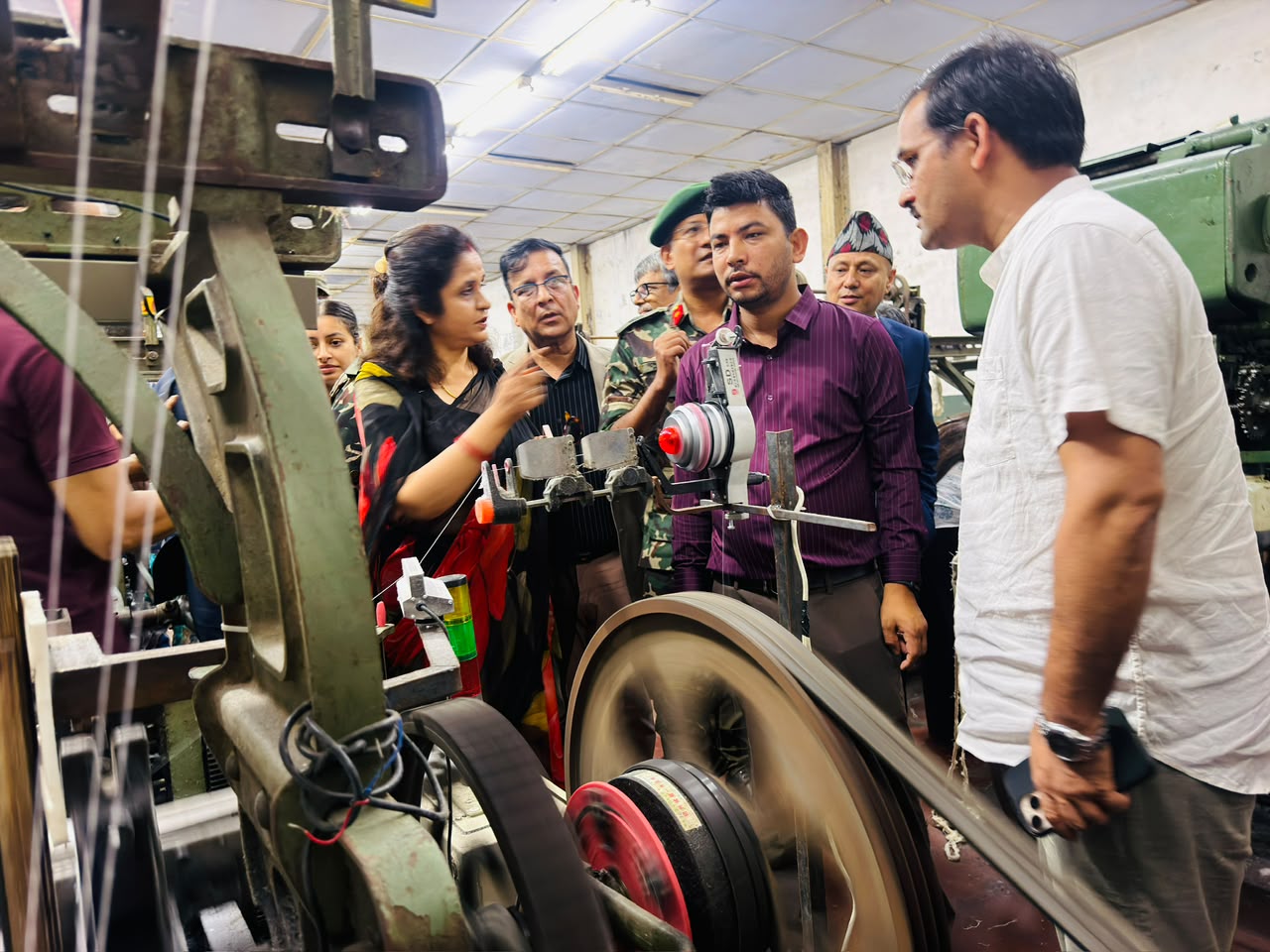
This was the scene that technician Raj Prasad Amatya saw when he entered the Hetauda Textile Factory, which has been closed for two and TAG_OPEN_div_46 a half decades. Tears welled up in his eyes as he looked at the dilapidated machine. But now, in the same industry, the ‘clatter’ sound of the loom (tan) has started echoing again.
“When we first came to see the machine, we were in tears,” Amatya said, “We have revived our dead machine.” ”
Amatya has come to Hetauda from Kathmandu after the government started preparations for the resumption of industries.TAG_OPEN_div_42 He has been running his own garment factory and has been deputed here with a technical team to help restart the government industry. At present, 10 looms of the factory produce garments. Three of them have been converted to automated technology.
The production has increased significantly after the new technology was installed in the old loom. According to technician Ramesh Bahadur Bhattarai, a loom used to produce 20 to 25 meters of cloth in eight hours. Bhattarai, who has been working in Tulsipur of Dang for saree production, was called to repair the machine. Initially, his team had studied the condition of the machine for three to four days and held consultations for necessary improvements. After that, the work of converting the old loom parts to the automated system began.
Equipment, including dubbys, slabards, brakes and clutches, have been changed to automate the loom.TAG_OPEN_div_38 Bhattarai said that the main iron structure is in good condition even though the leather and wooden materials used in the machine have been destroyed due to being out of use for a long time. He said, “The parts of the machine are damaged and they can be replaced. It is a pleasure to be here and serve the country. ”
It’s hard to find some parts of the old ‘shuttle loom’.TAG_OPEN_div_36 Technicians say that China has also stopped the production of these machines made long ago. But they can be converted into rapier technology, i.e., modern knitting machines that can be operated automatically, Amatya said. Necessary materials for the mission can be brought from China and Taiwan through suppliers in Kathmandu and Lalitpur, he said.
With the operation of the automatic loom, more can be produced with less manpower. According to the technicians, the machines can produce sarees, dresses, bedding, corps, colorful and embroidered clothes as well as various clothes required by the civil servants and security agencies.
After the government decided to resume the industry on July 1 TAG_OPEN_div_32, the Nepal Army has been given the responsibility of cleaning the factory premises, repairing the electricity system and machines. A total of 33 lakh has been made available for the test production. At present, around 40 technicians and various ranks of the Nepal Army Production Directorate are preparing to operate the industries.
Minister TAG_OPEN_div_30 for Industry, Commerce and Supplies, Gauri Kumari Yadav, visited the factory on Saturday and took stock of the progress of testing, production and maintenance. She said that 20 looms have been prepared for operation and 10 of them have already come into operation. For this, the government has provided Rs 33 lakh and the remaining machines will be brought into operation gradually, he added.
Minister Yadav said that raw materials required for the test production have been imported from the domestic Reliance Industries.TAG_OPEN_div_28 Stating that farmers have been urged to cultivate cotton to produce raw materials within the country, she said the government was ready to purchase the cotton produced by the farmers and provide necessary support.
The company was registered on September 30, 2032 BS with financial and technical support from the Chinese government.TAG_OPEN_div_26 The factory which had started test production in Kartik, 2035 BS was formally inaugurated on January 5, 2035 BS. As many as 1,200 people were directly employed in the factory when it was operating in full capacity.
The industry was in crisis due to political interference, frequent strikes, managerial weaknesses, outdated technology and increasing economic deficit. Finally, from 2057 BS, the industry was completely closed. Now, with the old loom coming out, there is hope for the revival of the industry. It still needs investment, raw materials, markets and sustainable management to operate at full capacity. As the technician said, the machine can run again by changing the parts. The future of the industry will depend on the continuity and managerial capacity shown by the government.












प्रतिक्रिया दिनुहोस्