

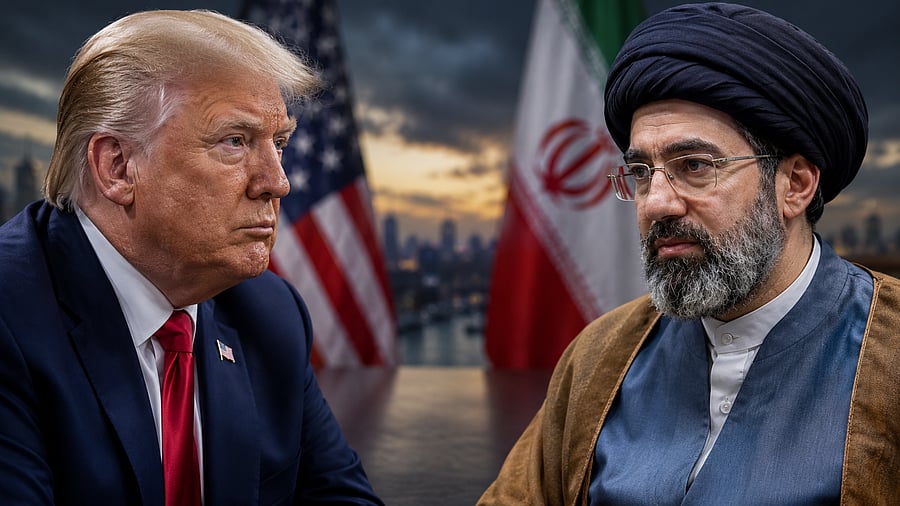
Kathmandu. Since the war on Iran broke out seven months ago, there has been a divide among the Iranian-American diaspora in the Washington area.
Soros, an Iranian-American who spoke on condition of anonymity, hates Tehran’s Islamist government but believes war “won’t do any good”.
Other exiles in the United States began to accuse him of supporting their oppressors.
Another Iranian-American, who identifies as Bahr, has also been divided within the diaspora because of his strong support for the war started by US President Donald Trump. He said that he has been accused of being a traitor.
Despite the US-Israeli invasion destroying a wide range of infrastructure, including the top leadership, the nearly 75 million Iranians living in the US are almost unanimous in their opposition to Iran’s Islamic rule.
There is a deep rift among migrants and exiles over whether the war will succeed in ending 47 years of religious rule in their homeland (Iran).
“Family relationships have been strained or broken. Lifelong friendships have also ended with this,” said Sahar Razavi, director of the Center for Iranian and Middle Eastern Studies at California State University, Sacramento. He said the war has already exacerbated tensions.
When talking to members of the Iranian community around Washington about the tensions, he asked not to be named when talking about his friends and relatives (Iranians).
There is no other solution
Soros, a 3D artist and animator who came to the US a decade ago, described the disputes between close friends and his brother and sister-in-law since the war broke out on February 28.
He recalled telling relatives about the negative effects of previous U.S. wars in the Middle East, “People in Iran will lose friends, family members. They will lose jobs and assets and savings.” ”
“It’s not the Iranian expatriate, it’s the people at home who are suffering,” Soros, a Christian convert, told AFP over a beer at a bar in Washington.
Bahar, who works in the medical field at a coffee shop in the city, and Ahu Sigarchi, who works in a bank, had a different perspective.
They are angered by the thousands of protesters killed by Iranian security forces in January 2026, which they say necessitates military action to topple the regime.
“We all have family and friends in Iran and we are saying words they can’t speak,” Ahu said. She is a staunch supporter of the exiled Reza Pahlavi. He called for an uprising and mobilized support in the diaspora.
“I think we are on the right track in the war and I believe that soon we will get what the people are looking for,” he said, dodging questions about the failure of military intervention to overthrow the regime.
“In reality, we don’t have a solution,” Ahu said.
The war is unpopular with the vast majority of the American population, which is suffering from rising fuel prices.
According to a survey conducted by the National Iranian American Council, an anti-war advocacy group, support among the Iranian diaspora declined quickly.
The community was roughly split in half when the war began, but in a second poll a month later, 66.1 per cent opposed the war and only 32.7 per cent supported it.
Stazai said anti-war protesters who were skeptical of an externally orchestrated regime change were right, but many supporters were “still standing”.
He said significant minority groups had also changed their attitude around the Iranian government’s anti-American stance.
“I see this growing in the Iranian diaspora,” he said.
‘Liberation struggle’ pressure
Mohammad Reza Mousavi, a former Tehran-based journalist who opposes both the war and the regime, feels that enthusiasm for the war is waning. He seems to be saddened by the intolerance of those who advocate war.
“If they know you’re not with them in everything, they can label them like that,” he said.
According to Razavi, the Iranian community organisations that organised Persian language classes or Persian poetry recitals were “severely criticised” for not openly supporting the “liberation struggle”.
Pahlavi’s supporters, however, say that the pressure from the community is not just one-sided.
Bahar called him a fascist for voting for Trump and lost hundreds of Instagram well-wishers. In the United States, he expelled his eight-year-old son from a school that teaches Iranian art and music after a teacher repeatedly raised the issue of war in class.
But Mousavi sees the devastation of the war as pragmatic.
“In these difficult times, you understand the people around you,” he said. ”










प्रतिक्रिया दिनुहोस्