61 percent loan for Nepal’s climate finance, calls for increasing subsidies
लगानी न्यूज
Kathmandu. Stakeholders have stressed that a large part of the international climate finance that Nepal receives for mitigation and adaptation to climate change should be made grant-based.
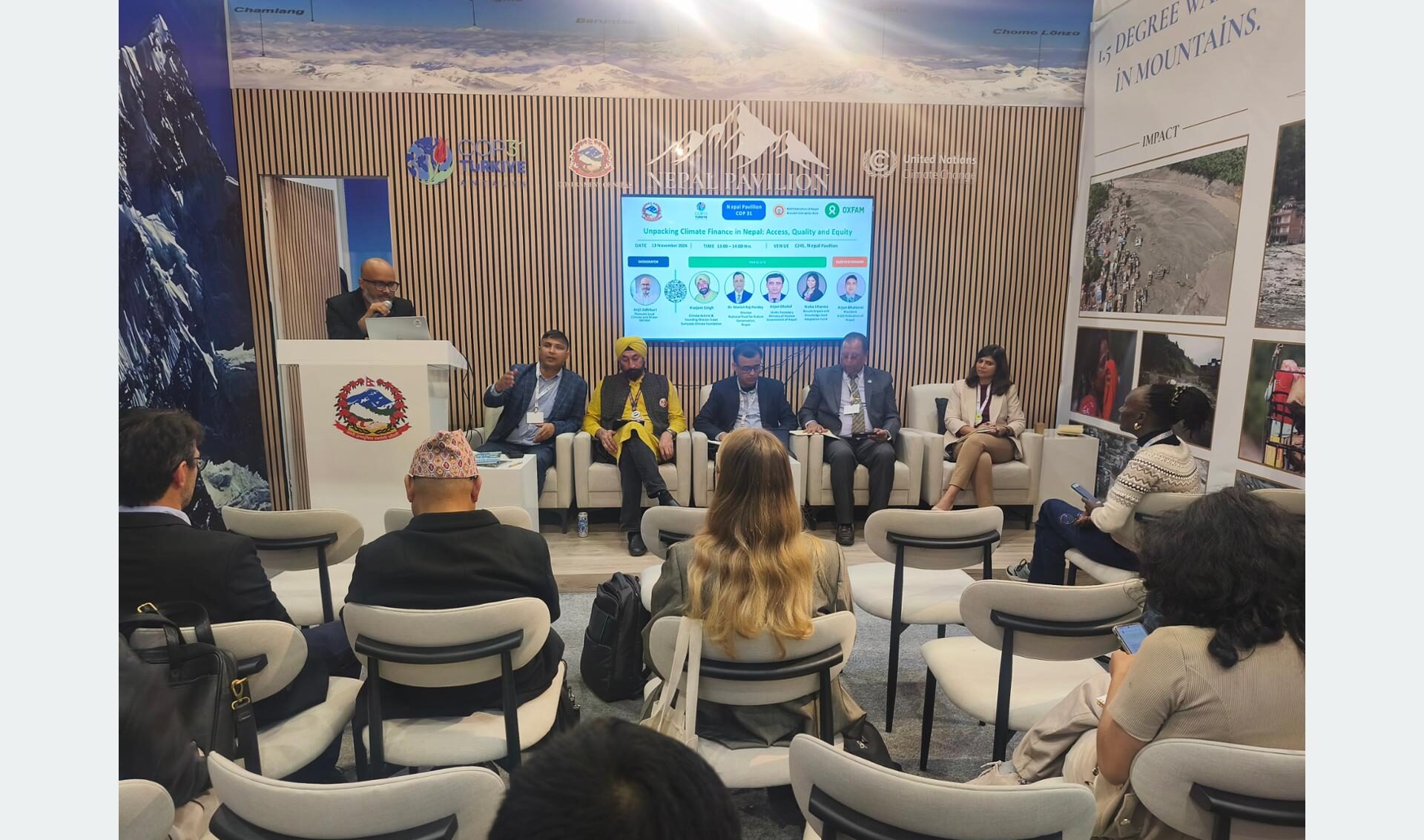
Speakers at a panel discussion on ‘Access, Quality and Equity of Climate Finance in Nepal’ held at the Nepal Pavilion under COP31 on Monday said that it was not justified for developing countries like Nepal, which have contributed less to climate change, to bear additional debt burden to deal with climate crisis.TAG_OPEN_div_52
According to the data presented at the program organized by the Federation of Non-Governmental Organizations (FNGO) Nepal and Oxfam, from 2011 to 2021, Nepal received 5.71 billion US dollars in climate finance from various sources. Of the finance received from multilateral sources, 61 percent is in the form of loans, 38 percent is in the form of grants, and one percent is in the form of shares and equity.TAG_OPEN_div_50
Of the $3.TAG_OPEN_div_48 03 billion received from multilateral sources, $3.48 billion is loans, $2.16 billion in grants, and $57 million in shares and equity.
In the group discussion, Arjun Dhakal, under-secretary at the Ministry of Finance, said that the grants and loans would be selected on the basis of the nature of the project, the condition of need, the availability of financial resources and the economic benefits to be derived from the climate finance mobilization.TAG_OPEN_div_46
He said that grants should be given priority in the area of adaptation for climate-vulnerable countries like Nepal. Dhakal said that grants would be better than loans for such projects as most of the investments in adaptation do not give direct financial returns.TAG_OPEN_div_44
However, Undersecretary Dhakal said that concessional loans can be mobilized for renewable energy, hydropower and climate infrastructure where economic returns can be achieved. He stressed that before accepting external loans, the repayment period, the grace period, the ability to repay the loan and the sustainability of the overall loan, should be taken into consideration.TAG_OPEN_div_42
Neha Sharma, Head of Results, Impact and Knowledge of the Adaptation Fund, said that institutional capacity building and meeting the necessary criteria is necessary to expand the direct access of national institutions to climate finance. He said that the National Implementing Agency can get direct financing from the International Climate Fund once the criteria related to gender equality, environmental and social protection, procurement process and financial management are met.TAG_OPEN_div_40
He said that there is a fast-track in the process of accreditation of the Adaptation Fund for an organization accredited by the Green Climate Fund, adding that it will help expand the capacity of national institutions and opportunities to mobilize climate finance. He said that the Adaptation Fund Preparedness Program will help organizations in capacity building from the initial stage of projects to implementation and completion.TAG_OPEN_div_38
Dr. TAG_OPEN_div_36 Manish Raj Pandey, Director, National Trust for Conservation of Nature, presented Nepal’s experience of biodiversity and access to genetic resources and distribution of benefits. According to him, the process started in 2017. It took about three years to prepare the legal provisions regarding access to genetic resources and benefit sharing. During this period, about 13 policies, guidelines and plans have been formulated and significant progress has been made in this area by 2024.
Harjit Singh, a climate activist and founding director of the Sustainable Heritage Climate Foundation, said that climate finance should not be made available as donations or aid, but as the responsibility of the developed countries that have contributed more to climate change and the rights of the affected countries. He said that while the developed countries are spending large sums of money in the fossil fuel industry and other sectors, they are not providing adequate finance to the developing countries affected by the climate crisis.TAG_OPEN_div_34
Although Nepal has made a negligible contribution to climate change, it is facing the challenges of glacier melting, increasing disasters and adaptation, said Director Singh, adding that Nepal’s glaciers are melting 65 percent faster than the previous decade. He said that along with loss and loss, there is a lack of adequate finance for adaptation. Director Singh said that it is unfair that countries that are not responsible for climate change have to take loans for their own security.TAG_OPEN_div_32
Stressing that multilateral financial institutions like the World Bank should provide grants instead of providing loan for climate adaptation and post-disaster recovery, he stressed that Nepal should raise its voice clearly in the international forum on the issue of climate justice, ending the use of fossil fuels like oil, gas and coal.TAG_OPEN_div_30
The program was facilitated by Anjil Adhikari, Head of Climate and Water at Oxfam. The discussion was attended by Arjun Bhattarai, President of the Federation of Non-Governmental Organizations, Nepal, and representatives of climate finance, government agencies and the conservation sector.



















प्रतिक्रिया दिनुहोस्