



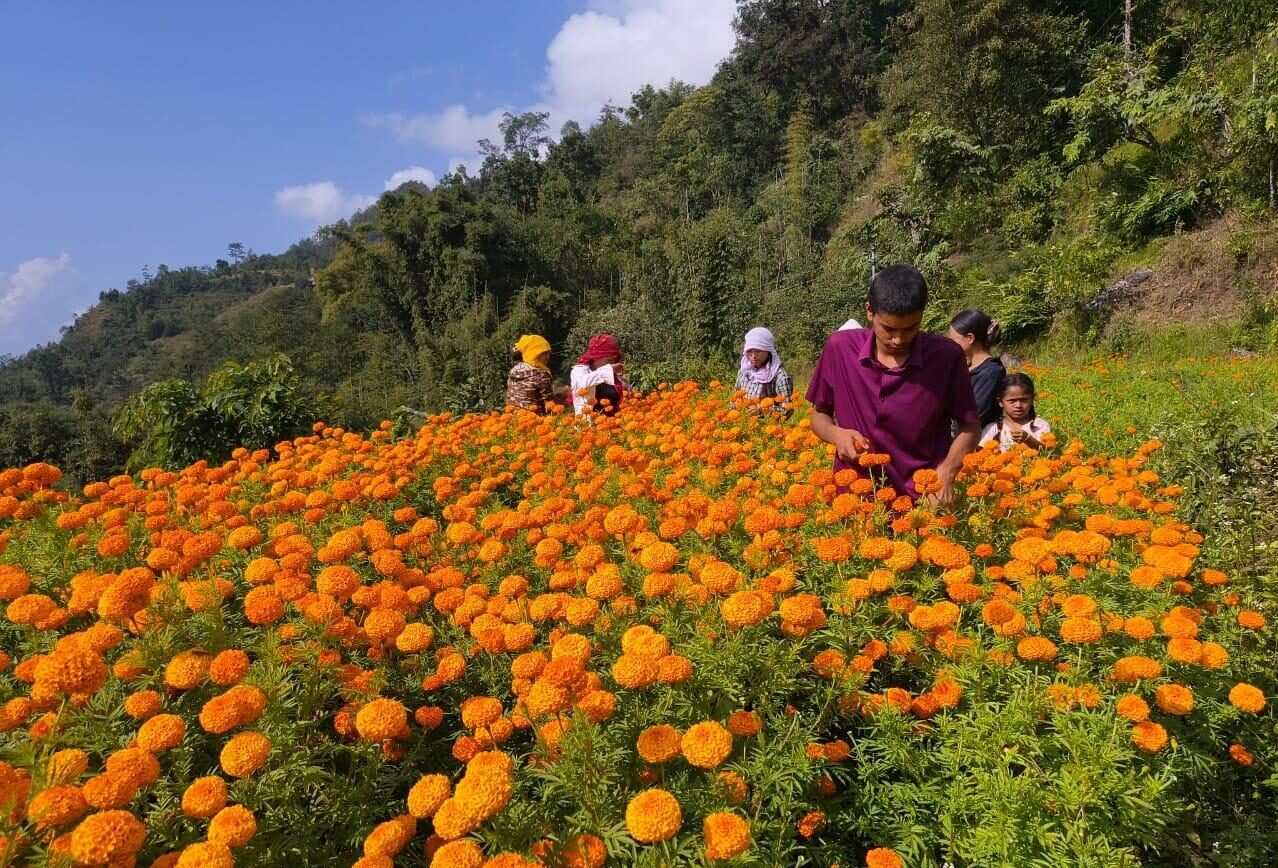
Kathmandu. The fields of Dhankuta are now full of marigolds. The yellow and orange flowers have not only enhanced the beauty of the fields and gardens of the village, but have also increased the hope of income for the farmers. As the festival approaches, flower farmers are busy picking flowers, making garlands and taking them to the market.
Tihar is the festival of flowers, garlands, diyas and Deusi Bhailo. From decorating the windows and doors of the house to putting the garland of Bhai Tika around the neck of the brothers, flowers are important. Turning this demand into an opportunity, the farmers of Dhankuta have been cultivating commercial flowers.
For Khagendra Poudel, a farmer of Majuwa of Chhathar Jorpati Rural Municipality-6, the farm has become the center of busyness these days. The marigolds planted on 10 ropanis of land in Shree Poudel Agriculture Farm, which he has been operating, are now being sold vigorously. The saplings planted three months ago are now full of flowers. He is now struggling to pick flowers and send them to the market as per the demand of the customers.
He has been sending flowers from the local market to Dhankuta, Dharan, Biratnagar, Butwal and Kathmandu. It is also difficult to supply flowers according to the demand from inside and outside the district. He has set a target of producing about 10 tons of flowers this year. He said that the flowers are being sold for Rs 300 to Rs 400 per kilogram. He said that in some places, flowers are being sold on the basis of kilograms and in some places, on the basis of bundles.
Although the demand of the market is good for flower cultivation targeting Tihar, there are many challenges in the production. Poudel feels that the flowers that should be planted about 100 days before the festival of Tihar are facing the problem of fungus in the Lekali region and the problem of leaf droppings. Despite these problems, he said that he is excited as the demand for flowers has increased in the market.
Prabin Pokhrel of Dhankuta Municipality-7 is also hoping to earn good income from floriculture. He has set a target of earning around Rs 2 lakh this year from flower farming planted on one ropani of land. Pokhrel said that in the past years, it has become difficult for Nepali farmers to compete in the market due to Indian flowers and artificial garlands.
He demanded that the government should control the uncontrolled import and use of Indian flowers and artificial flowers to get a proper market for the produce of domestic farmers. Pokhrel said that the flowers produced by the farmers have been sold easily due to the lack of Indian flowers and this year also it will be easier if the work is done according to the same. He said that the middlemen have come to buy the flowers but are preparing to sell them directly to the consumers.
Dhankuta flower from the village garden to the city market
}
The flowers produced in Dhankuta are not limited to the local market. It reaches Kathmandu and Butwal through various cities of the Terai along with neighboring districts. This has made floriculture a means of income for the farmers. According to the Agriculture Knowledge Center Dhankuta, flower farming is being done in at least 51 ropanis of land in the district. According to the Knowledge Center, about six metric tons of flowers are expected to be produced this year.
The farmers of the district have been producing and selling flowers ranging from Rs 50,000 to Rs 35 lakh. Govinda Prasad Acharya, chief of Agriculture Knowledge Center, Dhankuta, said that although there is no separate program for flower farmers in the knowledge center, necessary technical assistance has been provided. He said that increasing attraction of farmers towards floriculture is a positive aspect for this sector. According to Acharya, it is estimated that more flowers will be produced in Dhankuta than the data of the knowledge center.
Artificial garlands challenge indigenous farmers
}
Although flower farming is expanding in Dhankuta in recent times, Nepali farmers are facing various challenges in the market. In particular, farmers complain that the import of Indian flowers and the use of artificial garlands available in the market affect the sale of local products.
The use of artificial garlands is increasing not only during Tihar but also in other festivals, weddings, pujas and fairs. Farmers’ attraction towards artificial garlands seems to have increased as they are attractive and long-lasting, but if the use of locally produced natural flowers is increased, the income of farmers will increase and local products will get a market, said farmer Poudel.
Stakeholders say that the use of natural flowers will not only encourage agricultural production in the village but also contribute to the local economy. Farmer Pokhrel said that it is necessary to reduce the use of artificial garlands from the environmental point of view and give priority to natural flowers.















प्रतिक्रिया दिनुहोस्