



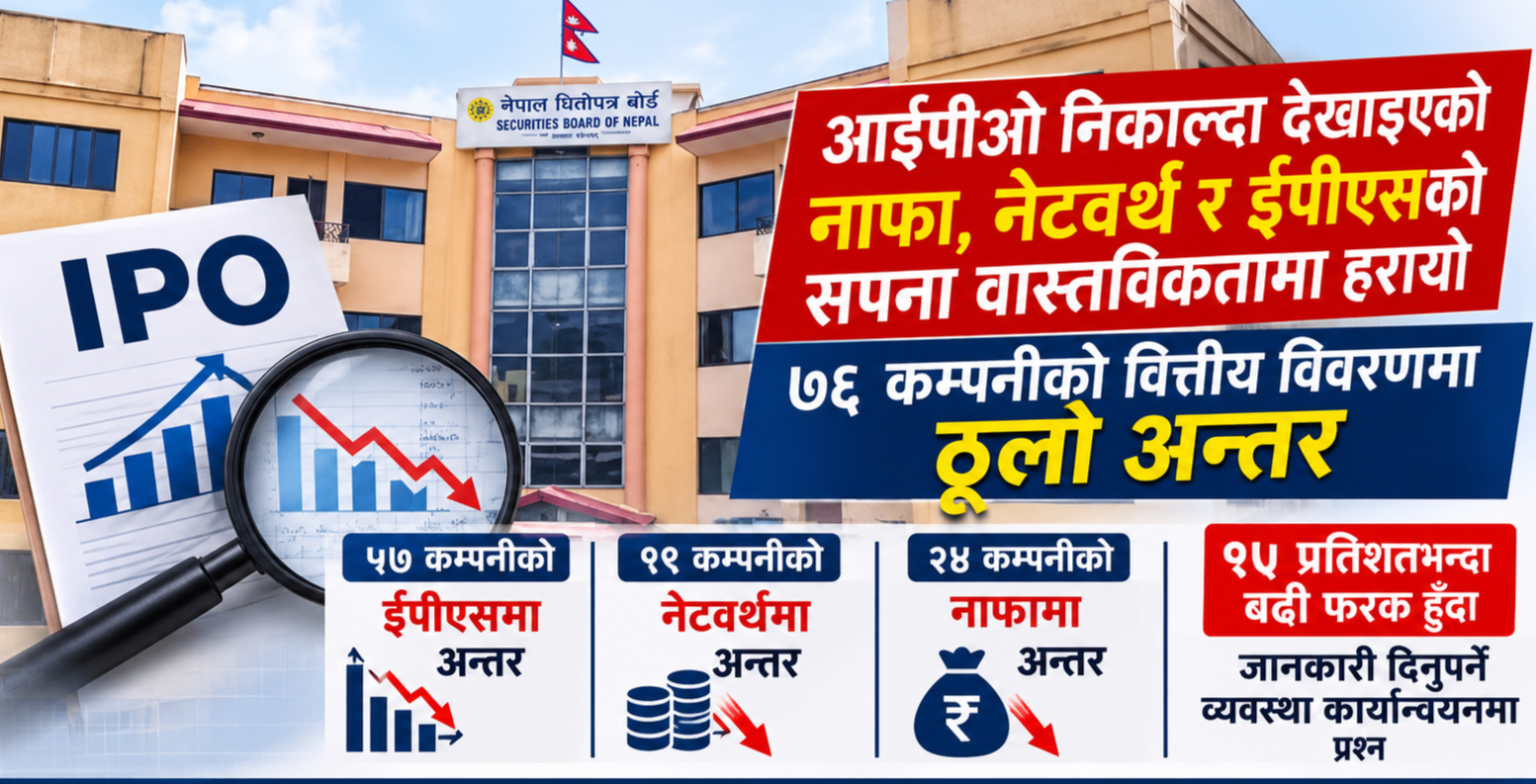
Kathmandu. Before buying a company’s shares, investors look at the company’s earnings, profit, net worth per share, and future prospects. On the basis of these details, investors decide to invest their money. But if there is a big difference between the financial projections shown at the time of selling the shares of the company and the actual statements that will be made public later, who will the investors believe?
A similar question has been raised while studying the financial statements of the companies that have issued public shares in the stock market of Nepal. During IPOs and right share issuances, companies make projections about the profit, earnings per share (EPS) and reserve fund of the coming year. However, when the actual financial statements come out, the results of some companies are much weaker than the projections.
A study of the projected and actual financial statements of 76 companies showed a difference in the earnings per share of 57 companies, the net worth per share of 19 companies and the profit of 24 companies. The study includes banks, microfinance, insurance, manufacturing and hydropower companies.
It is natural for the business to fluctuate. There may also be a situation where the company may not be able to make a profit as anticipated. However, there is a huge gap between the details shown during the public release and the reality, so the reason for this has to be investigated. The question has been raised as to what basis was taken while preparing the projection, whether the issue and sales manager had studied it or not, and whether the regulator had examined the details.
More than 92 percent difference in the reserve fund of the best cement{
}

Sarvottam Cement, the company that issued the IPO for the first time in Nepal through the book building method. The company had issued shares at Rs 360.90 per share since February 27, 2080. The IPO was issued by adding a premium of Rs 260.90 to the face value.
The company had projected a net worth per share of Rs 119.82, EPS of Rs 25.49 and reserve fund of Rs 4.64 crore for the financial year 2082/83.
However, in the actual financial statements, the net worth per share has reached Rs 199.82. This is 66.77 per cent higher than the projection. Earnings per share declined by 16.83 per cent to Rs 21.20.
The situation of the reserve fund is even different. The company had estimated a reserve fund of more than Rs 4.64 billion, but the actual amount was only Rs 33.68 crore. The reserve fund is 92.74 percent less than the projected amount.
While issuing shares through the book building method, the future earnings and financial position of the company are considered as the basis for the pricing of the company. The question has been raised as to how realistic the basis of pricing was when there was a huge difference between the projected and actual details of Sarvottam Cement.
Sonapur Cement’s EPS down 53%
}TAG_OPEN_strong_126

Sonapur Minerals and Oil Limited had issued an IPO at Rs 225 per share for the project-affected locals and foreign employed Nepalis and Rs 237.58 per share for the general public. The shares were issued to the general public from September 14, 2080.
In the financial year 2082/83, the company had projected net worth per share of Rs 229.52, earnings per share of Rs 23.55 and reserve and surplus of Rs 3.98 billion.
However, in the actual financial statement, EPS has been limited to Rs 10.96 per cent. This is 53.46 per cent lower than the projection. The reserve and surplus also fell to Rs 1,446,67,98,000. This is 63.67 per cent lower than the company’s estimate.
In the cement industry, the cost of production, market demand, raw material prices and loan interest can affect profits. However, the question has also been raised as to how much such risks were included in the projections made public at the time of the IPO issue.
EPS of Palpa Cement from Rs. 8.80 to Rs. 1.23
}

Palpa Cement Industries Limited had estimated net worth per share of Rs 135.96 and earnings per share of Rs 8.80 in the financial year 2082/83. Similarly, the reserve and fund was estimated to be Rs 1,34,85,33,000.
However, the actual financial statement showed the company’s earnings per share of Rs 1.23. This is 86.02 per cent lower than the projection.
What is the reason why the company’s profit is so much lower than the estimate? Is it the production capacity that is not being utilized, the cost has increased or was it an overly optimistic estimate at the time of preparing the projection? It seems that the company and the party preparing the report have to answer this.
NLG Insurance EPS down 89%

NLG Insurance Company Limited had issued right shares from November 26, 2081. The company had projected net worth per share of Rs 198.69, earnings per share of Rs 20.74 and reserve profit of Rs 30.89 crore in the financial year 2082/83.
However, in the actual report, the net worth per share was Rs 166.35, EPS was Rs 2.17 and profit was Rs 6.69 crore.
The company’s EPS is 89.54 per cent lower than the projection and the profit is 90.36 per cent. In the insurance business, claims payments, investment income and other expenses can affect the profit. However, it is necessary to be clear how these issues were evaluated in the financial projections made public at the time of the issue of rights shares.
The details of these companies show that there is a huge gap between the financial position and the reality shown at the time of the public release. The study pointed out that a similar problem was seen in the details of other companies.

Niranjay Ghimire, spokesperson for SEBON, said that although the companies submit their annual reports, they do not provide separate information as the projection details do not match.
If there is a difference of more than 15 percent, the Board should be notified
}
Investors have alleged that the Securities Board has not shown any interest in the fact that the financial statements presented by the companies during the public issue do not match the reality. However, there is a legal provision in this regard.
According to Directive 45 of the Securities Issue and Allotment Directive, 2074, if the projected figures vary by 15 percent or more in the prospectus, right share issue statement or other details, the company has to inform the Securities Board of India about the reason for the same. There is also a provision that such details should be included in the upcoming annual report and published.
However, the companies do not provide separate information about the difference between the projected financial statements and the actual situation. Niranjay Ghimire, a spokesperson for SEBON, said that although the companies submit their annual reports, they do not give separate information because the projected details do not match.
The companies send the annual report to the board. The board can seek clarification from the company if there is a discrepancy between the projected and the actual details in the same report. However, so far, the details of how many companies have been questioned by the board about such discrepancies are not public.
Section 33 of the Securities Act, 2006 makes the concerned company, directors and prospectus preparing experts accountable for the accuracy of the statements mentioned in the prospectus. There is also a provision for compensation for loss to the investors by deliberately inserting false information in the prospectus.
The law stipulates responsibility. However, the regulator has not been able to answer the question of whether the company has been investigated for a large discrepancy in the projected financial statements.
Merchant bankers say it can vary by 10-20 percent
Ramendra Rayamajhi, president of the Nepal Merchant Bankers Association, says that companies make future financial projections by looking at the past business. According to him, there can be a fluctuation of 10 to 20 percent, but it is not normal to have a difference of more than that.
Rayamajhi said that events such as the Corona epidemic, Genji agitation and floods and landslides may have affected the real financial results of companies.
However, when there is a huge gap between the financial statements of the companies and the actual statements, the reason for this has to be explained. The difference in the financial statements of all the companies cannot be explained for the same reason.
Rayamajhi said that the merchant bankers have been urging the Securities Board to hold a meeting with an analysis of the projected financial statements. He said that the board has not shown interest in this matter.
public.flourish.studio
Companies that misinform investors should be investigated
Stock investor Chhote Lal Rauniyar says that the Securities Board should investigate the issue of companies giving wrong information to investors. He also suggested that the sales manager should also pay attention to the financial statements presented by the companies during the public issue.
Rajan Lamsal, vice-president of Nepal Investors’ Forum and an investor, said that the details of the companies issuing the public have not been credible for a long time.
According to him, companies are creating confusion among investors when they show one financial statement at the time of the issue and then present the actual statement.
“The projected details brought by the companies going to public issue should be real rather than denting and painting,” Lamsal said.
According to him, the regulatory body has not shown any interest in this matter despite repeatedly informing the Securities Board of Nepal (SEBON).
10 Kit mentality makes it easy for the company
Due to the 10-unit policy in the primary stock market of Nepal, it has become easier for the public issue company to sell shares. Investors apply for 10 units of shares and apply for the same 10 units with the mentality of getting or not.
This has weakened the tendency to study the financial position of the company, future earnings and projection statements. The companies also seem to have not paid enough attention to inform the investors about the real financial situation in the mindset of selling shares.
However, the company cannot give false statements because the investors did not study. It is the responsibility of the company to ensure that the financial statements presented during the public issue are true and reliable.
What does Sebon do now?
The discrepancy in the financial statements of 76 companies has raised questions about the Securities Board’s monitoring system. It is necessary to investigate the basis on which the companies used the projections when they prepared the projections, whether the sales manager studied them and whether the board was informed when there was a difference of more than 15 percent.
The company should disclose the reason for the discrepancy between the projected financial statements and the actual results. The sales manager should also explain the methodology adopted while preparing the projection. The board should not ignore the discrepancies in the annual report, but should seek clarification from the company if necessary.
Just because the projections do not match does not mean that all companies have deliberately given false information. However, it is the responsibility of the regulator to find out the reason for the huge gap between the projected and the actual financial statements.
Investor confidence in the primary market will continue to weaken if companies show future profits when they raise money from investors, if the actual financial statements are different after the stock is sold, and the regulator does not show interest in it.
Should the company that raises investors’ money in the stock market be held responsible for the accuracy of the financial statements or should it be considered normal even if the projection does not meet the forecast? The financial statements of 76 companies have put the Securities Board in a position to answer this question.















प्रतिक्रिया दिनुहोस्