



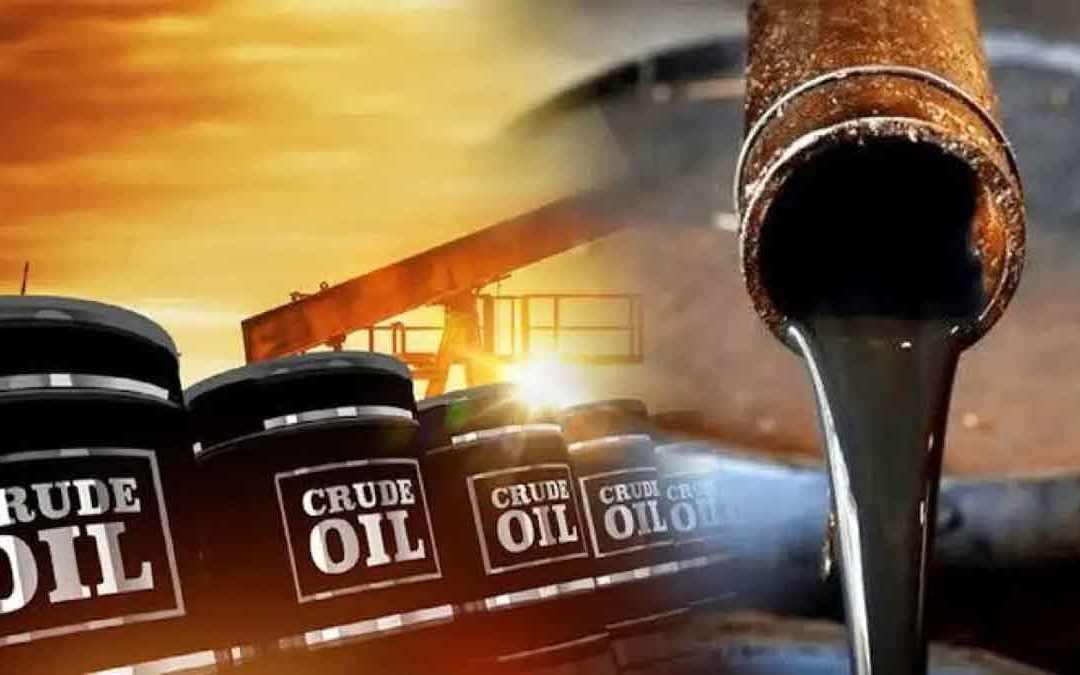
Kathmandu. The impact of the war in the Middle East and the global energy crisis is also visible in the civil war in Myanmar.
Small and informal oil facilities in central Myanmar have become the latest targets of conflict between rebels and government forces as the US-Israel war on Iran has caused fuel supply disruptions.
Small-scale crude oil miners in Myanmar are now at risk of attacks from both sides. Both rebels and the military have struggled to take control of the oil drilling facilities as they become more economically important due to rising fuel prices.
Htun Aung, 52, who works at an informal oil exploration facility in Myanmar’s arid central region, said they were at constant risk. “As long as we work here, bad luck can take our lives,” he said, speaking on condition of anonymity for security reasons. But it is more difficult to make a living than face the reality of death. ’
According to official figures, Myanmar imports about 90 percent of its total oil needs. Therefore, Myanmar has been most affected by the impact of the US and Israel’s war on Iran on the global supply chain.
In Myanmar’s central Magwe province, there is an informal small-scale crude oil extraction industry. There, local workers have been extracting small quantities of crude oil using old and dirty oil extraction equipment.
This area is also known as ‘Anya Dubai’. The name was given by the locals to compare the United Arab Emirates with Dubai, which is famous for oil production. But even when compared to Dubai’s oil industry, workers like Htun Ang who work here earn hardly $50 a week. They are forced to work all day in dirty water and mud mixed with crude oil.
The price of fuel at petrol pumps in Myanmar has almost doubled compared to the end of February. In such a situation, the ‘black gold’ i.e. crude oil under the ground has become an even more attractive asset for the warring parties.
“We just want to live peacefully. But now there is an attack from one side and an attack from the other side. They are constantly attacking each other,” Htun Ang said.
According to him, the local workers have been forced to flee their places of residence and workplace after repeated attacks. “We have run away three, four or five times. Sometimes we run here, sometimes there. We have to fill fuel on our motorcycles and run away again,” he said.
Rebels’ struggle to seize oil fields
The nationwide civil war that began in Myanmar after a military coup in 2021 continues to rage. Pro-democracy rebel groups have claimed control of an oil exploration area in Meiing Township, Magwe province, since 2023.
The rebels patrol the dusty terrain west of the Irrawaddy River in groups. They engage in security activities by wearing rocket-propelled grenades, protective jackets, bags and simple slippers.
The number of air and drone strikes in the Myang region since the beginning of 2026 has exceeded the total of 2025, according to ACLED, an organization that monitors conflict-related incidents. The organization estimates that more than 100,000 people have died in Myanmar since the 2021 military coup.
The rebels have been using security tactics by hiding among thousands of oil wells. These wells have been operating without any regulation for a long time. Crude oil is extracted with the help of engines by pumping pipes to a depth of dozens of meters in holes dug in the ground.
An experienced businessman has said that for oil exploration, local businessmen pay up to $3,500 to the landowner to rent a place. However, there is no certainty that oil will be found in that place.
Only a small amount of oil is released from some wells, while a large quantity of oil is obtained from others. The extracted oil is deposited in pits and drums covered with tarpaulins. It is then taken to temporarily operated refineries to make petrol and diesel.
Myanmar’s military said the area had come into the limelight due to the availability of enough oil in the “Anyar Dubai” region at a time when a quota system was being implemented for petrol distribution in areas controlled by Myanmar’s military.
He said the rebels had been able to halt the advance of government forces in recent days, but admitted that they had been affected by the army’s counter-attacks.
“We see this mainly as an attempt to destroy our strong supply routes and sources of income,” said Choe, a 35-year-old rebel spokesman. The Myanmar military could not be reached for comment.
But in September, Myanmar’s military claimed it had seized more than 130 oil wells in the Myaing region and an additional 735 in neighbouring Pakokku township.
Sources of finance for the war from the oil trade
Dozens of pro-democracy groups and ethnic minority armed groups have been fighting military rule in Myanmar since the military seized power in 2021 by overthrowing the elected government of Aung San Suu Kyi.
In the long-running war, all sides are trying to raise financial resources for the conduct of the war through the tax and trade of natural resources. Natural resources such as precious gem mines, rare earth, gold and teak wood have become the main sources of income for the warring sides.
In general, Myanmar’s big oil projects have little direct competition. These projects are heavily guarded by the military. According to the U.S. Energy Information Administration, Myanmar produced only about 6,000 barrels of crude oil per day last year. This production is very small by international standards.
But small and informal oil exploration areas remain of particular importance to the rebels. According to Thomas Kin, senior adviser on Myanmar at the International Crisis Group, the importance of these oil fields lies not in their production being large for the world market, but in their ability to operate outside government oversight because of their small size.
“One of the reasons these oil fields are important is that they are not a major production center globally,” he said. According to him, due to their small size, these oil fields can operate under government surveillance. But the income from them is enough to support the rebel group’s military activities.
According to Keane, rising oil prices in the world market do not directly inflame the conflict in Myanmar. But the government is increasing pressure on the rebels’ economic resources and sources of income to weaken their grip in the central part of the country.
However, as the economic benefits of the war increase, the importance of controlling the oil sector is also increasing. “We are talking about millions of barrels of crude oil being produced annually from these oil fields,” he said. ’
Thus, the global energy crisis sparked by the war in the Middle East has not only affected Myanmar’s fuel supply but also made the country’s small oil exploration hubs a key focus of the civil war’s economic and strategic competition.













प्रतिक्रिया दिनुहोस्