



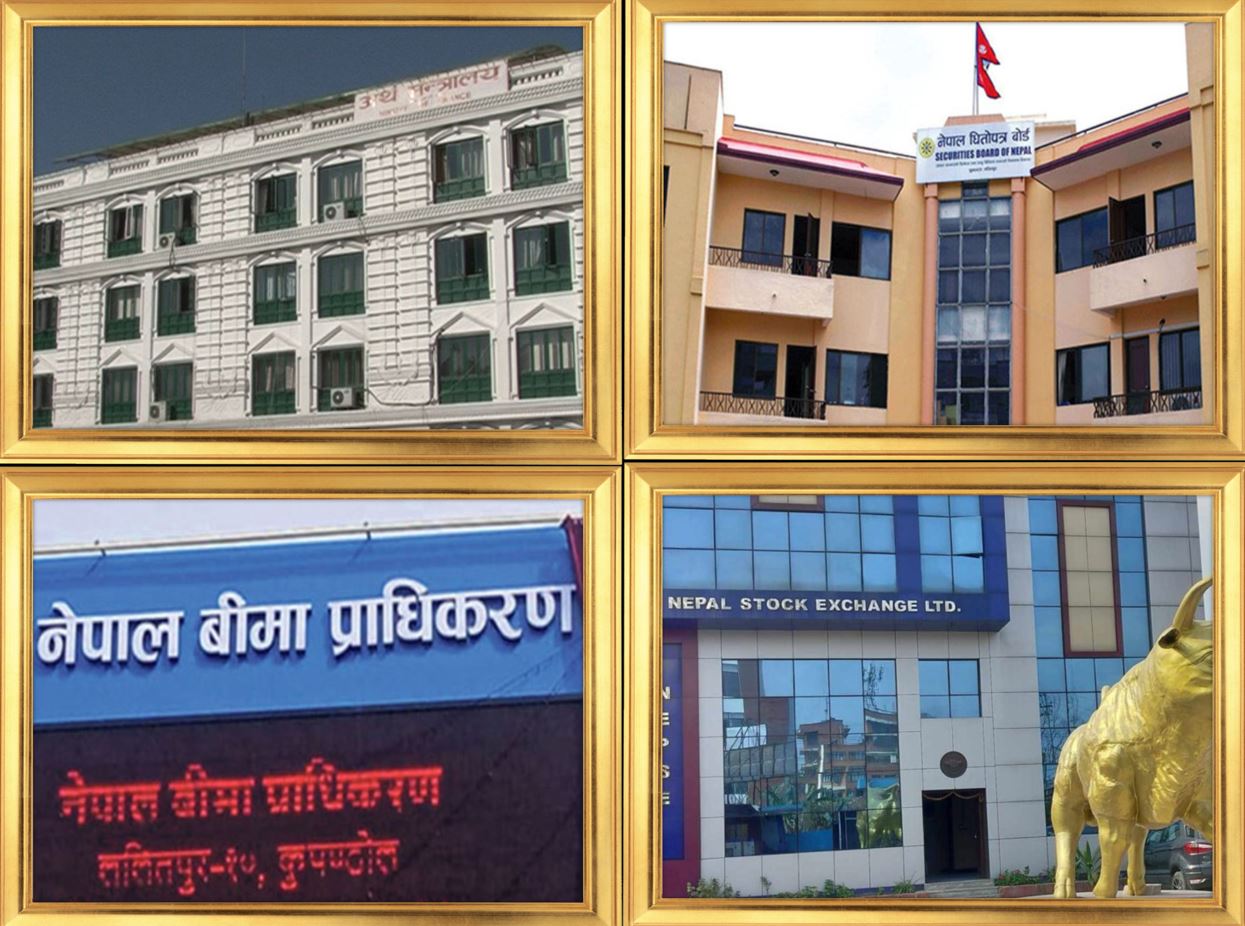
Kathmandu. Everyone is demanding that the Securities Board of Nepal, Nepal Insurance Authority and other corporations should be made autonomous bodies. This demand is not new. When some issues come up, they start hearing more.
In speech, the government has left these bodies autonomous. However, the officials in the concerned bodies argue that they are not in practice. Even though these bodies are said to be autonomous, they cannot do any work without the approval of the government.
In some cases, it is also discussed that these regulatory bodies are like the division of the Ministry of Finance. For the last 7 years, the Securities Board has not been able to find a permanent leader (chairman). The situation of the Insurance Authority has also been the same for the last one year.
The chairmen have not been able to work for the full term when it comes to financial transactions, government documents, qualifications. And these bodies have to be run by the joint secretary of the Ministry of Finance.
The members of the board of directors of these bodies are the representatives of the finances. The same director was given the responsibility of acting chairman when there was no next chairman. When the provision regarding the appointment of a chairman was amended in Section 7 of the Securities Act, 2008 through the amendment of some Nepal Acts, 2008, the law prevented the representative of finance from becoming the chairman.
Sub-clause 8 of the Act states that if the office of the chairperson falls vacant, the government of Nepal removes him from the post or if he is suspended, the member representing the Ministry of Finance in the Board shall work as the chairperson.
However, the practice of sending those who work according to the benefit of the Ministry of Finance to the Board continues. As soon as this provision was made in the Act, Ritesh Shakya, Joint Secretary of the Ministry of Finance, was given the responsibility of Chairman of the Board on April 17, 2081.
After the tenure of Ramesh Hamal ended on January 20, 2080, the executive director of the board, Navaraj Adhikari, was given the responsibility of acting chairman. Later, Shakya got the responsibility. Even before joining the board, there was talk that Deepak Bhatt, who was arrested in the money laundering case, was a special person. He could not work on the board for a long time. He went to the board and worked for the private and interest groups rather than for the interest of the market, employees and the organization. When he was on the board, he was accused of playing a key role in the approval process of the new stock exchange. It was also alleged that the Bhatt group had worked on the new stock to facilitate the stock that was going to be brought.
When he was the chairman, he completely blocked the process of issuing securities and did not approve any issue (ordinary shares, right shares, additional public issue, mutual funds). Shakya remained on the board for only about 1 month. On May 22, the then Deputy Prime Minister and Finance Minister Bishnu Prasad Poudel called him back and sent another joint secretary of the Finance, Narendra Kumar Rana, as the chairman.
During his tenure, Reliance Spinning Mills was allowed to issue an IPO. He also did not stay in Sebon for long. On July 17, 2081, the ministry sent Mahesh Baral, who was the Chief Customs Officer of the Tribhuvan International Airport Customs Office, as the chairman of the board.
At that time, Baral used to spend most of his time in Customs and less time in Sebon. When he was the chairman of the board, he completely blocked the process of issuing securities and did not approve any issue (ordinary shares, right shares, additional public issue, mutual funds). For a long time, the board was only a prisoner of indecision.
He approved the right shares of NLG Insurance, which was very controversial at that time. When he approved the right shares, he approved it so that it would be approved by the general body in the future. There was also a long dispute on this issue. Similarly, when he was on the board, the then chairman of Shivam Cement, Surendra Kumar Goyal, sold shares worth Rs 63,70,95,562 in violation of the securities laws. The Securities Board had studied this matter and recommended action. SEBON has not been able to find out where the file was taken when it was on the board. According to SEBON officials, if the chairman comes, this file will also be opened.
Another controversial current secretary sitting in the Securities Board is Shobhakanta Poudel, the then joint secretary. On October 1, 2021, the government removed Bhishma Raj Dhungana from the post of chairman of the board after finding that there was a conflict of interest. After that, Joint Secretary Poudel was made the chairman. During his tenure, there was a controversy about Emerging Nepal. On January 25, 2021, Emerging Nepal Limited was allowed to issue an IPO.
At that time, the rating agency ICRA Nepal had given Emerging Nepal a ‘ICRANP Issue Rating Double B Plus’ rating. This showed the ability of Emerging to meet its financial obligations as moderate risk. There was a lot of controversy at that time. He approved the IPO of Emerging and returned to the ministry. Later, he became the chairman of Nepse. NEPSE did not allow the ‘Nepse-30’ to be brought to the final stage.
According to a Nepse source, Poudel had asked him, Nepse and the market what would be the benefit of bringing NEPSE 30. After the NEPSE officials said that it would be in the interest of the market, there would be no benefit to Nepse and you (Poudel). That file is still on hold.
The employees of the Securities Board have been on strike for about 7 months due to Khatri, who is currently a director of the Securities Board. The employees of the board are agitating saying that due to the letter sent by the Ministry of Finance to Sebon on September 18, the services and facilities they were enjoying will be taken away.
However, the employees’ agitation could not be stopped due to Joint Secretary and member of the Board of Directors of the Securities Board, Uttar Kumar Khatri, who came to the board as a director from the ministry. The agitating employees took a stand that the letter sent by the Ministry of Finance should be withdrawn.
On October 26, Khatri insisted that the letter sent by Khatri to the ministry should be implemented at any cost. He played the role of aggravating the problem rather than solving the problem in the meeting. The agitation is still going on. Later, Khatri did not even go to Sebon for the board meeting. Instead, he called the board meeting at the ministry on November 26.
A letter was sent on September 14 stating that the services and perks of the employees would be curtailed due to the decision of the revenue secretary and the facilities provided by the previous employees should also be returned.
Earlier, there was a tradition of 2 directors from the Ministry of Finance in NEPSE. The chairman is the joint secretary. Now the chairman is appointed by the government. One director is from the economy.
The previous chairpersons (joint secretaries) have been trying to stop the restructuring of NEPSE due to lack of structural development of NEPSE.
The lower level employees of NEPSE have to go to the training themselves and the greed of the 3,000 allowances they get during meetings in NEPSE have prevented the restructuring of NEPSE. Studies have been done time and again to restructure NEPSE. The then Finance Minister Prakash Sharan Mahat had made a lot of efforts to resolve this issue which was in dispute for a long time. The Joint Secretary of Finance, who was the chairman of NEPSE, did not allow the file to be hidden.
It is said that some bad works are done rather than good work when the joint secretary of the ministry leads the board and authority appointing bodies.
Former Chairman of the Securities Board of Nepal Dr. Chiranjibi Nepal now suggests that the Act should be amended in bodies like the Board and the Ministry of ICAN and the Ministry of Federation should be removed. He believes that it is wrong to give the chairman to the joint secretary of the Finance Board as it will also operate in the board.
He suggested that if such bodies are to be allowed to operate effectively and become autonomous, the chairman and two independent experts should be appointed full-time directors.
“The directors to be appointed in such a way should be well-versed in law, management, accounting, etc., have a good image, and do not belong to interest groups,” he said. He claimed that the current way of operating the market with 7.7 million investors and a market capitalization of Rs 50 trillion is not possible and should not be played with.
The employees who make excuses for working in the interest of the market, investors, forwarding the file and facing problems during the promotion to the post of secretary are not afraid to work for the interest group.
The work of the Securities Board and Insurance Authority is to regulate and supervise, approve the issuance of shares, investigate and take action if there is any wrongdoing in the market, and recommend to other bodies for action if serious mistakes are found.
When the employees of the ministry become the chiefs, it is very difficult for these bodies to do such work. The representatives who go from the Ministry give less priority to the Board and the Authority. The first priority is given to the department and division under the Ministry. At times, the meeting of the Board of Directors of these bodies is also called by the Ministry of Finance.
There is a provision to give responsibility to the second-ranking employees in some agencies, including the Nepal Rastra Bank, which is the regulator of the financial sector. In the absence of a governor in the central bank, the senior deputy governor gets an executive role.
However, in other agencies, the finance ministry is dominant, so the joint secretary is in power.
Some people believe that if senior employees are given the permanent post in the absence of a chairman, then it will make less mistakes than others and work in the interest of the market. Experts argue that if there is no chairman in such bodies, then independent directors and senior employees should be given roles. However, the problem is increasing due to more political interference in such bodies and the influence of ruling parties and middlemen.
Former chairman Nepal suggested that a new chairman should be appointed a month before the end of the term of the chairman in such bodies. The issue of operating the commodity exchange market has been stuck in the board for a long time.
Outgoing Finance Minister Rameshwor Khanal claims that if the minister is honest while sending the representatives of the finance to such bodies, then the employees cannot do any wrong. Some time ago, he had said in a program, “If the minister sends the minister honestly as the acting chairman, then that employee cannot work in the interest or harm of anyone. The minister who sends first should be honest with himself.” ’’
As former Minister Khanal said, if he sends an honest person and works honestly, good results will be achieved. The latest example of this is the Insurance Authority.
Before Khanal became the minister, Sewantak Pokharel, the joint secretary of the Ministry of Finance, was the chairman of the authority. After Khanal came, Pokharel was dragged into the ministry and made Janak Raj Sharma Paudel the chairman. Both Khanal and Sharma are from Palpa. Being a resident of the district, he expected to get a good job from Sharma. However, that could not be fulfilled. Khanal had a lot of trust in Sharma and also expected a lot of work from him.
Sharma became the chairman of the NRA for about 2 and a half months. After getting the information that Janak was not working aggressively, he was called to the ministry. Later, Minister Khanal sent Chandrakala Poudel, secretary of the Ministry of General Administration, as the chairperson.
Before sending the authority, Minister Khanal had inquired about whether Poudel was very sensitive there and whether he could work or not. That work was the issue of Sulabh Agrawal, Deepak Bhatt and Himalayan Reinsurance. Sources claim that the authority was sent on the condition that he would not be able to work after knowing about the matter. Sources claim that before going to the authority, Poudel was given an iPhone and MacBook in the beginning and the ministry had instructed him not to take them.
According to sources, Minister Poudel has not yet taken an iPhone and a handbook from the authority as per the promise made to the minister in the ministry. She had said at that time that she would not let the intention of the minister’s work die. Accordingly, she went to the authority and opened the file of businessman Deepak Bhatta. She brought out the wrongdoings of Himalayan Reinsurance to sink Nepal Reinsurance. Now the Department of Money Laundering Investigation is investigating. Such matters were kept on hold by the previous chairmen.
Deepak Bhatta, the primary shareholder of Himalayan Reinsurance Company, misappropriated Rs 3,81,46,460 from Himalayan Reinsurance Company Pvt. Ltd., its subsidiary Himalayan Securities Banker Rs 221,19,71,445, Nepal Life Insurance’s subsidiary Rs 370 million, HLI Large Cap Fund Rs 25,14,84,748 and Nepal Micro Insurance Company Rs 16,17,52,873 from Nepal Micro Insurance Company Pvt. Ltd. It has come to light that Bhatta purchased shares through Bhrikuti Stock Broking Company Pvt. Ltd. They are currently investigating the matter.
The current government has also included joint secretaries who worked for interest groups in the board, NEPSE and NEPSE in the watchlist.
The government has also transferred some joint secretaries who were working in the Ministry of Finance to prepare the budget. The cabinet meeting held on Thursday transferred joint secretaries Sevantak Pokharel, Mahesh Baral and Madan Dahal. The Central Investigation Bureau (CIB) of Nepal Police has transferred businessmen Deepak Bhatt and Shulabh Agrawal, who are being investigated by the Central Investigation Bureau (CIB) of Nepal Police, to Madhes Province.
Mahesh Bhattarai has been transferred to Bagmati Province, Madan Dahal to Sudurpaschim Province and Sushila Aryal to Lumbini Province. Pokharel and Bhattarai were part of the budget writing team for the upcoming fiscal year. Dahal is the Director General of the Inland Revenue Department. Dahal was the chairman of the NRA before Sharad Ojha became the chairman.
It is said that Pokharel, Baral and Dahal were working in different bodies while Bhatt and Agrawal were working in different bodies. Sources claim that they were transferred saying that their work was against the country and the state.
The sudden transfer of the joint secretaries who are preparing the budget for the first time by the two-thirds majority government has been seen in a deep sense.















प्रतिक्रिया दिनुहोस्