

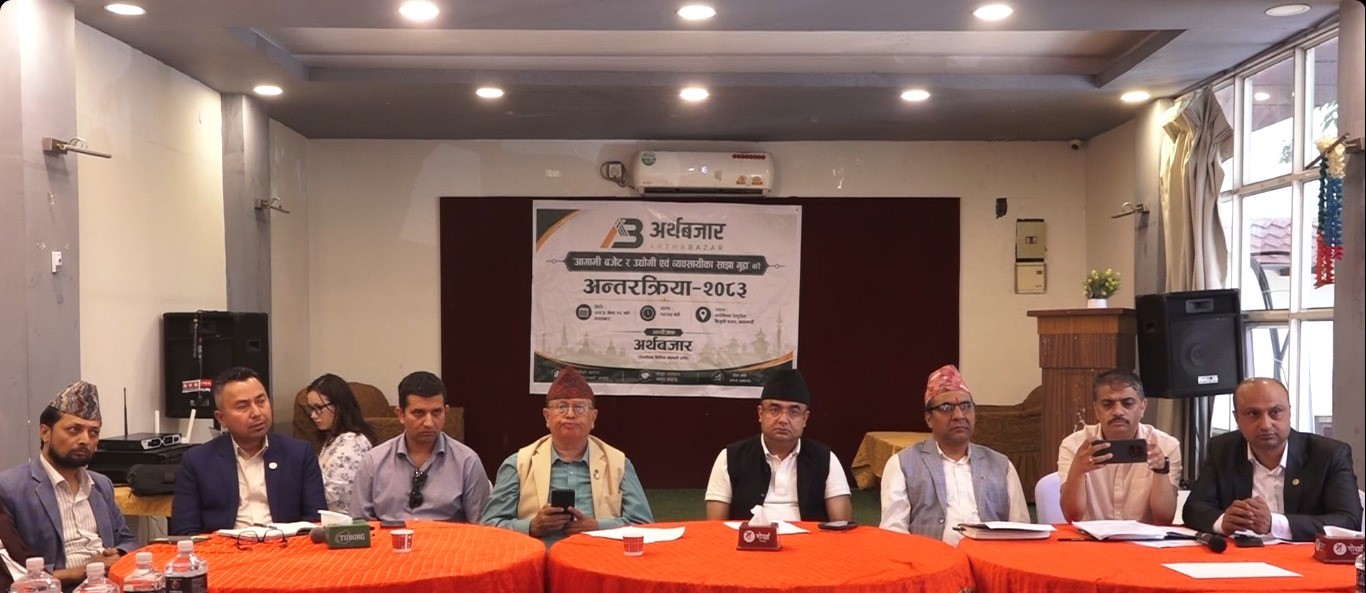
Kathmandu. Industrialists and businessmen from various sectors have expressed their dissatisfaction over the government’s tax policy, regulatory system, arrest style and policy instability with only a few days left for the budget for the coming fiscal year.
Speaking at an interaction program on ‘Upcoming Budget and Common Issues of Industrialists and Entrepreneurs’ organized by arthabazaar.com on Tuesday, representatives of information technology, medicine, mobile, dairy, cross-border trade, consultancy and cottage industry sectors said that the business operation has become more difficult.
On the occasion, Acting President of CAN Federation, Chiranjibi Adhikari, commented that the government has not understood the technology sector adequately. Stressing that the technology developed by Nepalis should be used in Nepal, he said that it was wrong policy to impose exorbitant tax on the domestic companies operating data center and cloud services and give subsidies to foreign software.
Pointing out the risk of wrong data in AI, he stressed the need of using homegrown data and Nepali technology to make Nepal an information technology hub. Stating that the PPP model has not been successful in practice, he stressed the need of a policy to regulate investors through monetary penalty rather than jailing them.
Ramesh Kumar Ghimire, president of the Federation of Mobile Entrepreneurs of Nepal, said that the entrepreneurs are in a dilemma due to lack of a clear policy regarding second-hand mobile transactions. Stating that entrepreneurs have to go to jail due to customer’s mistake, he said the problem has been further complicated due to the open border.
Stating that there is a risk of legal action even while unlocking mobile phones, he demanded the government to formulate clear working procedure and implement it across the country. He said that it is difficult to sustain the mobile business as there is only 1 to 3 percent margin in the mobile business.
Surya Bahadur Kandel, senior vice-president of Federation of Cottage and Small Enterprises (FNCCI), said economic self-sufficiency was not possible without producing economy. According to him, although the country is rich in natural resources and raw materials, Nepal is compelled to import finished goods by sending raw materials abroad for lack of value-added industries.
According to him, youths have been compelled to go abroad for employment opportunities due to the failure to increase production and create employment by prioritizing domestic industries. He said that building a competitive economy would be possible only if the industries were modernized through the use of technology and IT.
Pawan Acharya, president of the Association of Drug Importers, said that there is a growing shortage of essential medicines used in the treatment of cancer. He criticized the government for not adjusting the prices of medicines even though 17 health ministers have been changed in the last 11 years.
He claimed that although the price adjustment takes place every year in India, the price of medicines in Nepal has remained stable and some medicines have stopped being imported. He suggested that an automatic price adjustment system should be implemented according to India’s prices. Complaining that additional tax has been imposed on essential medicines, he pointed out the need of a scientific and systematic tax system.
President of the Federation of Himalayan Cross-Border Entrepreneurs, Ramhari Karki, said that the trade has been affected due to weak infrastructure at the northern border point. According to him, the entrepreneurs have been facing a lot of problems due to poor management of road and transport at the border points with China.
He said that the government’s role should be effective in facilitating cross-border trade and promoting export of domestic products through the upcoming budget. Stating that China has exempted tax on eight thousand goods, he suggested contributing Nepali products towards export.
Pujan Chamling, a consultancy entrepreneur, criticized the government’s recent action against 69 consultancies and accused them of defaming those who have no convictions. He also claimed that the license renewal and new registration were obstructed.
Entrepreneur Lila Ballav Dahal accused the government of arresting everyone from small businessmen to big industrialists. He warned that the state could be heading towards economic crisis despite having excess liquidity, adding that the problem has also increased in the tourism sector. “The big businessmen are surviving on their structure, the poor are surviving by spending, but the middle class entrepreneurs who light the stove are the worst hit,” he said.
Stating that medium enterprises were creating jobs, cooking small enterprises and taking big industries to the market, he argued that the government’s upcoming budget should keep this class in the centre.
According to Dahal, although there is liquidity in the banks and financial sector in recent times, entrepreneurs are unable to take loans. “More than Rs 15 billion has not gone into the loan market. Millions of businessmen are blacklisted. They have not been able to pay the banks, finance and the state,” he said. ”
Talking about the tourism sector, he said that the tourism industry has been hit hard by the earthquake, coronavirus pandemic and the recent tax policy. He said that small travel agencies are in trouble due to the VAT levied on the ticketing business.
Dairy Association of Nepal vice-president Deep Prasad Dhamala said that the industry could not be competitive without protection of domestic production, stable tax policy and long-term concessional loan.
Stressing the need of a stable tax policy for at least 5 to 10 years, he demanded that the loan should be available at fixed interest rate of 25-30 years to operate the industries. Stating that the ‘Mohi Abhiyan’ has become a success, he urged the State to encourage to increase the consumption of local products.
General Secretary of Federation of Nepalese National Traders’ Associations Nabin Luitel said there was policy-level ambiguity in the implementation of the MRP system. He complained that although the MRP should be implemented from the producers and importers to the retail level in a phased manner, now only small shops are being pressured.
He said it would not be practical to implement action-oriented policies without giving time, training and clear directives to small entrepreneurs. The entrepreneurs have demanded the government to review the overall tax structure, MRP system, regulation and monitoring in a coordinated manner.
They urged the government to bring business-friendly environment, stable policy, protection of domestic production and investment encouragement through the upcoming budget.











प्रतिक्रिया दिनुहोस्