

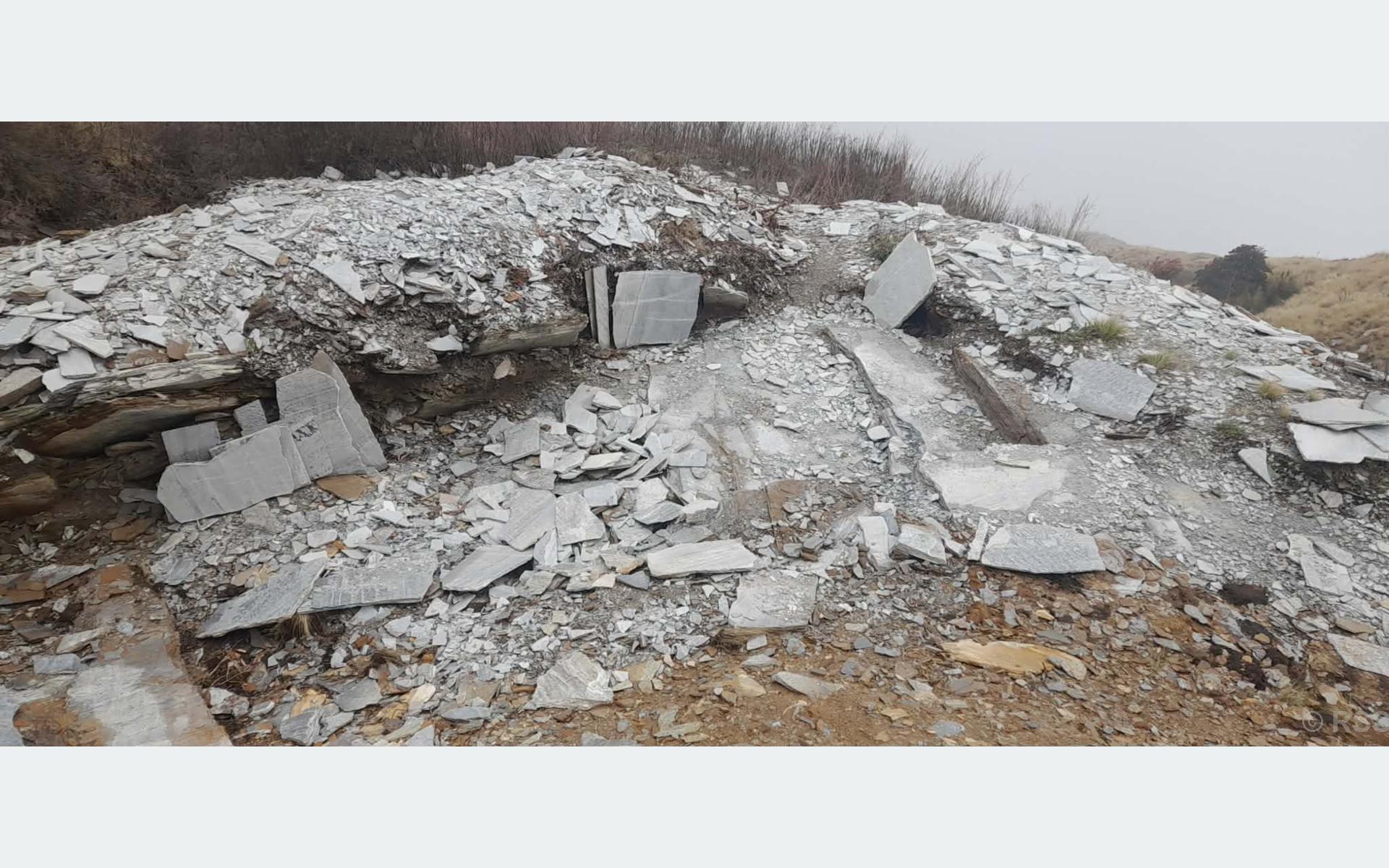
Mountains. Modi Rural Municipality has decided to start a slate quarry that can be used as a roof, courtyard or modern houses.
The stone mine located at Mateko Lake in the border of Modi Rural Municipality-1, Bhuktangle, Ward No. 3 Deurali and Kyang of Modi Rural Municipality has remained closed for the past 18 years. The slate mine, which was closed due to the border dispute between the erstwhile Kyang, Deurali and Bhuktang VDCs, is to come into operation in the current fiscal year.
The 19th village convention of Modi Rural Municipality held on Tuesday endorsed the plan to operate slate mine. The policy and programmes presented by the rural municipality chairperson Hira Devi Sharma for the upcoming fiscal year states that feasibility study would be carried out for the operation of slate or stone mine located in Mate Lake and coordinate with the federal and provincial bodies.
This is the first time in nine years since the rural municipality’s people’s representatives were elected.
Sharma said that the mining operation programme has been put in place to increase the revenue of the rural municipality and create employment opportunities. Budget has also been allocated for feasibility study as well as for the construction of necessary access roads. He said that the budget has been arranged in such a way that it will be managed from the current expenditure. It is estimated that millions of rupees will be generated annually from here.
The closure of stone mines at Mateko Lake in three wards of Modi Rural Municipality — Kyang, Deurali and Bhukangli — has caused huge loss to the locals and the local government has lost millions of rupees in revenue.
The mining was shut down in 2064 BS after locals of Deurali, Kyang and Bhuktang VDCs claimed that the mines fall within their respective VDCs.
Narsingh Pun, former chairman of the then Kyang VDC, said that the shutdown was imposed after all the people started arguing over the mines. He said that there is no alternative to shutting down the mine after the dispute escalated. The then District Forest Office (DFO) had nationalized the forest to end the dispute.
Although there are plenty of stones in the mine, they have become useless due to lack of operation. During the operation of the mine, hundreds of workers were directly employed every day. The stones mined here were transported to various places of Parbat, Baglung and Myagdi of the then Dhawalagiri zone.
According to Bhane Bahadur BK, a local, who has been collecting stones from the mines and selling them to feed their families, the closure of the mine has affected the livelihood of the dependent families and the youths have been forced to migrate. The locals are elated after the mining operation was included in the local government’s policy, programme and budget. BK said that he is hopeful that the mine will be reopened.
BK complained that he was unemployed even though he worked in the mine for 10 years. With this income, BK was supporting a family of four. The stones here are used for roofing houses, cowsheds, and mats. People still prefer to be covered with stones because of their size, strength and durability compared to zinc sheets.
According to the villagers, the house will last for two or three generations. Ram Pun, a local, said that the state could earn millions of rupees annually if the stones were excavated and stones were sold. Some people used to put entire stones as walls. There are five stone mines in one kilometer area in the public land. Although some used to throw stones and some extract stones from the mines, they have now fled. Pun, a local, said that the stones extracted from the mines were taken to neighbouring districts like Baglung, Pokhara, Myagdi and Kathmandu. Almost all the houses in most of the wards of the northern Parbat are covered with stones.
“Villagers used to get good employment when the mine was in operation in the past”, said Harka Bahadur Pun, a local, adding, “Now, some have gone abroad after losing employment while some have been working as daily wage earners in the village.” ”
Although the mine is located at an altitude of 3,100 meters, there is no settlement in the vicinity. Even though there are plenty of stones, the villagers are disappointed that they are wasted. Former VDC Chair Pun said that the houses covered with stone look attractive and once they are roofed, they do not need to be covered for two or three generations. “The living standard of the villagers would change if the mines were brought into operation”, he said, adding, “That’s why we are ready to work as per the government regulations.” According to Pun, it would be easier to transport the road to Pokhara, Kathmandu and other cities as the road facility has also reached a little below the mine in recent period.
It was popular because the stones would break only due to hailstorms and other reasons, and once invested, there would be no hassle for years. Nar Bahadur Pun, a local, said that people have to pay a high fee to cover the stones. Now we are compelled to buy zinc sheets from the market to cover our houses. Ganga Bahadur BK, a local, opined that the mines should be brought into operation as there was possibility of exporting marble outside the district as well as for ensuring employment opportunities to the locals.













प्रतिक्रिया दिनुहोस्